What to eat in Singapore: 10 dishes and where to find them
From Tian Tian's chicken rice to the only hawker stall with a Michelin star, ten dishes that define Singapore, with hawker centres, addresses and prices in Singapore dollars.
What to eat in Singapore is decided at the hawker centre: Hainanese chicken rice, laksa, char kway teow, bak chor mee and satay, cooked by stalls that often make one dish and nothing else, for a few Singapore dollars a plate. Do not leave without a bowl from the only hawker stall with a Michelin star and a chilli crab dinner.
Singapore cooks with Chinese, Malay, Indian and Peranakan hands at once, and feeds itself from more than a hundred public hawker centres. In 2020 UNESCO added hawker culture to its list of intangible cultural heritage. The Michelin Guide Singapore reached its tenth edition this summer: the Bib Gourmand list published on 28 July 2026 names 97 addresses, most of them market stalls.
Knowing what to eat in Singapore also means knowing where the queue is. Prices below are in Singapore dollars (S$) and come from menus and recent listings in 2026.
In Singapore the most famous plates cost under S$10 and come with a queue.
What to eat in Singapore: start at a hawker centre
The rule for eating well is simple: follow the queue, order the one dish the stall is named after, and mark your table with a packet of tissues. Famous stalls sell out early, so lunch is safer than dinner.
Hainanese chicken rice at Tian Tian, Maxwell Food Centre
Poached chicken, cooled so the skin sets, over rice cooked in chicken fat, stock, ginger and pandan. Three sauces do the rest: chilli with lime, pounded ginger and dark soy.
Tian Tian has sold it at Maxwell Food Centre, 1 Kadayanallur Street, since 1986 and has held a Bib Gourmand in all ten Singapore editions. A plate costs S$5 to S$9 depending on size; a whole chicken is S$24.
Chilli crab at Keng Eng Kee, Bukit Merah
Mud crab stir-fried in a sweet, sour and gently hot sauce of tomato, chilli and egg, with fried mantou buns to mop it up. It is a zi char dish, Chinese home cooking from open-air kitchens.
Keng Eng Kee is a third-generation family business that began as a stall on Old Havelock Road in the 1970s; its dining room is at Block 124 Bukit Merah Lane 1, by Alexandra Village. Crab is sold by weight, around S$100 a kilo in recent reviews: ask before ordering and count on S$40 to S$60 a head.
Laksa at 328 Katong Laksa, Katong
The Katong version is thick rice noodles cut short, in a coconut and dried-shrimp curry broth with cockles and prawns, topped with laksa leaf. It is eaten with a spoon only.
328 Katong Laksa, at 51 East Coast Road, is the best-known bowl in the neighbourhood where the dish took shape. Expect S$6 to S$8 for a bowl. King of Laksa, Aljunied, joined the Bib Gourmand list in 2026.
Bak chor mee at Hill Street Tai Hwa Pork Noodle, Lavender
Minced pork noodles, tossed dry with black vinegar, chilli and lard, then topped with minced and sliced pork, liver, meatballs and dried sole.
The stall at 466 Crawford Lane holds one Michelin star and is the only hawker stall in the 2026 guide with one. Bowls cost S$6 to S$10; expect a queue of half an hour or more.
Bak kut teh at Song Fa, New Bridge Road
Pork ribs simmered in a clear broth heavy with white pepper and garlic, the Teochew style, served with rice, braised peanuts and you tiao for dipping.
Song Fa started as a pushcart on Johor Road in 1969; its outlet at 11 New Bridge Road, a short walk from Clarke Quay, has kept a Bib Gourmand since 2016. A bowl of ribs costs about S$9.90, or S$13.90 for the premium cut.
Char kway teow at Outram Park Fried Kway Teow Mee, Hong Lim
Flat rice noodles and yellow noodles fried very hot with dark soy, lard, egg, Chinese sausage and cockles. What locals judge is wok hei, the smoky breath of a wok over a strong flame.
The stall, in business since 1953, is at #02-17 of Hong Lim Market and Food Centre, 531A Upper Cross Street, in Chinatown. Plates cost S$5 or S$6, extra cockles S$2.
Hokkien mee at Nam Sing, Old Airport Road
Yellow noodles and rice vermicelli braised in a stock made from prawn shells and heads, with prawns, squid and pork belly, finished with lime and sambal.
Nam Sing has cooked only this dish since 1960, at #01-32 of Old Airport Road Food Centre, one of the city's largest hawker centres. Plates cost S$5 to S$8.
Nasi lemak at The Coconut Club, Beach Road
Rice steamed in coconut milk and pandan with sambal, fried anchovies, peanuts, egg and cucumber. Here it comes with ayam goreng berempah, chicken fried in a spice paste.
The Coconut Club works from a restored shophouse at 269 Beach Road in Kampong Gelam and holds a Bib Gourmand. The set costs about S$19 to S$21, well above hawker prices. For the same region's slow-cooked side of the table, try our beef rendang recipe at home.
Fish head curry at Muthu's Curry, Little India
A whole red snapper head simmered in a tamarind-sharp South Indian curry with okra and aubergine, served on banana leaf with rice. The dish was created in Singapore, not in India, by an Indian cook who wanted to win Chinese customers, who prize fish heads.
Muthu's Curry, at 138 Race Course Road, is open daily and holds a Bib Gourmand in 2026. A fish head for two to three costs from about S$32 before service charge.
Satay at Satay Street, Lau Pa Sat
Skewers of chicken, beef, mutton or prawn grilled over charcoal and served with peanut sauce, ketupat rice cakes, cucumber and onion.
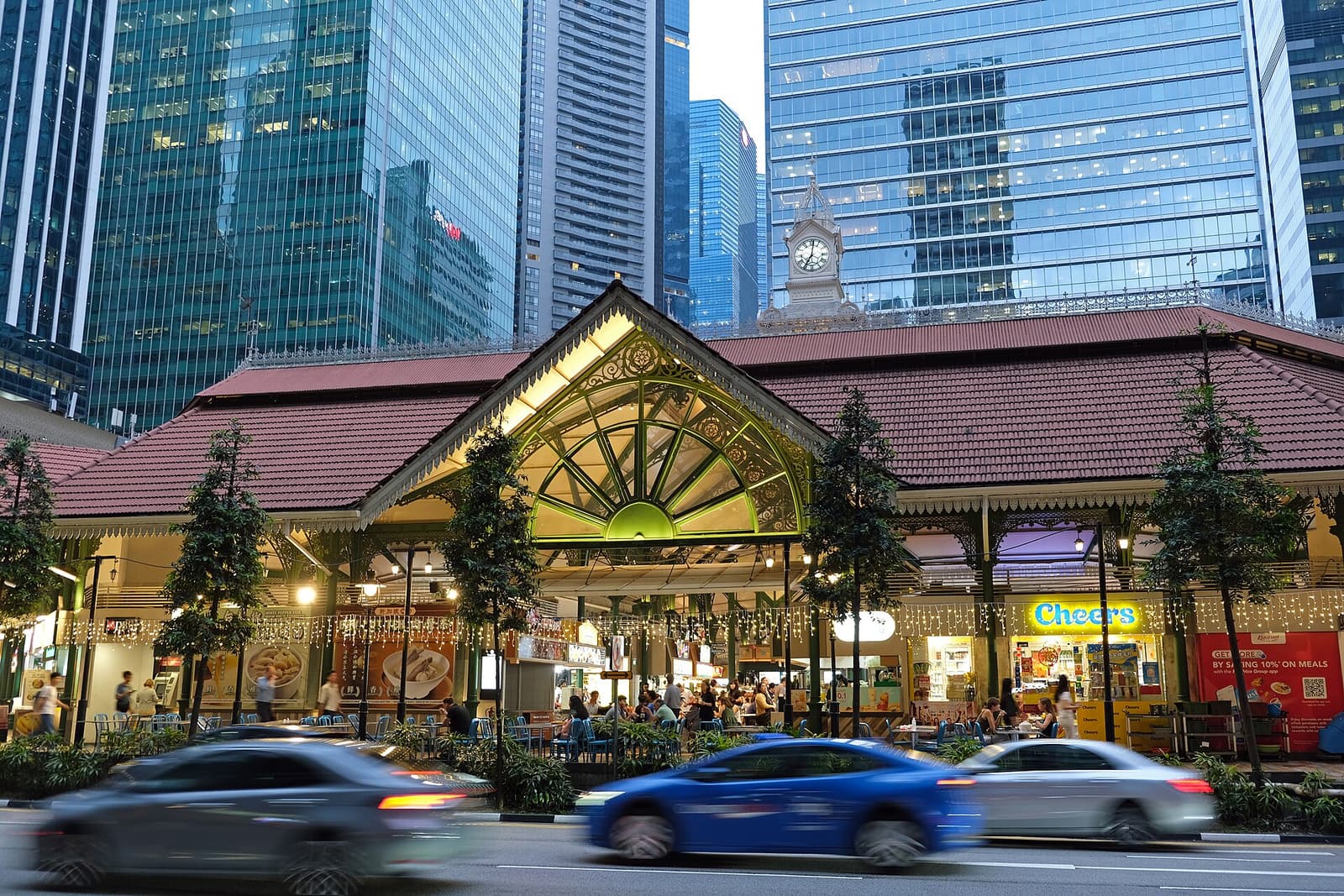
Every evening Boon Tat Street, beside Lau Pa Sat's Victorian market hall, closes to traffic and fills with tables. Stalls open at 7pm on weekdays and 3pm at weekends; plan on S$10 to S$20 per person with a drink.
Hawker centres, neighbourhoods and when to go
If you plan your days around what to eat in Singapore, group them by district:
- Maxwell Food Centre (Chinatown): chicken rice and a dense lunch crowd from 11.30am.
- Hong Lim Market and Food Centre (Chinatown): noodles and char kway teow, best before noon.
- Old Airport Road Food Centre (Dakota): huge, busy at dinner.
- Katong and Joo Chiat: laksa, Peranakan bakeries and shophouses.
- Kampong Gelam and Little India: Malay, Arab and South Indian cooking, open late.
- Lau Pa Sat (Raffles Place): satay from the evening, crowded on Fridays.
- Breakfast: kaya toast and kopi at Ya Kun, 18 China Street, about S$5 a set.
Singapore is hot and humid all year; December and January bring the most rain. Hotels keep changing hands and teams, as at Avani Singapore Hotel, which has named a new general manager.
Frequently asked questions about eating in Singapore
Is Singapore expensive to eat in? Restaurants are, hawker centres are not: most famous stalls charge S$5 to S$10 a plate, and the Michelin-starred bak chor mee costs S$10 or less.
Can I pay by card at hawker centres? Some stalls take cards or PayNow; carry small notes.
What is the one dish to try if I only have a day? Hainanese chicken rice at lunch, then satay at Lau Pa Sat in the evening.
When do hawker stalls close? Most close one day a week and stop when they sell out, often by mid-afternoon; check the day before you cross the city.
Where to book first
Candlenut, Block 17A Dempsey Road: Malcolm Lee's restaurant was the first Peranakan kitchen to win a Michelin star and keeps it in 2026; book weeks ahead.
Burnt Ends, 7 Dempsey Road: wood-fired barbecue with one Michelin star in 2026.
Keng Eng Kee, Block 124 Bukit Merah Lane 1: book by phone for the chilli crab dinner. International names keep arriving too, such as Chi Spacca Singapore at Hilton Orchard, but what to eat in Singapore is still answered first at the hawker centre.
Sources
- MICHELIN Guide - Singapore Bib Gourmand 2026 selection ·
- MICHELIN Guide - The 10th MICHELIN Guide Singapore selection ·
- MICHELIN Guide - Hill Street Tai Hwa Pork Noodle ·
- MICHELIN Guide - Keng Eng Kee (Bukit Merah) ·
- MICHELIN Guide - Nam Sing Hokkien Fried Mee ·
- Lau Pa Sat - Satay Street ·
- Song Fa Bak Kut Teh - official site ·
- Time Out Singapore - 10 new Bib Gourmand spots in the Michelin Guide Singapore 2026 ·