What to eat in Budapest: 8 dishes and where to find them
A paprika soup, a Jewish Quarter pastry revival, two Michelin tasting menus and a ruin bar's pálinka list — where Budapest's kitchens and market stalls actually send you, with 2026 prices.
What to eat in Budapest starts with gulyás, the paprika-red soup that gave Hungarian cooking its name abroad, and runs through market-hall lángos, Jewish Quarter cholent and a chimney cake eaten hot off the coals.
Budapest's food rests on three legs: the herding cuisine of the Hungarian plain, built on paprika, pork fat and soured cream; the confectionery culture it shares with Vienna, an easy stop after a few days eating through Vienna, two and a half hours away by train; and the Jewish Quarter's slow-cooked stews and layered pastries, nearly lost under communism and rebuilt by hand over the past fifteen years.
What to eat in Budapest, and where it clusters
Gulyás made the city's name; the Jewish Quarter and the market hall built its everyday menu.
Decades of state-run canteens flattened the restaurant scene until the 2010s, when a wave of younger cooks reopened old kitchens and pushed Hungarian ingredients onto tasting menus. What to eat in Budapest today spans both ends of that history: the city holds seven Michelin-starred restaurants, one of them with two stars, alongside the lunch canteens and market stalls that never stopped working.
Most of what matters sits in two districts: Erzsébetváros, the old Jewish Quarter, for cholent, flódni and the ruin bars; and the river-facing centre around the Great Market Hall for everything fried, cured or smoked.
Gulyás at Kádár Étkezde, Erzsébetváros
Gulyás is the dish that gave Hungarian cooking its name worldwide, though in Budapest it sits closer to a soup than the thick stew tourists often expect: beef, onion, potato and sweet paprika simmered loose enough to drink, finished with csipetke, pinched egg dumplings the size of a fingernail.
Kádár Étkezde, a lunch canteen on Klauzál tér, reopened in September 2025 after a hiatus and still runs the format that made it a fixture: shared tables, a handwritten daily menu and gulyás for around 1,900 forints. It closes Sundays and Mondays, and the kitchen often sells out by mid-afternoon. For the version to cook at home, follow our Hungarian goulash recipe.
For a dressier plate, Baltazár Budapest serves its gulyás from a small cast pot with fresh bread in the Castle District, alongside chicken paprikash from the same kitchen group.
Lángos at Retró Lángos and the Great Market Hall
Lángos is deep-fried dough, chewy inside and blistered outside, brushed with garlic water and piled with sour cream and grated cheese. It began as a way to use the leftover heat in a bread oven and is now Budapest's definitive street food.
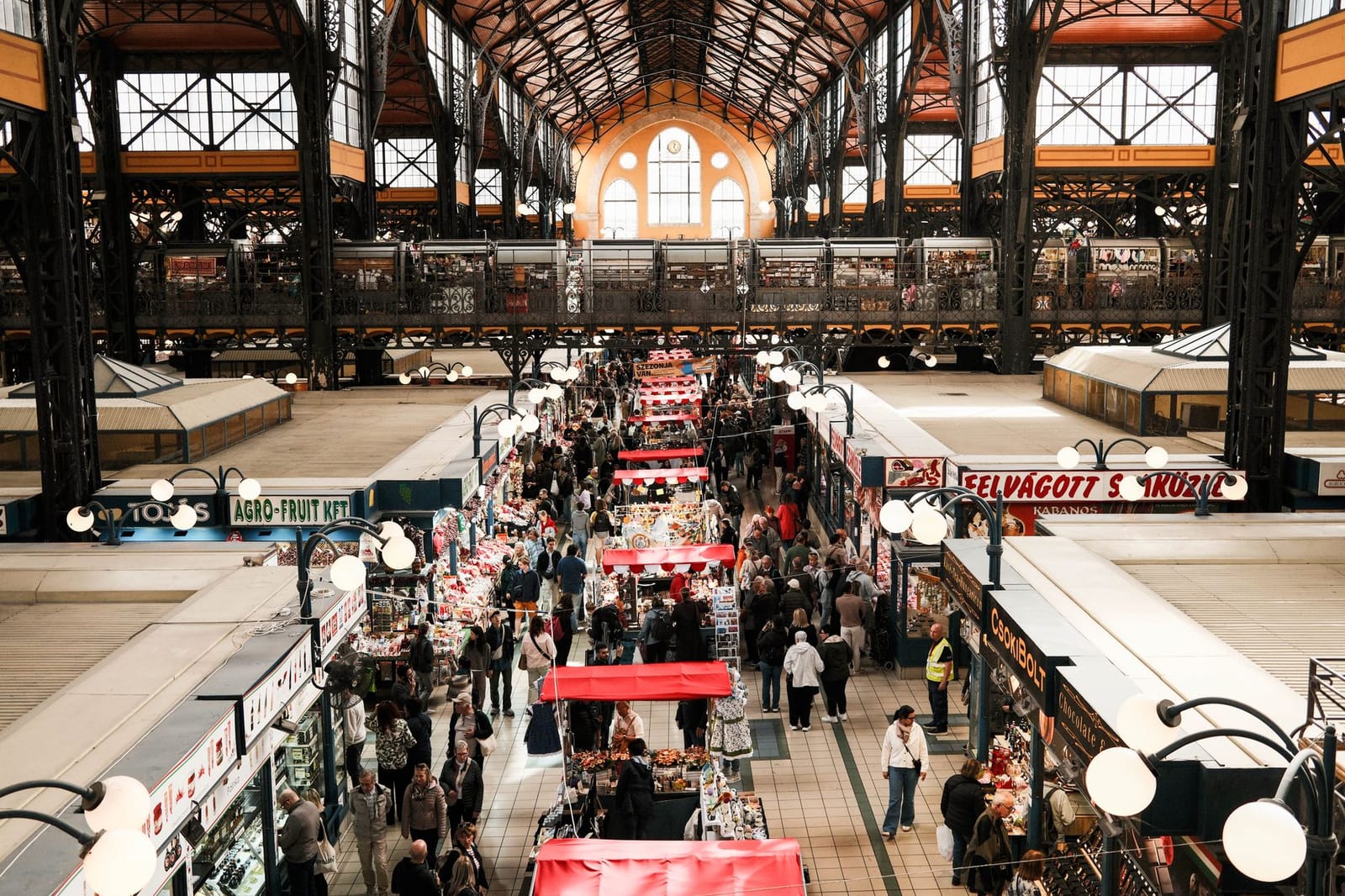
Retró Lángos Büfé, on Vécsey utca near Parliament, offers more than thirty toppings and charges around 3,490 forints for its classic version — pricier than a market stall but open late and central. The upper gallery of the Great Market Hall (Nagycsarnok) on Vámház körút sells a simpler, cheaper version, best eaten standing at the counter.
Tasting menus at Stand and Essência, two Michelin tables
Budapest counts seven Michelin-starred restaurants in its current guide, led by Stand, the city's only two-star kitchen, on Székely Mihály utca at the edge of the Jewish Quarter. Its tasting menu runs 89,500 forints and reworks Hungarian ingredients — goose liver, mangalica pork, river fish — with French technique.
Essência, one of six one-star addresses, pairs Portuguese technique with Hungarian produce on Sas utca; its shorter tasting menu starts at 41,900 forints. Both need booking well ahead, and the 15% service charge standard at Budapest's fine-dining rooms is not always shown next to the menu price.
Kürtőskalács at Molnár's, Váci utca
Kürtőskalács, chimney cake, is a yeasted dough wound around a wooden spindle, rolled in sugar and roasted over heat until the outside caramelises into a shell. Transylvanian in origin, it has become Budapest's signature street pastry, sold warm from kiosks across the centre — a dough tradition closer to Vienna's strudel than to Hungary's savoury kitchen; see our apple strudel recipe for that Austrian cousin.
Molnár's stall on Váci utca, the main pedestrian shopping street, rolls its cakes over open coals rather than an electric warmer — a detail worth checking anywhere else, since the heat source changes the texture. Cinnamon, walnut and chocolate are the standard coatings; the Christmas markets from late November bring out more stalls and more variants.
Flódni at Auguszt Cukrászda, Buda
Flódni is a four-layer Jewish-Hungarian pastry — walnut, poppy seed, apple and plum jam stacked between sheets of pastry — that nearly disappeared under communism and has become a symbol of the Jewish Quarter's food revival.
Auguszt Cukrászda, a family bakery running since 1870, sells it from its original Fény utca shop, where the owner still works the counter most days; cakes here run roughly 1,700-2,200 forints a slice. The bakery closes Sundays and Mondays.
Cholent at Kőleves, Erzsébetváros
Cholent, a bean, barley and meat stew left to bake overnight so it can be eaten without lighting a fire on the Sabbath, survives in Budapest as a Friday lunch special rather than an everyday dish.
Kőleves, set inside an 1851 building that once processed kosher meat, serves it alongside matzo ball soup and flódni on Síp utca; Gettó Gulyás runs cholent and flódni as its own Friday set menu nearby. Both sit within a ten-minute walk of most of this list.
Pálinka at Szimpla Kert, Kazinczy utca
Pálinka, Hungary's fruit brandy, is distilled mostly from plum, apricot or pear and drunk as a shot before or after a meal rather than mixed. Local bottles are said to fill at least 15% of the back bar at Budapest's drinking spots.
Szimpla Kert, the ruin bar that started the genre inside a derelict building on Kazinczy utca, keeps one of the longer pálinka lists in the city alongside its patchwork of secondhand furniture and courtyard seating; shots run roughly 650-1,500 forints depending on the fruit. Entry is free, but arrive before 9pm to skip the queue.
Unicum at the House of Unicum, Ferencváros
Unicum is a near-black herbal liqueur, bitter enough that most visitors need a second taste to place it, made to a recipe the Zwack family has kept since 1790 from more than forty herbs and spices.
The House of Unicum, at Dandár utca 1, runs hour-long tours through the barrel cellar that end in three tastings — draft Unicum, a plum-flavoured version and the aged Reserva — for around 12 euros. English-language tours run most days; check the schedule before going, since times shift.
Practical tips: markets, districts and when to go
Knowing what to eat in Budapest also means knowing when the kitchens are open: canteens like Kádár keep daytime hours only, and several bakeries close on Mondays.
- Great Market Hall (Nagycsarnok), Vámház körút 1-3: paprika and salami downstairs, souvenirs upstairs — buy spice in tins or vacuum bags, not the decorative cloth sacks, which don't keep it fresh. Open Monday 6am-5pm, Tuesday-Friday 6am-6pm, Saturday 6am-3pm; closed Sunday.
- Erzsébetváros (the Jewish Quarter): cholent, flódni and most of the ruin bars within walking distance of each other.
- Várnegyed (Castle District): the dressier end of Hungarian cooking, including Baltazár.
- Christmas markets, late November to early January: the peak season for kürtőskalács and mulled wine, centred on Vörösmarty tér and St Stephen's Basilica.
Frequently asked questions
Is Budapest expensive to eat in? Not by Western European standards. A canteen lunch costs under 2,000 forints, a sit-down meal with wine runs 6,000-12,000 forints a head, and even Budapest's Michelin tables, at 40,000-90,000 forints for a tasting menu, undercut equivalents in Paris or Vienna.
Do I need to tip in Budapest? Many restaurants, especially fine-dining rooms, add a 10-15% service charge automatically — check the bill before tipping again in cash.
Is tap water safe, and is cash still necessary? Tap water is safe across the city. Markets, canteens and ruin bars lean cash-only or card-reluctant, so carry forints rather than relying on contactless.
What's the best time of year for what to eat in Budapest? Late November through early January, when the Christmas markets multiply kürtőskalács stalls and mulled wine appears alongside pálinka; summer brings longer hours at the Great Market Hall's outdoor stalls.
Where to book first
Three addresses to start with: Stand (Székely Mihály utca 2), for the two-star tasting menu that sums up where Hungarian cooking has gone since 2010; Kádár Étkezde (Klauzál tér 9), for gulyás the way the Jewish Quarter has eaten it for decades; and Szimpla Kert (Kazinczy utca 14), to close the night on pálinka in the bar that started Budapest's ruin-bar scene.
Sources
- Hungary Unlocked — Budapest Michelin restaurants 2026 (Stand two stars, six one-star addresses, tasting menu prices) ·
- Hungary Unlocked — best lángos in Budapest 2026 (Retró Lángos price and address) ·
- Pénzcentrum — Kádár Étkezde reopening, September 2025, goulash price ·
- House of Unicum — tour and tasting details, Dandár utca ·
- Offbeat Budapest — flódni history and Auguszt Cukrászda ·