What to eat in Taipei: 10 dishes and where to find them
From a 1958 oil shop turned dumpling house to a 1920s teahouse once used by dissidents, Taipei eats in layers: night-market stalls, breakfast counters and a century of tea trade.
What to eat in Taipei starts with a bowl of beef noodle soup, the dish locals argue about more than any other, and runs through night-market oyster omelettes, soup dumplings and a tea ceremony older than the Taiwanese capital's skyline. Do not leave without a bowl of lu rou fan, Taiwan's everyday braised pork rice, and a round of xiaolongbao eaten standing up if the queue demands it.
Taipei's food culture runs on two currents: a street-market tradition built by post-1949 migrants from across mainland China, and a slower, older rhythm of tea houses and herbal shops that predates them by a century. The two meet on almost every block, usually within sight of a 7-Eleven.
Most of what matters sits within four districts: Da'an, Zhongzheng, Songshan and Datong. None of it requires a reservation except the places on this list that do.
Night-market stalls and a 1920s teahouse, five minutes apart, both worth the queue.
Beef noodle soup at Lin Dong Fang
Niu rou mian, beef noodle soup, is Taipei's unofficial signature dish, built on a dark, peppery broth simmered for hours with beef shank and doubanjiang. Ask ten residents for the best bowl and the name that comes up most is Lin Dong Fang (林東芳牛肉麵), a Zhongshan District institution open into the small hours.
A bowl runs around NT$220-260. Order it "hong shao" (red-braised) for the fuller, soy-and-chilli broth rather than the clear version. A different hand-pulled bowl from further west in China, AMUSE's Lanzhou beef noodle soup recipe, shows the knife-free technique behind the noodles.
Xiaolongbao at Din Tai Fung's original branch
Din Tai Fung began in 1958 as a cooking-oil shop on Xinyi Road; it only turned to dumplings after tinned oil undercut the retail trade. Its soup dumplings, filled and pleated to a reported 18 folds, made the Xinyi Road original a global name after the New York Times listed it among the world's best restaurants in 1993.
A basket of ten pork xiaolongbao costs roughly NT$220-240. Go for lunch on a weekday and expect to still queue. For another hand-folded dumpling from the region, AMUSE has a gyoza recipe that breaks down the pleating technique.
Soy milk and dan bing at Fuhang Dou Jiang
Breakfast in Taipei means a stall counter, not a table. Fuhang Dou Jiang (阜杭豆漿), upstairs in Huashan Market near Shandao Temple station, draws a line onto the pavement before 6am for dan bing, a thin egg crepe rolled around scallion or dried pork, and savoury soy milk curdled with vinegar, dried shrimp and pickled radish.
A crepe and a bowl of soy milk together cost under NT$100. The shop does not open for dinner, so this is a breakfast stop only.
Oyster omelette at Lee Chi, Raohe Street
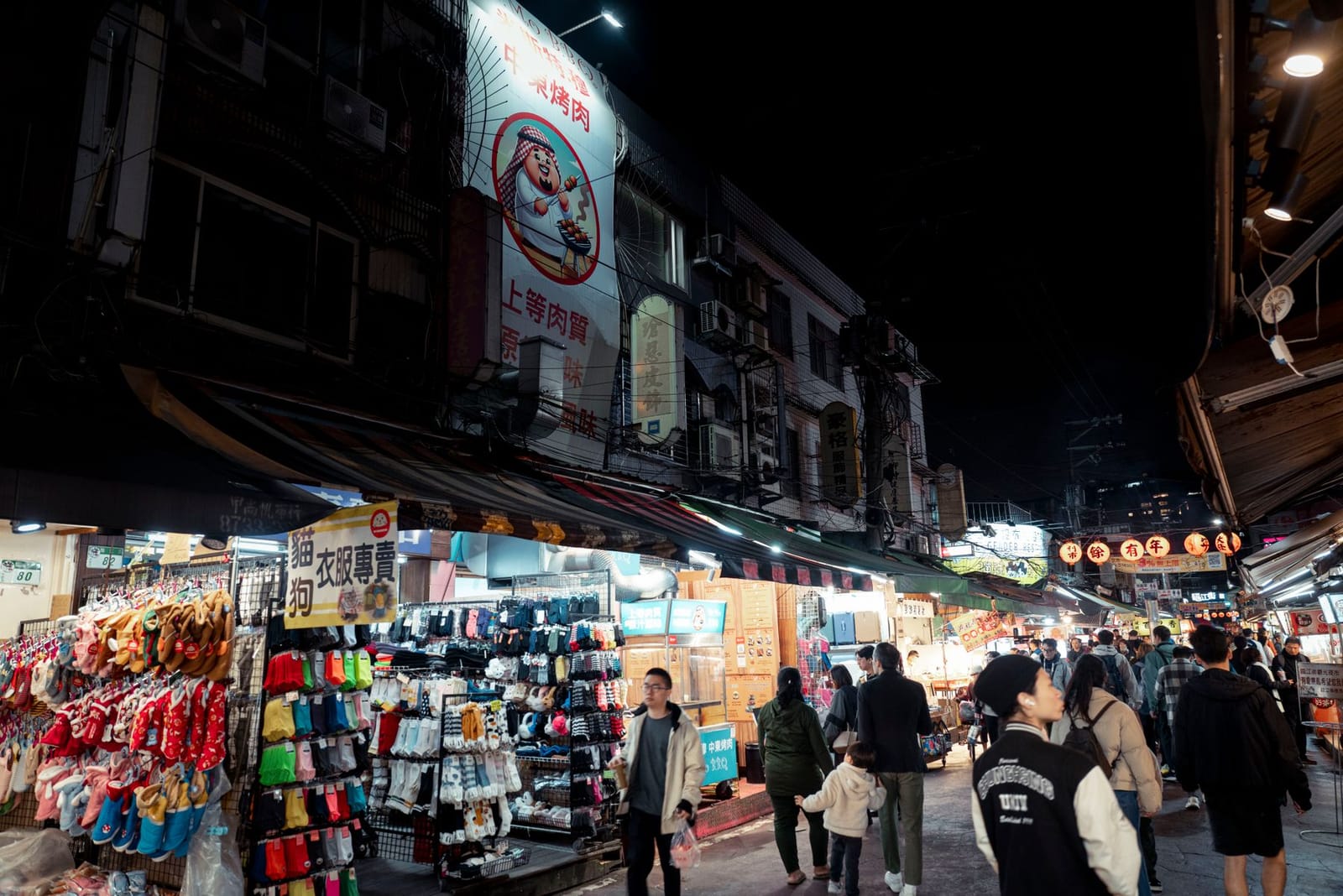
Raohe Street Night Market, one of Taipei's oldest, runs off the Songshan Ciyou Temple. At its western end, Lee Chi (李記蚵仔煎) has cooked oyster omelettes to order since 1980: plump oysters set in a starchy batter, finished with a sweet-savoury tomato-plum sauce.
A plate costs around NT$70-90. Eat it standing at the stall's own counter; the batter firms up fast and is best within minutes of leaving the pan.
Stinky tofu at the night market
Chou doufu, fermented tofu deep-fried to a crisp shell around a custardy centre, announces itself from two stalls away. Raohe and Ningxia night markets both sell it with pickled cabbage and chilli sauce on the side.
A portion costs about NT$50-70. The smell is strong and clings to clothing; the taste is milder than the aroma suggests, closer to a sharp, fermented cheese than anything rotten.
Braised pork rice at Jin Feng
Lu rou fan, rice topped with pork belly braised in soy, five-spice and shallots, is Taiwan's everyday comfort dish. Jin Feng (金峰滷肉飯), on Roosevelt Road near the Chiang Kai-shek Memorial Hall, is a long-running, no-frills choice popular with office workers on their lunch break.
A bowl costs around NT$50-60. For the technique behind the dish, AMUSE has a lu rou fan recipe built for a home stove.
Bubble tea, where it began
Taiwan's biggest drinks export has a disputed birthplace, but Chun Shui Tang, founded by Liu Han-chieh in Taichung in 1983, has the strongest claim: Liu began shaking iced black tea after watching a barista shake iced coffee in Japan, and in 1988 a manager, Lin Hsiu-hui, dropped tapioca pearls into a glass of it.
Taipei's own tea shops, from mall-corner chains to Yongkang Street specialists, sell the drink for NT$50-70 a cup. Order it "wu tang", without sugar, to taste the tea underneath.
Pineapple cake at Chia Te
Fengli su, a short, buttery pastry filled with pineapple jam, is Taipei's standard souvenir. Chia Te, founded in 1975 by Chen Tang-peng after a four-year apprenticeship in Changhua, is one of the city's most queued-for bakeries and ships its boxes internationally.
A box of a dozen runs to roughly NT$400-450. Buy it to eat immediately, too; it does not need the flight home to taste good.
Dihua Street's dried-goods market
Dihua Street, laid out in the 1850s near the old Dadaocheng wharf, has traded tea, Chinese medicine and dried seafood for more than 150 years. Stalls north of Minsheng West Road sell dried mushrooms, scallops, mullet roe and shredded squid by the catty, much as they did a century ago.
Go on a weekday morning, when stallholders have time to talk through what is in season. The street empties out by early evening.
A pot of tea at Wistaria Tea House
Wistaria Tea House (紫藤廬) occupies a 1920s Japanese-era wooden house in Da'an District, named for the vines in its courtyard. It became a teahouse in 1981 and a city-designated historic site in 1997, after years as a meeting place for Taiwan's political dissidents under martial law.
A gongfu service of oolong or pu'er, brewed in small pours over a sitting, costs from around NT$350 per person, with light snacks available. Reservations help on weekends.
Markets, neighbourhoods and when to go
Night markets run roughly 5pm to midnight; arrive before 7pm to eat before the crowds peak. October to April is Taipei's cooler, drier season and the more comfortable time to queue outdoors; June to September brings heat, humidity and typhoon risk.
- Raohe Street Night Market, Songshan District — evenings, food-focused, built around Ciyou Temple
- Ningxia Night Market, Datong District — evenings, a compact, old-school food market
- Dihua Street, Datong District — daytime, dried goods, tea and Lunar New Year shopping
- Yongkang Street, Da'an District — daytime and evening, restaurants and dessert shops near Da'an Forest Park
Frequently asked questions
Is Taipei expensive to eat in? No. A full day of street food and one sit-down meal rarely passes NT$1,000 (around €30) per person. Tasting-menu restaurants and hotel dining cost considerably more.
Do I need reservations? Night-market stalls and breakfast counters do not take them. Din Tai Fung's busiest branches and Wistaria Tea House are worth booking or arriving early for.
Is street food safe to eat? Stalls with a constant queue of local customers and high turnover are the standard local guide to safety; food poisoning from Taipei's licensed night-market vendors is rare.
What should vegetarians order? Night markets sell fried tofu, scallion pancakes and vegetable dumplings, and dedicated vegetarian buffets (su shi) are common near temples, including around Longshan Temple.
Where to book first
Din Tai Fung, 194 Section 2, Xinyi Road, Da'an District — the original branch, for xiaolongbao.
Wistaria Tea House, 1 Lane 16, Section 3, Xinyi Road, Da'an District — for a sit-down gongfu tea service.
Fuhang Dou Jiang, 2F, 108 Section 1, Zhongxiao East Road, Zhongzheng District — for breakfast, before 8am.