What to eat in Vienna: 10 dishes and where to find them
From a veal Wiener Schnitzel fried in butter to Tafelspitz in its copper pot and a Käsekrainer at 4am, ten Viennese dishes with addresses, districts and 2026 prices in euros.
What to eat in Vienna is mostly settled by history: a veal Wiener Schnitzel, Tafelspitz in its copper pot, a Käsekrainer from a sausage stand, Sachertorte, Kaiserschmarrn and apple strudel, a Melange in a coffee house and a jug of Gemischter Satz at a Heuriger. The question is where each one is still done properly, and what it costs in 2026.
Vienna eats in four kinds of rooms: the Beisl, a neighbourhood tavern with a short menu of stews and fried things; the Kaffeehaus, where coffee comes with a glass of water and nobody hurries you; the Würstelstand, the sausage stand that stays open after the bars close; and the Heuriger, the wine tavern on the city's own vineyards. Coffee-house culture has been on Austria's national register of intangible cultural heritage since 2011, and sausage-stand culture joined it in 2024.
Knowing what to eat in Vienna also means knowing which name on the menu is protected and which is not. Prices below are in euros and come from menus and listings checked in September 2026.
In Vienna the menu tells you what is protected: a real Wiener Schnitzel is always veal.
What to eat in Vienna, and in what order
Start with the savoury classics at lunch, when Beisln serve fixed menus, keep the cakes for the afternoon in a coffee house, and leave the sausage stand for late at night. Most of the addresses below sit in the Innere Stadt, the 1st district, within a 15-minute walk of St Stephen's Cathedral; the wine taverns and the Prater need a tram ride.
Wiener Schnitzel at Meissl & Schadn, Innere Stadt
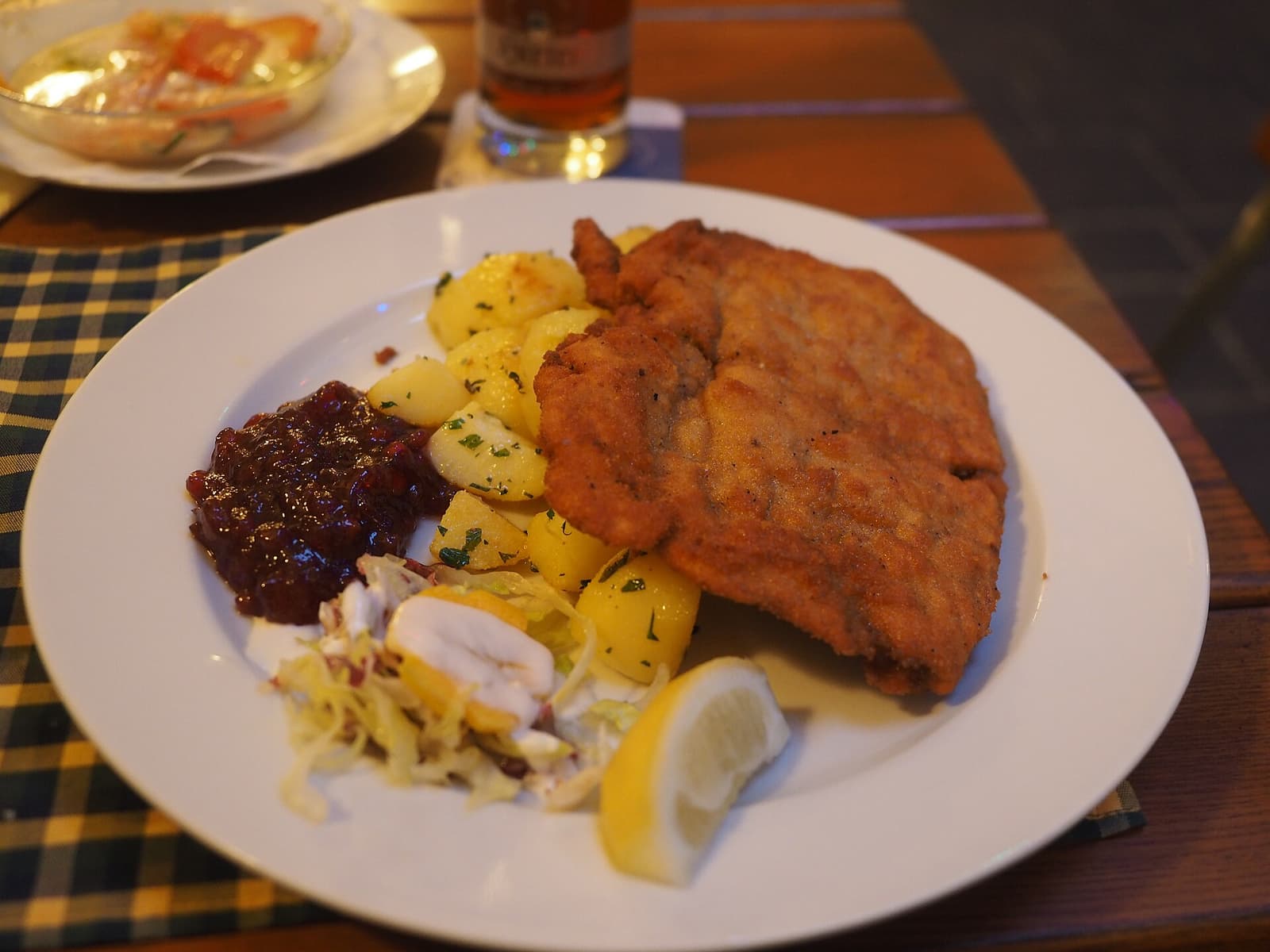
A thin escalope of veal, breaded and fried until the crust puffs away from the meat, served with lemon, lingonberries and a potato salad dressed with vinegar and stock. Austrian food labelling reserves the name Wiener Schnitzel for veal; a pork version has to be sold as Schnitzel “Wiener Art”.
Meissl & Schadn, at Schubertring 10–12, fries its veal schnitzel to order in an open show kitchen, in clarified butter, lard or vegetable oil, at your choice. It costs €30.90 on the current menu. Figlmüller, at Wollzeile 5 since 1905, serves a plate-sized pork schnitzel for €21.90: good, but not the same dish.
Tafelspitz at Plachutta, Wollzeile
Boiled beef sounds like hospital food; in Vienna it is a ceremony. The meat arrives in a copper pot with its broth, root vegetables and a marrow bone, alongside apple horseradish, chive sauce and roasted potatoes. You drink the soup first, spread the marrow on dark toast, then eat the beef.
Plachutta, at Wollzeile 38, opens daily from 11.30am to 11.30pm and lists more than ten cuts of boiled beef from Austrian free-range cattle. The Tafelspitz itself costs €36.80; the leaner Tafelstück is €29.80.
Käsekrainer at Bitzinger, Albertinaplatz
A lightly smoked pork sausage with 10 to 20 per cent cheese inside, which melts as it grills, according to the city's tourist board. It comes sliced with mustard and a slice of bread, or stuffed into a hollowed baguette.
Bitzinger, on Albertinaplatz behind the State Opera, is open every day from 8am to 4am and sells champagne next to the beer, for anyone leaving the opera hungry. Recent reviews put a sausage at roughly €5 to €7.
Rindsgulasch at Gmoakeller, Landstraße
Viennese goulash is a beef stew cooked down with as much onion as meat, sweet paprika, caraway and marjoram, and served with bread or a dumpling. It descends from the Hungarian herdsmen's pot, which is closer to a soup: see our Hungarian goulash recipe for the original.
Gmoakeller, a cellar tavern at Am Heumarkt 25 open since 1858, serves beef goulash with salted potatoes at €14.20 small and €18.40 large, and a two-course lunch menu at €14.80, Monday to Saturday. It is closed on Sundays.
Sachertorte at Café Sacher, Philharmonikerstraße
A dense chocolate sponge, a thin layer of apricot jam and a hard chocolate glaze, served with unsweetened whipped cream. The hotel dates the recipe to 1832 and says each cake is made by hand in 34 steps.
Café Sacher, at Philharmonikerstraße 4, is open daily from 7am to 11pm. A slice of Original Sacher-Torte with cream costs €11.50. Expect a queue at the door in the afternoon; mornings are quieter.
Kaiserschmarrn at Demel, Kohlmarkt
A thick, sweet pancake batter torn into pieces in the pan as it cooks, caramelised with sugar and served with plum compote.
Demel, the former court confectioner at Kohlmarkt 14 since 1786, has a Kaiserschmarrn counter that opens daily from 10am to 7pm. In the café a portion with vanilla sauce and jam is €12.90; the takeaway window is cheaper. Demel does not take reservations.
Apfelstrudel at Gerstner, Schönbrunn
Dough stretched by hand until you can read through it, rolled around apples, breadcrumbs fried in butter, raisins and cinnamon. Our apple strudel recipe explains how the dough is pulled.
At Schönbrunn Palace, Gerstner runs a café-restaurant in the Kavalierstrakt, Hietzing, and a strudel show daily at 11am, noon, 3pm and 4pm: €19.90 including a slice and a hot drink. Without the show, Meissl & Schadn sells apple strudel for €8.50.
Melange at Café Sperl, Mariahilf
The Melange is Vienna's house coffee: a mocha lengthened with hot milk and topped with milk foam, served on a small tray with a glass of water. In traditional coffee houses it costs about €4.80 to €5.80 in 2026.
Café Sperl, at Gumpendorfer Straße 11 since 1880, has billiard tables, worn upholstery and newspapers on wooden holders. It opens Monday to Saturday from 7am to 10pm and on Sundays from 10am to 8pm, except in July and August, when it closes on Sundays.
Gemischter Satz at Mayer am Pfarrplatz, Heiligenstadt
Vienna is a wine city: vineyards cover the hills of Döbling and Floridsdorf, and the Heuriger is where growers pour their own wine. The local white is Gemischter Satz, several grape varieties planted together and picked on the same day. Austria's 2026 harvest was the smallest since 2010, so the young wine will be scarce.
Mayer am Pfarrplatz, at Pfarrplatz 2 in the house where Beethoven lived in 1817, opens daily from noon with a hot and cold buffet: roast pork, cold cuts and Liptauer cheese spread for a Brettljause, the board you assemble yourself. A quarter-litre at commercial Heurigen runs €6 to €9.
Stelze at Schweizerhaus, Prater
A whole pork knuckle, roasted until the skin cracks like glass, served with mustard, horseradish and pickles, and meant for at least two people. It is sold by weight, so ask the price before ordering.
Schweizerhaus, a beer garden in the Prater in the 2nd district, is open daily from 11am to 11pm until 31 October 2026 and reopens in mid-March. A half-litre of Budweiser Budvar costs €5.90.
Practical tips: markets, districts and hours
- Naschmarkt: Vienna's best-known market runs along the Wienzeile between the 4th and 6th districts; stalls may open Monday to Friday 6am–9pm and Saturday 6am–6pm, and are closed on Sundays.
- Saturday flea market: beside the Naschmarkt at Kettenbrücke, from 6.30am to 3pm.
- Lunch menus: Beisln serve a soup and main course at midday for about €15; many close on Sundays.
- Innere Stadt (1st district): Tafelspitz, schnitzel, Sachertorte and Kaiserschmarrn within walking distance.
- Mariahilf and Wieden (6th and 4th): coffee houses and the market.
- Döbling and Heiligenstadt (19th): Heurigen, reached by tram D or bus 38A.
- Late night: Bitzinger on Albertinaplatz serves until 4am.
Frequently asked questions
Is Wiener Schnitzel made of veal or pork? Veal. Under Austrian labelling rules a pork schnitzel must be labelled “Wiener Art”, which is why Figlmüller's famous plate is pork and cheaper.
How much does eating in Vienna cost? About €5 to €7 for a sausage, €15 for a Beisl lunch menu, €30 to €37 for a schnitzel or Tafelspitz in the centre, and €5 to €6 for a Melange.
Do I need to book? For Plachutta and Meissl & Schadn, yes, especially at weekends. Demel does not take reservations, and Café Sacher has a queue most afternoons, so go early.
What else should I know about what to eat in Vienna? Order tap water freely, round the bill up by about 5 to 10 per cent, and do not ask for ketchup with a Wiener Schnitzel.
Where to book first
With one day to test what to eat in Vienna, book these three. Plachutta, Wollzeile 38, 1010 Vienna, for Tafelspitz at lunch. Meissl & Schadn, Schubertring 10–12, 1010 Vienna, for the veal schnitzel fried in butter. Gmoakeller, Am Heumarkt 25, 1030 Vienna, for goulash and a weekday lunch menu.