What to eat in Porto: 10 dishes and where to find them
From francesinha to Port wine cellars, a guide to Porto's tripe-and-tascas food identity and where the city actually eats.
What to eat in Porto starts with two things the city won't let you forget: tripe and Port. Portugal's second city built its cooking on offal, salt cod and bread, then layered a Michelin-lite modern scene and two centuries of fortified wine trade on top.
Porto's food identity comes from the Douro river as much as the Atlantic. Boats once carried Port wine barrels down from the terraced vineyards upriver to age in the cellars of Vila Nova de Gaia, across the water from the old town, and that trade shaped what the city eats as much as what it drinks.
Francesinha at Café Santiago, Baixa
Porto's kitchen was built on offal and bread. The fine dining came later, and it knows it.
Francesinha is Porto's best-known dish and its least apologetic: cured ham, linguiça sausage and steak stacked between bread, blanketed in melted cheese, then flooded with a spiced tomato-and-beer sauce. It was invented in the 1950s by a Porto emigrant who returned from France and adapted the croque monsieur for a harder-drinking crowd.
Café Santiago, in the Baixa district near Praça da Batalha, is the reference point locals send visitors to, and the queues at lunchtime prove the recommendation still holds. A francesinha here runs roughly €10-14, usually with a fried egg on top and fries on the side.
Tripas à moda do Porto at Adega São Nicolau, Ribeira
The dish that gave Porto's residents their nickname, tripeiros, is a slow-cooked stew of tripe, white beans, chouriço and assorted meats, dating to a 15th-century legend in which the city sent its best meat to outfit an expedition and kept only the offal for itself.
Adega São Nicolau, tucked into the Ribeira district with a view over the Douro, is one of the steadier places to try it done properly. Expect to pay €12-16 for a plate that arrives built for a full afternoon, not a quick lunch.
Cachorrinho at Gazela, Baixa
Not to be confused with a hot dog, Porto's cachorrinho is a spiced sausage in a long roll, melted cheese pressed on top, finished with a piri-piri sauce that runs from mild to punishing depending on who's asking. Gazela, a narrow standing-room counter near Aliados, has served little else since the 1960s.
A cachorrinho and a small beer costs under €6, and the counter turns over fast enough that lingering isn't really the point.
Bifana at Conga, near Mercado do Bolhão
A bifana is thin pork marinated in garlic, white wine and paprika, fried fast and stuffed into a plain bread roll with mustard, nothing more. Conga, close to Mercado do Bolhão, has built an institution's reputation on sticking to that simplicity for decades.
At €4-5 a sandwich, it is the cheapest true taste of the city, and locals treat it as a mid-morning or late-night fixture rather than a sit-down meal.
Grilled sardines and caldo verde at Mercado do Bolhão
Mercado do Bolhão reopened in 2022 after a four-year renovation, splitting into a working ground-floor market and an upper level of small kitchens and stalls. Grilled sardines, in season from June to September, arrive with boiled potatoes and cornbread for around €8-10; a bowl of caldo verde, the kale-and-potato soup that anchors Portuguese comfort food, runs €3-4, and a glass of young vinho verde adds about €2.
It is the single best stop for grazing across several dishes without committing to a sit-down restaurant.
Port wine tasting in Vila Nova de Gaia
Crossing the Dom Luís bridge to Vila Nova de Gaia takes you into the lodges where Port has aged for centuries: Taylor's, Graham's and Cálem all run cellar tours with tastings, priced from roughly €15-22 for a standard visit to €60-70 for a premium pairing session at Graham's Vintage Room. Taylor's has the more dramatic river views; Cálem pairs its cellar tour with a fado performance for around €19-22.
This is also the easiest way into the wider Douro story: growers upriver have spent this year dealing with an unharvested-grape support scheme after a difficult season, a reminder that the vines behind these bottles don't always have an easy year.
Modern Portuguese tasting at Cantinho do Avillez, Baixa
Chef José Avillez's first restaurant outside Lisbon is a bistro-priced take on his sharper Lisbon cooking: northern Portuguese ingredients handled with technical polish rather than the heavier, oil-forward style of the city's older tascas. A full meal runs €30-45 a head, which is inexpensive next to what the format would cost in most capital cities.
It is the counterpoint to everything above: proof Porto's food scene has more than one register.
Pastéis de nata and petiscos at Cais de Gaia
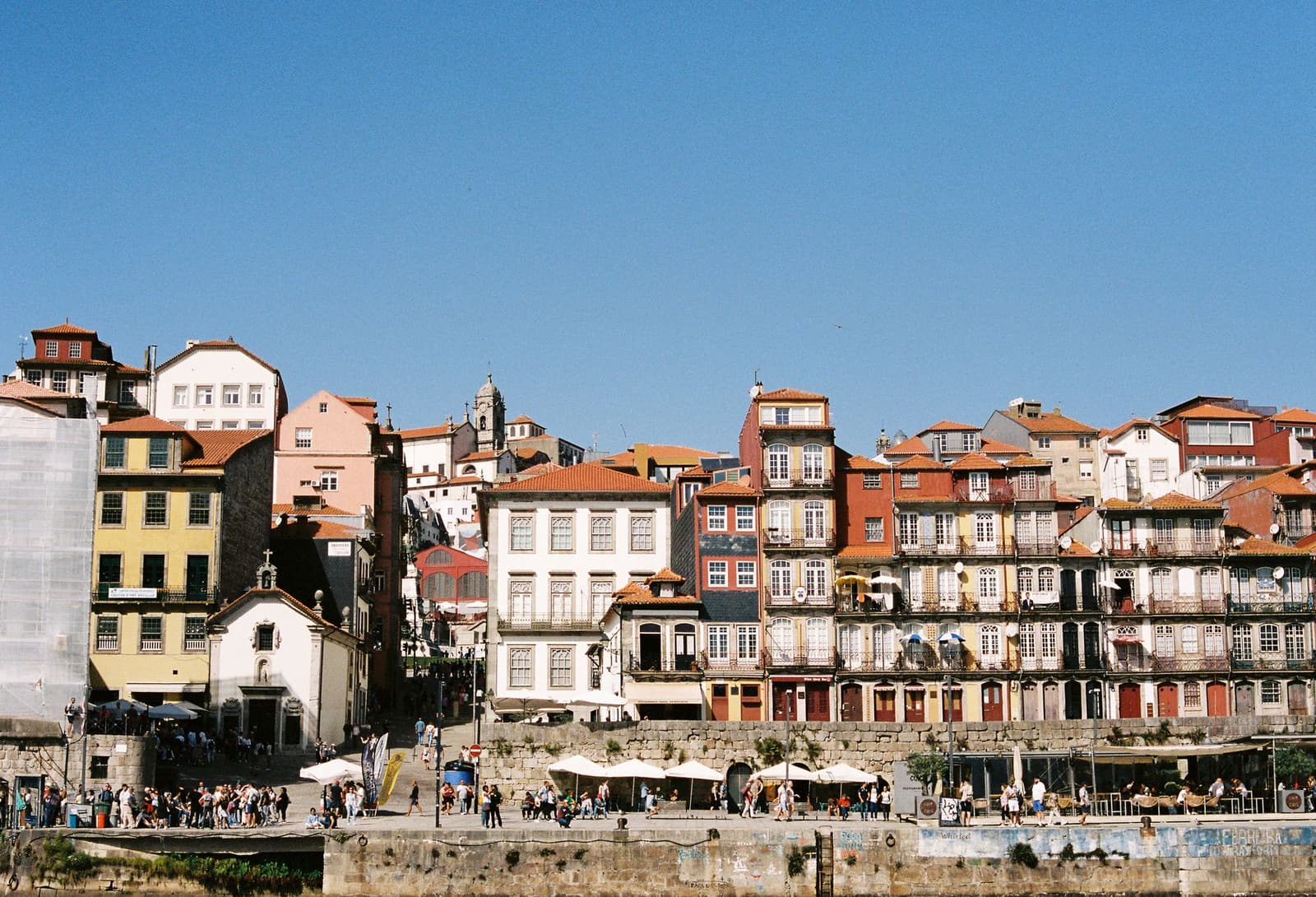
The riverfront promenade on the Gaia side, and the renovated Mercado Beira Rio nearby, group stalls from several of the city's better kitchens around outdoor tables looking back at the Ribeira's stacked, tiled houses. Pastéis de nata, Portugal's custard tart, cost around €1.20-1.50 here; a round of petiscos, the small plates built for sharing over a drink, from octopus salad to cod fritters, typically runs €4-8 a dish.
For a lighter, more Portuguese take on sweet endings, a duck rice from further north makes a good comparison point: Braga's oven-baked arroz de pato shares the same instinct for turning simple, unglamorous ingredients into something worth queuing for.
Markets, neighbourhoods and when to go
- Mercado do Bolhão: reopened 2022, best for a fast multi-dish lunch, closed Sundays.
- Mercado Beira Rio / Cais de Gaia: riverside stalls, best at golden hour for the view across to Ribeira.
- Ribeira: the tourist-facing waterfront, worth a walk but not where locals eat.
- Cedofeita and Bonfim: residential neighbourhoods behind Bolhão where tascas serve the same dishes for less.
- Best time to visit for food: June to September for sardine season, October for the start of the Port harvest's aftermath in Gaia's lodges.
Porto food FAQ
Is Porto expensive to eat in? Not by Western European standards. A bifana or cachorrinho costs under €6, a market lunch under €15, and even a tasting menu at a chef-led restaurant rarely tops €50 a head.
Is francesinha always this heavy? Yes. It is meant as a substantial meal, often eaten after a night out rather than as a light lunch, and portions are not built for sharing.
Do I need a reservation for Port cellar tours? Booking ahead is recommended in summer and around the October harvest season, when tour slots at Taylor's and Graham's fill up by early afternoon.
Is tripe really unavoidable? No. Porto's other classics, from bifanas to bacalhau, mean it is entirely possible to eat well here without ordering it once.
Where to book first
Café Santiago, Rua de Passos Manuel 226, for the francesinha that set the standard. Adega São Nicolau, Rua de São Nicolau 1, for tripas à moda do Porto with a river view. Cantinho do Avillez, Rua Mouzinho da Silveira 166, for a modern counterpoint before crossing to Gaia for Port. Porto, like Lisbon further south, rewards eating in both registers on the same trip.