Char siu bao recipe: Andrew Wong's steamed pork buns
Snow-white, crack-topped buns stuffed with barbecue pork, built on the cornstarch dough technique A. Wong's chef explains rather than guards.
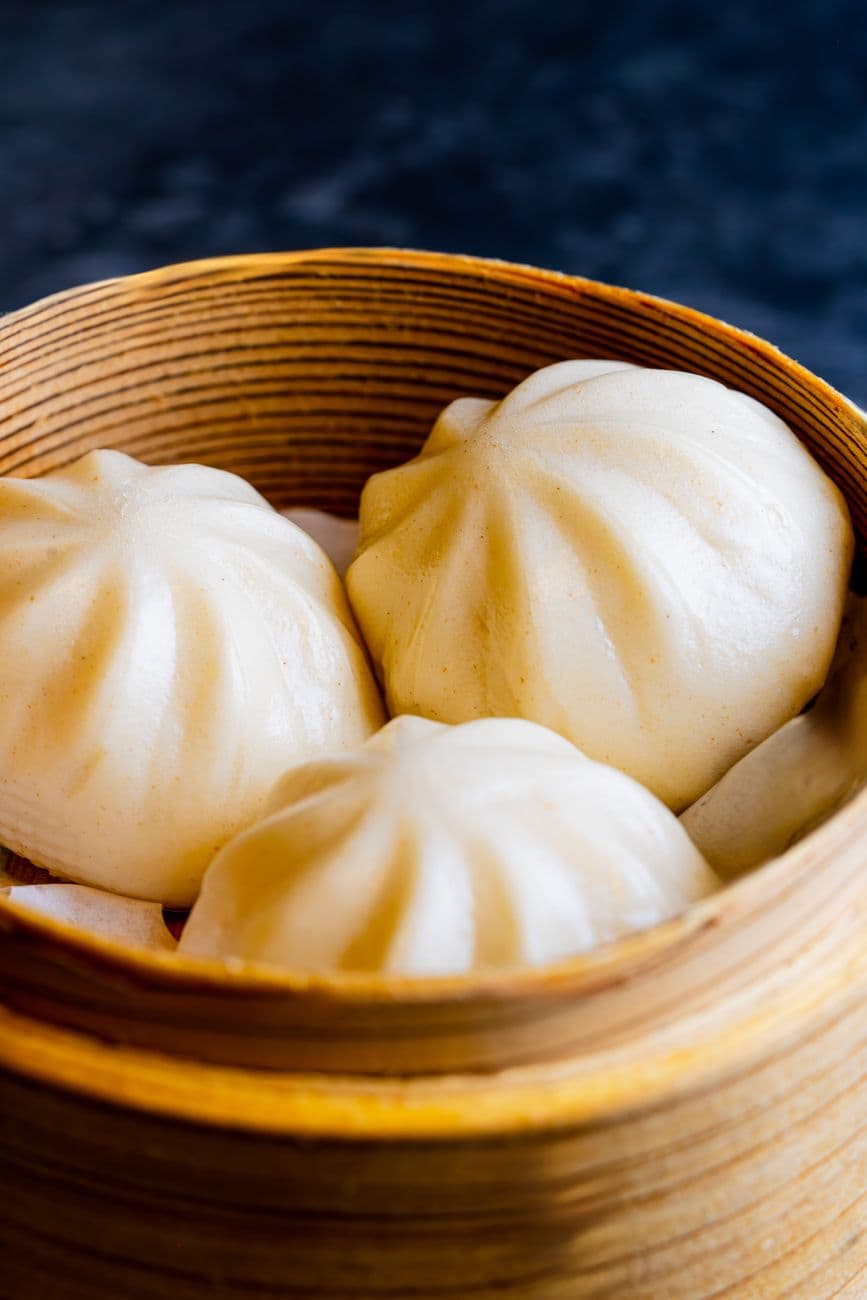
Char siu bao are Cantonese steamed buns stuffed with barbecue pork, built on a dough that Andrew Wong, chef of the two-Michelin-starred A. Wong in London, has spent years explaining rather than guarding: a mix of flour, cornstarch and a touch of baking powder that gives the buns their snow-white colour and the characteristic crack across the top.
The technique sits at the centre of the texture-driven menu Wong has just opened at A. Wong, and the same principles, cornstarch for a tender, matte crumb, a double proof for lift, a hot fast steam for structure, apply just as well in a home kitchen without a dim sum trolley.
Ingredients
Cornstarch for a matte crumb, baking powder for the crack, patience for the lift.
- 300 g bao flour (or plain flour sifted with 2 tbsp cornstarch)
- 1 tsp instant yeast
- 1 tsp baking powder
- 40 g caster sugar
- 160 ml warm water
- 1 tbsp neutral oil
- 250 g char siu (Chinese barbecue pork), diced
- 1 small onion, finely chopped
- 2 tbsp oyster sauce
- 1 tbsp light soy sauce
- 1 tsp sesame oil
- 1 tsp cornstarch, mixed with 2 tbsp water
Method
- Whisk the flour, yeast, baking powder and sugar together, then work in the warm water and oil until a smooth dough forms. The baking powder is what forces the bun's surface to crack open as it steams, so do not skip it.
- Knead for 8-10 minutes until elastic, then cover and prove for 1 hour, until doubled. A patient first proof gives the yeast time to build the open crumb that holds the filling without collapsing.
- While the dough proves, soften the onion in a splash of oil, add the char siu, oyster sauce, soy sauce and sesame oil, and stir over medium heat for 2 minutes. Pour in the cornstarch slurry and cook until the sauce clings to the meat rather than pooling, so the filling stays put once wrapped.
- Knock back the dough, divide into 10 pieces and flatten each into a disc, thinner at the edges than the centre. A thicker centre supports the weight of the filling; thin edges pleat closed without tearing.
- Spoon filling into each disc and pleat the edges shut, twisting to seal. Rest the shaped buns on squares of baking paper for 20 minutes, a second, shorter proof that keeps them light under steam.
- Steam over simmering, not boiling, water for 12 minutes. Water that is too hot drives steam through the dough too fast and collapses the structure; a gentle simmer cooks the buns evenly.
Serve them Wong's way
Can char siu bao be made ahead? Yes — steam them fully, cool completely, then reheat in a hot steamer for 3-4 minutes; the double proof keeps the crumb soft rather than drying out.
What should I drink with them? A pot of jasmine or oolong tea cuts through the sweetness of the char siu better than anything stronger, in keeping with the way A. Wong pairs its own dim sum service.