What to eat in Barcelona: 10 dishes and where to find them
From Bar Tomàs's century-old bravas to Disfrutar's three-star tasting menu, ten dishes that define Barcelona, with bar addresses, opening hours and prices in euros checked in 2026.
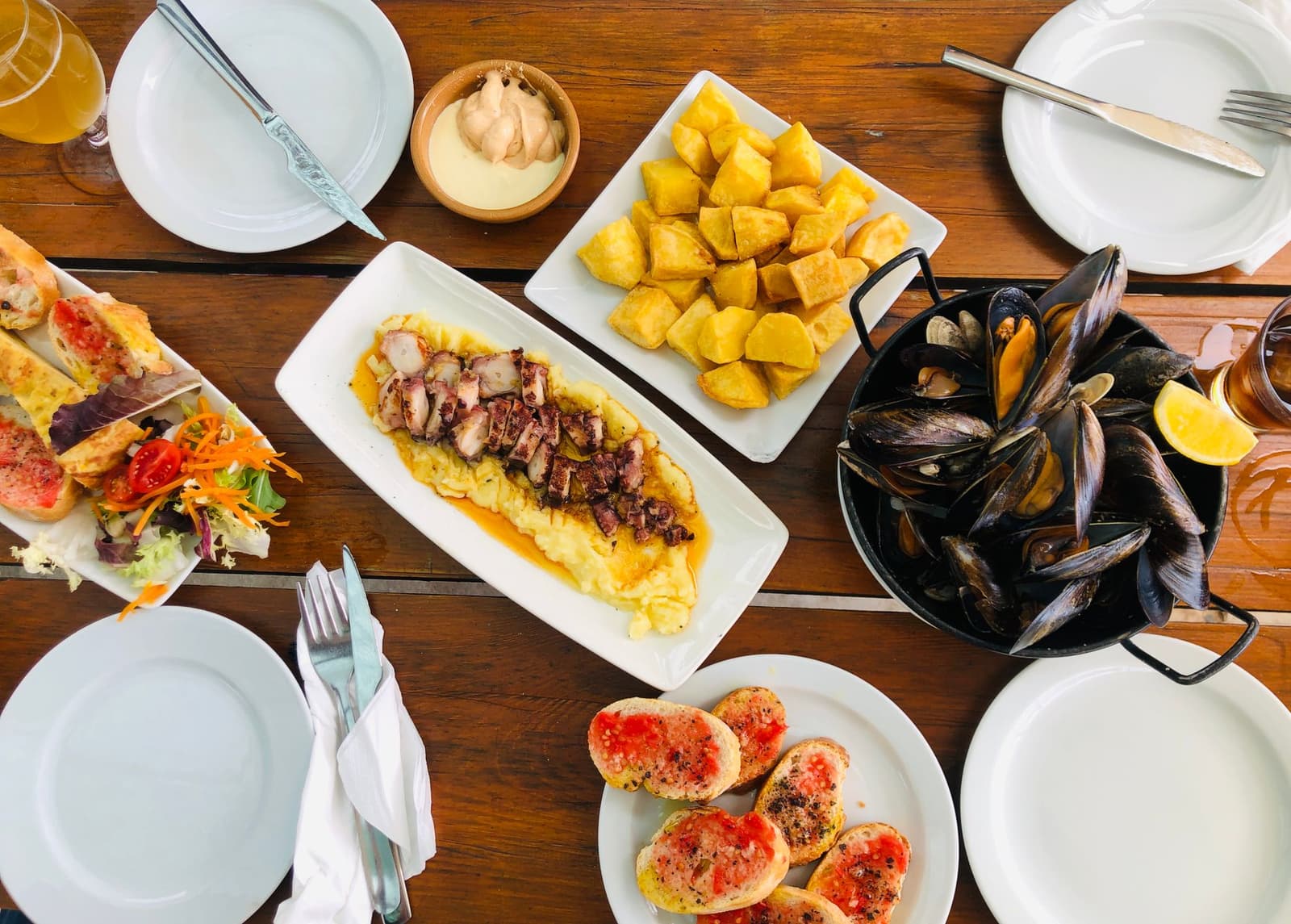
What to eat in Barcelona starts with pa amb tomàquet and a glass of vermut, but the city rewards anyone who keeps going: standing-room bodegas serving century-old tapas a few streets from tasting menus built on elBulli's old techniques. Do not leave without a bomba in Barceloneta, fideuà by the old fishing port, and a market breakfast where the city's own cooks eat on their day off.
Catalan cooking runs on a short list of fixed ideas, repeated with precision: good bread, ripe tomato, olive oil and salt; a sofregit built slowly before anything else goes into the pan; seafood bought that morning from a fleet that still lands at the Barceloneta pier. Centuries of trade through the port layered in rice, saffron and salt cod, and twentieth-century migration from the rest of Spain added its own counter food — the bomba, the vermut hour, the Sunday paella. For the slower side of that repertoire, see our fricandó recipe, the veal and wild mushroom braise most households still cook midweek.
What makes the food culture distinct today is the gap between those fixed points and what grew out of them. Ferran Adrià's elBulli closed in 2011 an hour up the coast, but its alumni now run several of the kitchens keeping Barcelona on world's-best lists, treating foam and spherification as technique rather than spectacle. Knowing what to eat in Barcelona also means knowing when each address opens: prices and hours below were checked against 2026 menus and bar boards, and most bodegas here do not take bookings and close for much of August.
Barcelona eats standing up at a zinc counter long before it ever sits down for a tasting menu.
What to eat in Barcelona first: pa amb tomàquet and patatas bravas at Bar Tomàs, Sarrià
Start at the counter, standing up. Pa amb tomàquet is the opening move of most Catalan meals: toasted bread rubbed with ripe tomato, olive oil and salt, nothing else. Bravas are fried potato cubes under two sauces, one sharp with paprika, the other a thick garlic aioli.
Bar Tomàs has served it since 1952 from a single room in Sarrià, uphill from the tourist routes, and locals still argue — without resolving it — over what goes into the red sauce.
Carrer Major de Sarrià 49; closed Sunday and August; a ración of bravas runs about €7, a beer around €2.50.
Montaditos at Quimet i Quimet, Poble-sec
A montadito is a small open sandwich, built to order on a slice of bread from the tins, jars and cold cuts stacked behind the bar — salmon, truffle, anchovy, foie, whatever that day's combination is.
Quimet i Quimet has been run by the same family since 1914, now in its fifth generation, standing room only, no menu beyond what the counter suggests. The salmon, yogurt, truffle and honey montadito is what regulars order first.
Carrer del Poeta Cabanyes 25; Monday to Friday, 12pm–4pm and 6pm–10:30pm, closed weekends and August; montaditos run €3–5 each.
Bombas at La Cova Fumada, Barceloneta
A bomba is a fried ball of mashed potato with a core of minced meat, served under a spicy sauce and a dollop of aioli — built for one bite and a beer.
La Cova Fumada, open since 1944 and still unmarked from the street, is the bodega most often credited with inventing it. The kitchen keeps fishermen's hours: doors open around 9am, service ends mid-afternoon, no reservations taken.
Carrer del Baluard 56; closed Sunday and Monday afternoon; a bomba costs about €3, a full stop with calamars and bunyols de bacallà runs €15–20 a head.
Cava and anchovies at El Xampanyet, El Born
El Xampanyet pours Catalonia's own sparkling wine cold and young, alongside a saucer of Cantabrian anchovies and whatever else is in the tins that week.
The same family has run the bar since the 1930s; the marble counters, hand-painted tiles and total absence of a printed menu have barely changed since.
Carrer de Montcada 22; Tuesday to Saturday, 12pm–4pm and 7pm–11:30pm, closed Monday and August; a glass of cava with a plate of anchovies costs about €8–10.
Huevos con chipirones at El Quim de la Boqueria
Fried eggs set over baby squid and a scattering of garlic, the signature plate of a counter inside La Boqueria market itself, feet from where the squid was unloaded.
Joaquín Márquez opened the stall in 1987; it is now one of the market's busiest, fishmongers sitting next to chefs and tourists who queued for a stool.
Mercat de la Boqueria, La Rambla 91; Tuesday to Thursday 7am–4pm, Friday and Saturday 7am–5pm, closed Sunday and Monday; the eggs cost about €19, a full stop with cava closer to €35–50 a head.
Fideuà and suquet de peix at Can Solé, Barceloneta
Fideuà is Catalonia's noodle answer to paella: short toasted pasta cooked in fish stock in a wide pan. Suquet de peix is the fisherman's stew behind it — monkfish, potato and sofregit, simmered slowly rather than reduced for show.
Can Solé has held the same Barceloneta address since 1903, run by the fourth generation of the same family, cooking for a neighbourhood built around the fleet docked two streets away.
Carrer de Sant Carles 4; closed Sunday evening and Monday; mains run €20–28, a fideuà for two with wine closer to €55–65.
Botifarra amb mongetes and crema catalana at Can Culleretes, Barri Gòtic
Botifarra is Catalan pork sausage, grilled plain and served over slow-cooked white beans. Crema catalana closes the meal: custard under a brittle caramelised crust, flavoured with lemon and cinnamon rather than vanilla.
Can Culleretes has operated since 1786, the oldest restaurant in Barcelona; it began as a pastry shop selling this exact dessert before it ever added a kitchen.
Carrer d'en Quintana 5; closed Sunday evening and Monday; mains run €14–18, crema catalana about €5.50.
Vermut hour at La Confitería, Raval
Vermut hour is the midday ritual that structures a Barcelona Sunday: red vermouth over ice with a slice of orange, next to a small plate of olives or anchovies, drunk before lunch rather than after.
La Confitería occupies an intact 1912 confectioner's shop, its façade and marble-and-timber bar protected as a city landmark interior, and macerates its own vermouth on site.
Carrer de Sant Pau 128; opens from noon on weekends, evenings on weekdays; a glass of vermut with a tapa runs €6–8.
Xuixo at Hofmann Pastisseria, El Born
A xuixo is a deep-fried, sugar-rolled pastry filled with crema catalana — the same custard that tops the dessert at Can Culleretes, piped inside dough instead of set under a torch.
The pastry originated in Girona, but Hofmann, founded by the late chef Mey Hofmann and still running a culinary school behind the counter, treats it as a technical exercise worth getting right.
Carrer dels Flassaders 44; a xuixo costs about €3.50.
The tasting menu at Disfrutar, Eixample
Disfrutar is run by Oriol Castro, Eduard Xatruch and Mateu Casañas, three former elBulli chefs who plate old techniques — spherification, foams, liquid centres — as working tools, not spectacle.
The restaurant holds three Michelin stars and topped the World's 50 Best Restaurants list in 2024. Barcelona's fine-dining map keeps shifting, though: this year Slow & Low gave up its own Michelin star to serve tapas instead, a bet on volume over ceremony.
Carrer de Villarroel 163; tasting menus run €295–330 before wine pairing, and the booking calendar opens roughly a year out.
Markets, neighbourhoods and when to go
Mapping what to eat in Barcelona by neighbourhood beats chasing addresses one by one:
- La Boqueria (La Rambla 91) — quietest before 10am or after 5pm; closed Sunday.
- Mercat de Sant Antoni (Carrer del Comte d'Urgell 1) — a working market with a Sunday book and record stall outside; fewer tourists.
- Mercat de la Barceloneta (Plaça de la Font 1) — small and seafood-heavy, by the old fishing harbour.
- El Born — tapas and cava bars through medieval streets near the Picasso museum.
- Barceloneta — the old fishermen's grid, best for rice and suquet by the water.
- Poble-sec — bodegas and montadito bars running up toward Montjuïc.
- Barri Gòtic and Raval — the oldest kitchens and the vermouth bars, side by side.
- Best months for food: April to June and September to October, when markets peak and August closures are over.
Continuing on through Spain, our guides to what to eat in Madrid and what to eat in San Sebastian cover the rest of the country's deepest tables.
What to eat in Barcelona, answered
Is Barcelona expensive to eat in? Not if you eat the way locals do. A vermut and a tapa costs under €10, a montadito lunch under €20, and most bars here land between €15 and €35 a head. Costs climb fast only at the tasting-menu end, where Disfrutar and its peers charge upward of €300 before wine.
Do I need to book ahead? Not for the bodegas and market stalls — arrive early or expect to queue, especially at La Cova Fumada. For a weekend table at Can Solé, a same-day call helps. For Disfrutar, book months ahead; the calendar opens roughly a year out.
What's the best time of year for Barcelona's food scene? Late spring and early autumn, when markets run at full stock and the heat has not cleared out the kitchens. August is the one month to route around — family-run bodegas shut for weeks.
Is there good food here for vegetarians? Escalivada, pa amb tomàquet and the vegetable stalls at La Boqueria make plant-based eating easy, though the bar menu leans toward pork, seafood and egg.
Where to book first
To sum up what to eat in Barcelona, three stops to lock in before anything else: Disfrutar (Carrer de Villarroel 163, Eixample) for the city's most ambitious tasting menu, reserved as far ahead as the calendar allows; Can Solé (Carrer de Sant Carles 4, Barceloneta) for fideuà and suquet by the old fishing port; and La Cova Fumada (Carrer del Baluard 56, Barceloneta) for the bomba the dish is named after, eaten standing up before the kitchen shuts for the afternoon.
Sources
- Time Out Barcelona — Bar Tomàs ·
- Time Out Barcelona — Quimet i Quimet ·
- Atlas Obscura — La Cova Fumada ·
- Time Out Barcelona — El Xampanyet ·
- Time Out Barcelona — El Quim de la Boqueria ·
- Time Out Barcelona — Can Solé ·
- Barcelona Obertura — Barcelona's Michelin stars 2026 ·
- Euronews — Time Out world's best food cities 2026 ·