Cassoulet recipe: the Castelnaudary way, crust and all
Lingot beans, duck confit, Toulouse sausage and an earthenware cassole: the slow-baked dish of the Lauragais, following the town brotherhood's reference recipe.
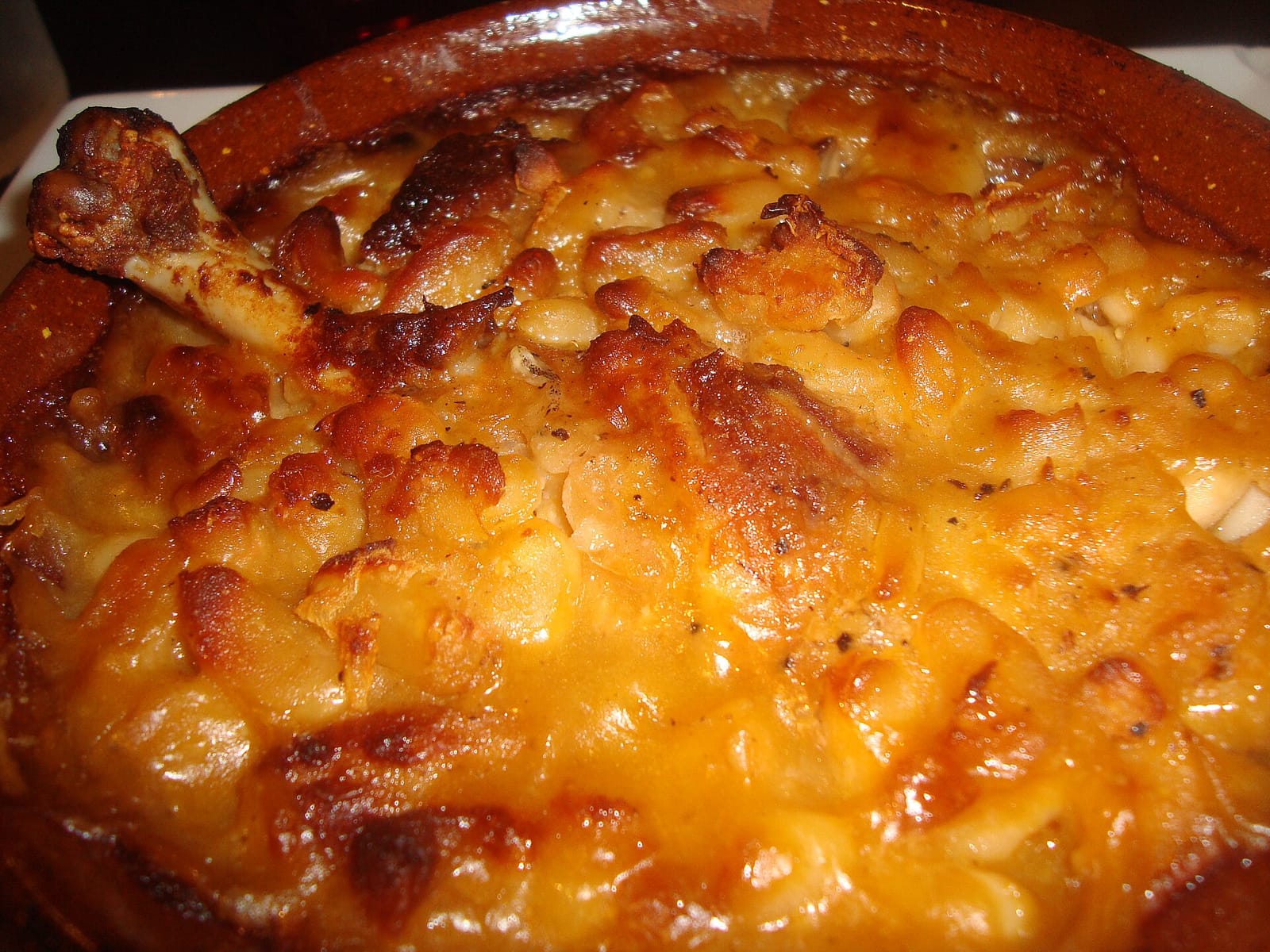
This cassoulet recipe follows the reference version of the Grande Confrérie du Cassoulet de Castelnaudary: lingot beans cooked in a pork-rind broth, duck confit, Toulouse sausage and pork, baked slowly in an earthenware cassole while the crust is pushed down again and again.
Castelnaudary, in the Lauragais between Toulouse and Carcassonne, calls itself the capital of cassoulet. The town's brotherhood, founded in 1970, publishes a reference recipe for four; our cassoulet recipe is scaled for six. The name comes from the cassole, a glazed clay pot that heats slowly, so the beans turn creamy without bursting.
Ingredients
The crust is not a lid: you push it in, and the beans make another.
- 600 g dried lingot beans from Castelnaudary, or Tarbais beans
- 3 duck confit legs, halved at the joint
- 6 pieces Toulouse sausage, about 80 g each
- 6 pieces pork shoulder or belly, about 60 g each
- 350 g fresh pork rind
- 60 g salt pork
- 4 garlic cloves
- 1 duck carcass or 500 g pork bones
- 1 onion and 1 carrot
- Salt and black pepper
- Soft or filtered water
Method
- Soak the beans overnight in plenty of cold water so they cook evenly and keep their skins.
- Drain, cover with fresh cold water, boil for 5 minutes and drain again: this rinses away the soaking flavour and starts the cooking.
- Simmer the rind, cut into wide strips, with the carcass, onion, carrot, salt and pepper in 3 litres of water for 1 hour. Strain and keep the rind: its collagen makes the sauce glossy.
- Cook the beans in this broth for about 1 hour, until tender but whole. Soft water matters: calcium toughens bean skins.
- Meanwhile, warm the confit gently to release its fat, and in that fat brown the sausages, then the pork, for colour the oven will not give.
- Drain the beans, keeping the broth hot. Pound the garlic and salt pork into a paste and stir it through.
- Line the cassole with half the rind, then layer a third of the beans, the confit and pork, and the rest of the beans. Push in the sausages, tops showing. Add hot broth just to cover, pepper and a tablespoon of duck fat.
- Bake at 150-160°C for 2 hours 30 minutes. Each time a brown skin forms, push it into the beans with a spoon, adding broth if the top dries. Castelnaudary tradition says seven times.
Why the crust is broken
Each crust is starch and fat browned on the surface; pushing it in seasons the beans below and lets a new one form, so the flavour deepens with every turn. Made a day ahead, this cassoulet recipe is even better: reheat for 1 hour 30 minutes at 150°C with a little broth. For another bistro classic, try our French onion soup recipe.
Cassoulet recipe: your questions
Do you add breadcrumbs? Many recipes do; the Castelnaudary reference does not, so the crust comes from the beans and fat alone.
Can I use canned beans? You can, but they are already soft and will not absorb the broth.
What if I have no cassole? Any deep earthenware dish works; in cast iron the crust forms faster, so watch it.