What to eat in Ho Chi Minh City: 10 dishes and where to find them
Ten dishes, ten verified addresses: from a 1968 pho broth shop to a Bib Gourmand grill stall. This is exactly how Saigon eats in 2026, dish by dish.
What to eat in Ho Chi Minh City starts with a bowl of phở at a shop that's been simmering the same broth since 1968, and ends on a plastic stool at Bến Thành Market after dark. Ten dishes, ten addresses, all open and verified for 2026.
Saigon's kitchen runs on rice, pork and a colonial loaf repurposed with pâté and chili. The city's southern palate is sweeter and herbier than Hanoi's — see our Hanoi eating guide for the comparison — and most of what to eat in Ho Chi Minh City sits within District 1's old core, District 3's residential streets and District 4's river-edge stalls.
Michelin's Vietnam guide, running since 2023, has put its Bib Gourmand on several of the stalls below, which settles arguments locals have been having for decades about which bowl is worth the queue — the same award that just added 26 addresses in Thailand for 2027. None of these places take reservations in the usual sense; you turn up, you wait, you eat.
Saigon's best bowl is never the fanciest one in the room.
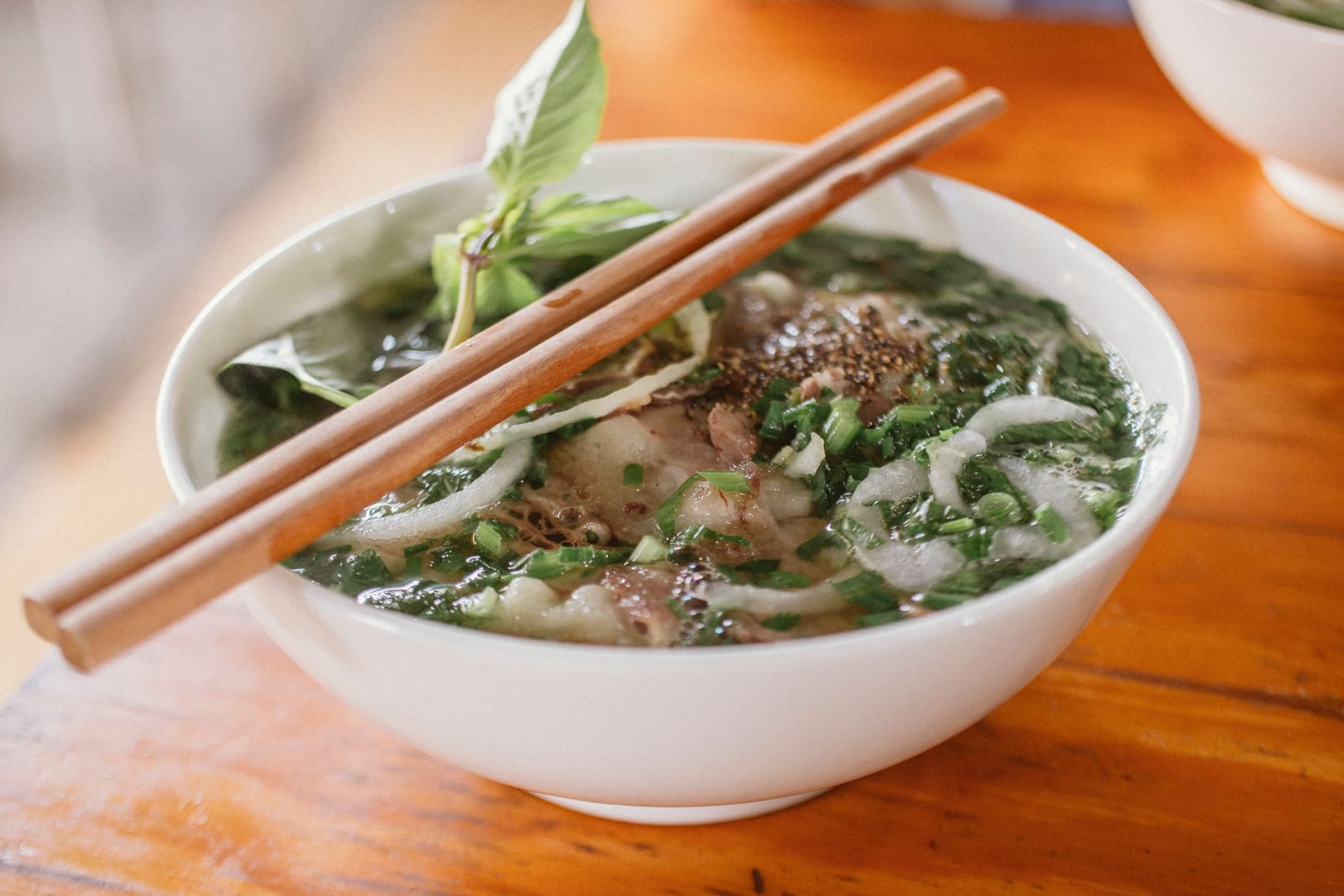
What to eat in Ho Chi Minh City: phở bò at Phở Hòa Pasteur, District 3
Phở here runs sweeter and herbier than the Hanoi original: a broth simmered for hours with charred ginger and star anise, finished at the table with bean sprouts, saw-tooth coriander and a squeeze of lime.
Phở Hòa Pasteur has served it from the same corner since 1968, through a dining room that still runs on handwritten paper tickets — one of the names that comes up first in almost any list of the city's pho, from Michelin's own coverage down to the taxi drivers.
A bowl of phở tái nạm, rare beef and brisket, costs 85,000–120,000 VND at Phở Hòa Pasteur, 260C Pasteur Street, District 3. Go before noon; by 1pm the pot is running low.
Bánh mì at Bánh Mì Huỳnh Hoa, District 1
The baguette is the most visible leftover of French rule, but what goes inside has nothing colonial about it: pork pâté, five kinds of cold cuts, pickled carrot and daikon, cucumber, chili and coriander, packed into a loaf thin-shelled enough to shatter on the first bite.
Bánh Mì Huỳnh Hoa has run from the same Lê Thị Riêng storefront for more than three decades, and the queue that forms most afternoons is the clearest sign the formula hasn't needed fixing.
A loaf costs 60,000–70,000 VND at Bánh Mì Huỳnh Hoa, 26 Lê Thị Riêng Street, District 1 — more than double a street-stall version, for roughly twice the filling.
Cơm tấm at Cơm Tấm Ba Ghiền, Phú Nhuận
Broken rice, the cracked grains once sold off as livestock feed, is Saigon's default lunch: a grilled pork chop, a steamed egg-and-meat custard, shredded pork skin and a fried egg, all set on rice that's drier and chewier than the usual steamed kind.
Cơm Tấm Ba Ghiền has held a Michelin Bib Gourmand since the award's first Vietnam edition in 2023, the payoff for a stall that's been grilling pork over charcoal since the 1990s; the owner's son steers regulars toward dish No. 3 on the handwritten menu, chicken with a fried egg.
Expect to pay 50,000–90,000 VND, cash only, at Cơm Tấm Ba Ghiền, 84 Đặng Văn Ngữ Street, Phú Nhuận District.
Bánh xèo at Bánh Xèo 46A, District 1
The Saigon crêpe is turmeric-yellow, crisped in a hot pan with pork belly and shrimp folded inside, then torn apart and wrapped in lettuce and herbs before it goes anywhere near the dipping sauce.
Bánh Xèo 46A picked up its Bib Gourmand in 2024, with Michelin's own write-up singling out the al fresco seats by the open kitchen as close to the real thing as a sit-down version gets.
A plate for two runs 150,000–220,000 VND at Bánh Xèo 46A, 46 Đinh Công Tráng Street, District 1.
Bún bò Huế at Bún Bò Huế 14B, District 4
Central Vietnam's contribution to the city's noodle map trades phở's gentleness for lemongrass, chili oil and fermented shrimp paste, with thick round noodles standing in for phở's flat rice ribbons.
Bún Bò Huế 14B has run as a take-out-only stall since 2018 and earned its own Bib Gourmand in 2024 — proof that a dish from one region can still find its following three decades after the people who brought it south settled in.
A bowl costs 45,000–65,000 VND at Bún Bò Huế 14B, 14B Đường số 46, Ward 2, District 4.
Hủ tiếu at Hồng Phát, District 3
Hủ tiếu traces back to Teochew and Khmer cooks who settled in the Mekong Delta: a clear pork broth over thin, springy noodles, layered with minced pork, liver, shrimp and, at Hồng Phát, a slab of braised blood curd for anyone who wants it.
Michelin's inspectors have kept Hồng Phát on the Bib Gourmand list since the guide's first Vietnam edition, for a shopfront that's barely changed its menu in decades.
A bowl costs 50,000–75,000 VND at Hồng Phát, 389–391 Võ Văn Tần Street, District 3.
Bún thịt nướng at Bún Thịt Nướng Kiều Bảo, District 1
Cold rice vermicelli, grilled pork marinated in fish sauce and lemongrass, crushed peanuts, pickled vegetables and a fried spring roll, brought together at the table with a ladle of nước chấm — the dish Saigon reaches for when phở feels too heavy for the heat.
Kiều Bảo runs a self-service counter on Đề Thám where regulars build their own bowl from trays laid out behind glass, a format that's kept the line moving since well before the street became a backpacker strip.
A full bowl with spring roll costs 40,000–55,000 VND at Bún Thịt Nướng Kiều Bảo, 139 Đề Thám Street, District 1.
Cà phê sữa đá at Cheo Leo Café, District 3
Coffee here is dripped through a metal phin over condensed milk and ice, robusta beans roasted dark enough to stand up to the sugar.
Cheo Leo Café has made it this way since 1938, using cà phê vợt, a cloth-filter method that's largely died out everywhere else in the city; three sisters, the third generation of the family that opened it, still run the front room.
A glass costs 25,000–35,000 VND at Cheo Leo Café, 109/36 Nguyễn Thiện Thuật Street, District 3.
Dim sum at Dim Tư Tắc, District 5
Chợ Lớn, the Chinese quarter spread across District 5, runs on a different cuisine entirely: steamed shrimp dumplings, char siu, crispy rice rolls and a trolley doing the rounds instead of a menu.
Dim Tư Tắc has worked this format on Trần Hưng Đạo for years, with Peking duck as the dish regulars order a table around.
A full spread for two, duck included, runs 300,000–500,000 VND at Dim Tư Tắc, 29B Trần Hưng Đạo Street, District 5. Go before 10am on a weekend; the carts empty out fast once the neighbourhood wakes up.
Street food after dark at Bến Thành Market, District 1
By day, Bến Thành is tourist-market stalls and a handful of grill counters; after sunset, vendors move onto the surrounding pavements and the market turns into something close to a food court without walls.
Grilled seafood, bánh bèo, bánh tráng trộn — most plates run under 100,000 VND, and a roughly 30-year-old bánh bèo stall near the market's west gate is one of the few vendors here that's outlasted several waves of change around it.
Bến Thành Market, Lê Lợi Street, District 1. Evening stalls run from around 6pm.
Markets, neighbourhoods and when to go
Saigon rewards a plan more than a wander — the useful addresses sit in clusters, and the clock matters as much as the map.
- District 1: Bến Thành Market and the streets around it, the easiest first-night crawl.
- District 3: quieter and residential, where Phở Hòa Pasteur, Hồng Phát and Cheo Leo Café sit within a 15-minute walk of each other.
- District 4: across the canal from District 1, known for its street-food alleys and for Bún Bò Huế 14B.
- District 5 (Chợ Lớn): the Chinese quarter, for dim sum and Cantonese cooking, best done in the morning.
- Phú Nhuận: a short taxi ride north of the centre, home to Cơm Tấm Ba Ghiền.
- Eat breakfast dishes — phở, bánh mì, bún thịt nướng — before 10am; lunch service for cơm tấm and bánh xèo often sells out by 1:30pm.
What to eat in Ho Chi Minh City: frequently asked questions
Is street food in Ho Chi Minh City safe to eat? Stick to stalls with a high turnover and a queue of locals; anything cooked to order over open flame or at a rolling boil carries less risk than food left sitting at room temperature.
Which district has the best concentration of food? District 1 and District 3 cover most of what to eat in Ho Chi Minh City within a short taxi ride of each other; District 5 is a separate trip, best done as a morning outing — see our best restaurants in Hanoi list for how the two cities compare at the top end.
Is phở actually a Ho Chi Minh City dish? No — it travelled south from Hanoi after 1954, and the local version answers back with more sugar, more herbs and a sweeter broth.
Do these places take cards? Rarely. Carry cash in small notes; several of the stalls on this list, Cơm Tấm Ba Ghiền included, are cash only.
Where to book first
Cơm Tấm Ba Ghiền, 84 Đặng Văn Ngữ Street, Phú Nhuận District — arrive for lunch before 1pm, cash only.
Bánh Mì Huỳnh Hoa, 26 Lê Thị Riêng Street, District 1 — no reservations, expect to queue from mid-afternoon.
Dim Tư Tắc, 29B Trần Hưng Đạo Street, District 5 — call ahead for a table of four or more on weekends.