What to eat in Osaka: 10 dishes and where to find them
Takoyaki standing up in Namba, kushikatsu in Shinsekai and a bowl of kitsune udon in a room open since 1893: the city's cooking, dish by dish, with prices.
What to eat in Osaka comes down to konamon, the flour-based street cooking the city turned into an industry, plus the fish and the offal that fed its merchants. Eat takoyaki standing up in Namba, kushikatsu in Shinsekai, and a bowl of kitsune udon in a wooden room that has been serving since 1893.
Osaka calls itself tenka no daidokoro, the nation's kitchen, and it earned the name as a rice and merchant port rather than a court city. Kyoto refined; Osaka fed. What came out of that is a food culture built on volume, cheap protein and a local word for eating yourself into ruin: kuidaore.
The three specialities every list starts with are cooked in front of you and cost less than a train ticket. They are also better two streets off the main drag. Ten dishes follow, each with a place that was trading in 2026, a neighbourhood and a price in yen.
Kyoto refined the plate; Osaka worked out how to sell it twice as fast.
Takoyaki at Wanaka, Sennichimae
Batter, a cube of octopus, pickled ginger and tempura crumb, turned in a cast-iron dimple plate until the outside sets and the middle stays liquid. This is the dish the city exports.
Wanaka has several branches; the Sennichimae shop near Namba is the one locals queue at. Eight pieces run about 500 to 700 yen. Eat them from the tray with the wooden pick and accept that the first one will burn your mouth.
Okonomiyaki at Mizuno, Dotonbori
A cabbage-heavy batter pancake cooked on a griddle and finished with sauce, mayonnaise, bonito flakes and seaweed powder. Osaka-style means everything mixed into the batter, not layered as in Hiroshima.
Mizuno, on the Dotonbori strip, has held a Bib Gourmand and still cooks over the counter in front of you. Budget 1,300 to 1,800 yen a pancake, and expect to wait outside.
Kushikatsu at Kushikatsu Daruma, Shinsekai
Skewered meat, vegetables and seafood, breaded in fine panko and fried in beef fat. The rule on the counter is absolute: one dip in the communal sauce, never two.
Daruma has been frying in Shinsekai, under the Tsutenkaku tower, since 1929. Skewers cost roughly 150 to 300 yen each and a decent run of ten lands around 2,000 yen.
Kitsune udon at Usami-tei Matsubaya, Minami-Semba
Soft Osaka udon in a pale kombu and light-soy broth, topped with a sheet of aburaage, fried tofu simmered in sugar and soy until it drips. The city claims the dish as its invention.
Usami-tei Matsubaya has been open in Minami-Semba since 1893 and is still run by the same family. A bowl is around 580 to 700 yen, which is the best value in this guide.
Butaman at 551 Horai, Namba
A steamed pork bun with a coarse, juicy filling and a thick, faintly sweet wrapper. Osaka eats them on train platforms; the smell on the Shinkansen is a running local joke.
The 551 Horai main shop sits on Namba, and there are counters in most big stations. Buns are about 200 to 250 yen each and are sold in twos and fours.
Negiyaki at Negiyaki Yamamoto, Juso
Okonomiyaki's thinner, sharper cousin: the cabbage is replaced by a heavy load of spring onion, and the finish is soy and citrus rather than brown sauce and mayonnaise.
Yamamoto in Juso, north of the river, invented the form and still cooks it on a horseshoe counter. A negiyaki runs about 900 to 1,200 yen. Juso is ten minutes from Umeda and feels a decade behind it.
Sushi at Endo Sushi, Kyobashi
Osaka's older sushi tradition is pressed, not hand-formed, but the market counters serve both. Sets arrive as five pieces on a wooden board, eaten fast and standing if the seats are full.
Endo Sushi's Kyobashi counter is the easy version of the market ritual, open from the morning. A set is roughly 1,300 to 1,600 yen. Go before ten if you want a seat.
Horumon at the Tsuruhashi yakiniku houses
Grilled offal: intestine, tripe, diaphragm. Tsuruhashi is Osaka's Korean quarter, built by immigrants from Jeju, and the smoke in the covered arcade is the neighbourhood's signature.
Yakiniku Sora runs several Tsuruhashi rooms; a five-piece horumon set is around 2,300 yen. Order kimchi and cold noodles alongside and drink the cheap beer.
Ikayaki and doteyaki at Hanshin Snack Park, Umeda
Ikayaki is squid and batter pressed between two hot plates for under a minute, sold folded like a crepe. Doteyaki is beef sinew stewed for hours in miso and mirin until it collapses.
Both are on the basement floor of the Hanshin department store at Umeda, at standing counters, for roughly 185 to 400 yen a portion. It is the cheapest good eating in the city centre.
A kappo counter in Shinsaibashi
Kappo is Osaka's answer to Kyoto kaiseki: the same seasonal precision, served across a counter by the cook, with less ceremony and more conversation.
Asai, in Shinsaibashi, is one of the counters worth the outlay, with menus from about 15,000 yen. Book weeks ahead, through a hotel concierge if your Japanese is thin.
Markets, neighbourhoods and when to go
- Kuromon Ichiba: 580 metres of covered market in Nippombashi, over 150 stalls, open roughly 09:00 to 18:00. Takoyaki 500 to 600 yen for six; melon by the slice from 1,000 yen.
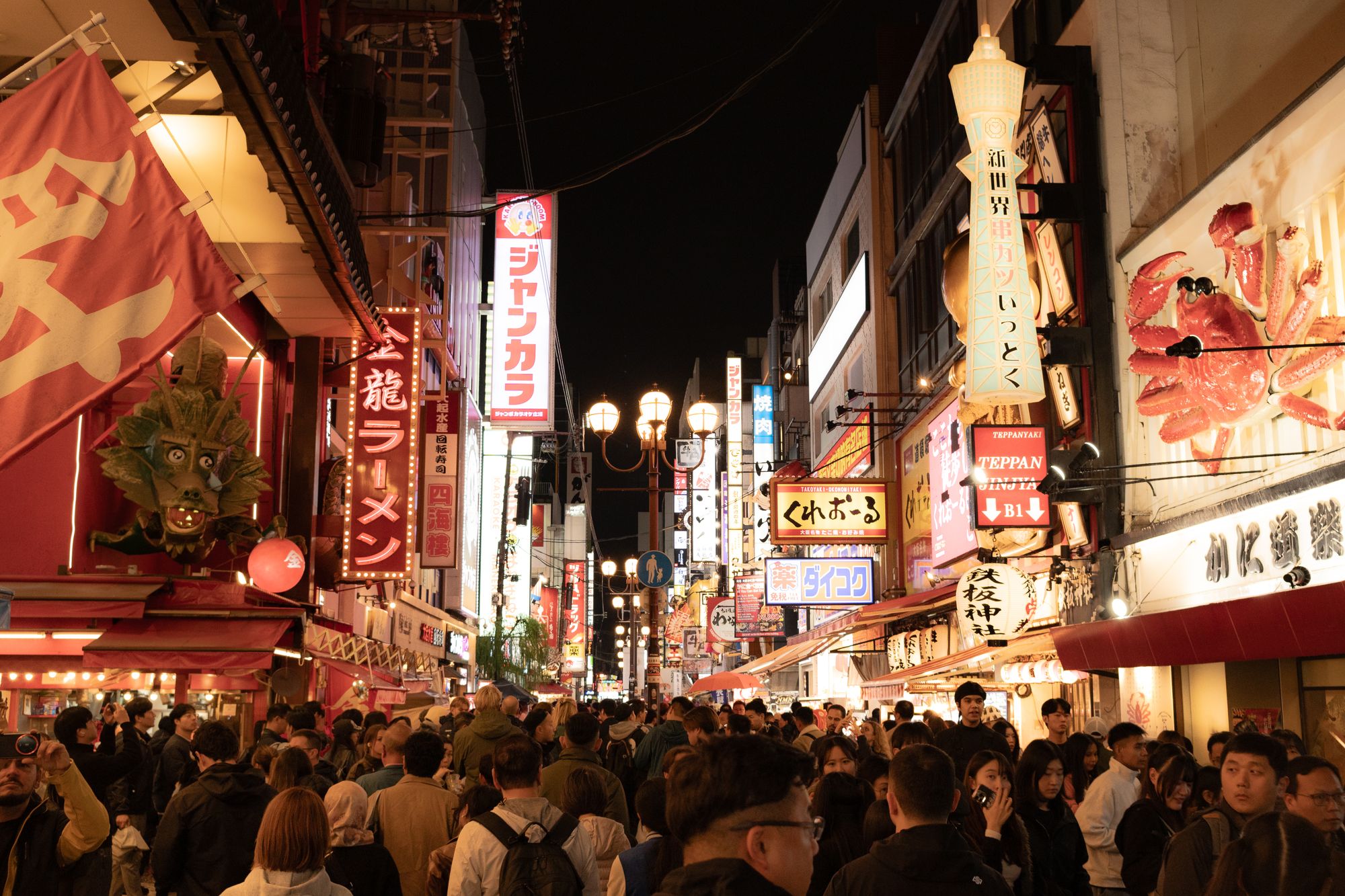
- Dotonbori and Namba: the neon strip and the streets behind it. Loud, crowded and still the best konamon in the city if you turn off the canal.
- Shinsekai: kushikatsu and retro signage around Tsutenkaku. Cheap, and busiest from six in the evening.
- Tsuruhashi: Korean groceries, kimchi stalls and grill rooms in a covered maze by the station.
- Umeda and Kita: department-store basements, standing counters and the office-worker lunch trade.
- When: October and November, or late March to April. August is humid enough to ruin a queue.
Frequently asked questions
Is Osaka expensive to eat in? No. Two konamon meals and a market snack come in under 3,000 yen a head. A kappo counter is the only line item that changes that.
How does Osaka differ from Tokyo? Cheaper, louder, and weighted towards street cooking and offal rather than sushi counters and soba. Portions are larger and service is faster.
Do I need to book? Only for kappo and the better sushi counters. Everything else is a queue, and the queue usually moves.
Can vegetarians eat well? With effort. Dashi is in almost everything, including udon broth. Kitsune udon without the broth, vegetable kushikatsu and market produce are the reliable routes.
Where to book first
Book Asai in Shinsaibashi for the one expensive meal. Walk to Usami-tei Matsubaya in Minami-Semba for lunch on the first day, and to Kushikatsu Daruma in Shinsekai for the first evening.
Osaka's restaurant economy is not immune to the pressures elsewhere in Japan: a large local operator collapsed with 1.2 billion yen of debt this year, and input costs keep climbing, as the record price of Uji matcha shows. Check that a place is still trading before you cross the city for it.
Sources
- Osaka.com · 2026-09-01
- Inside Osaka · 2026-08-15
- Japankuru · 2026-05-20
- Japan Guide · 2026-07-10