What to eat in Rotterdam: 9 dishes and where to find them
Kapsalon, meatballs on the Maas, Dudok's appeltaart, roti, cachupa and oysters: nine plates that tell you where you are, mapped to the snack bars, cafés and dining rooms serving them in 2026.
What to eat in Rotterdam is the food of a working port: a kapsalon from the snack bar that invented it, a meatball on the quay and roti on the Witte de Withstraat. The best plates in the city are cheap, filling and mostly eaten without a reservation.
The German bombing of 14 May 1940 flattened the old centre, and Rotterdam rebuilt itself as a modern city with little patience for ceremony. Its kitchens followed the people who came to work the docks: Chinese seamen who settled in Katendrecht in the early twentieth century, Surinamese and Antillean families, and a Cape Verdean community of around 20,000, commonly described as the largest in Europe after Lisbon's.
The high end is strong too, with three two-star restaurants in the current Michelin selection, which will be replaced when the Michelin Guide Netherlands announces its 2026 stars in Maastricht on 5 October. The nine plates below are a better answer to what to eat in Rotterdam day to day. Prices were checked against 2026 menus; read them as ranges.
Rotterdam cooks for people with work to do, and its best plates are still eaten standing up.
What to eat in Rotterdam starts with a kapsalon at El Aviva, Delfshaven
Kapsalon means hairdresser's. It is a takeaway tray of fries covered with shawarma and cheese melted under the grill, then topped with salad, garlic sauce and sambal. It was created in 2003 at Shoarma El Aviva for Nathaniël Gomes, a Cape Verdean hairdresser who worked nearby and wanted his favourites in one box; it became a fixed menu item about two years later and then spread to snack bars across the Netherlands. Gomes died in July 2023, aged 47.
El Aviva, at Schiedamseweg 22A, has been on the street since 1999. It reopened in August 2025 after a fire in July 2024, and it has been for sale since January 2026 because its owner is retiring, so check it is still trading before you cross the city. Its ordering site lists the kapsalon at €9.50 small, €11.50 large and €14 jumbo; a recent listing gives opening hours of noon to 01:00 daily.
Appeltaart at Dudok, Meent
Dutch apple pie is tall rather than wide, with a buttery crust around a deep filling of apple and cinnamon, served in a thick wedge. Dudok's version is the one Rotterdammers send visitors to. The grand café opened in 1991 in the building W.M. Dudok designed for the insurer De Nederlanden van 1845, completed in 1952 during the reconstruction.
It is at Meent 88 and opens daily from 09:00 to 23:00. A slice of the original appeltaart costs €5.75, whipped cream €0.80 more, and a warm slice with cinnamon ice cream and cream €9.25. Amsterdam's rival slice is at Winkel 43, one of the stops in our guide to what to eat in Amsterdam.
Bal gehakt at De Ballentent, Parkhaven
A bal gehakt is a large meatball of seasoned minced meat, served here in gravy with bread or fries. It is café food, not restaurant food, and De Ballentent has made it the reason to walk to the river.
The wooden building at Parkkade 1 is more than a hundred years old and began as a customs depot; after the Second World War it became Café Maaszicht, and regulars renamed it after the meatballs. René Keehnen has run it since 2003. A meatball costs €5.20, €6.10 with bread and €8.90 with fries, while the house-style plates cost €9.60 to €12.40. The kitchen serves from 11:00 to 21:00, and the terrace looks straight onto the Maas.
Broodje pom and roti at Warung Mini, Witte de Withstraat
Pom is a Surinamese oven dish of chicken layered with grated pomtajer, a starchy root, baked with citrus until the top caramelises; in a soft roll it becomes broodje pom. Roti is the Surinamese-Hindustani flatbread served with curried chicken, potato, long beans and egg, torn by hand and eaten with it.
Warung Mini has cooked both since 1983 and is now run by the third generation of the family. The restaurant is at Witte de Withstraat 47, the takeaway two doors along at number 53. A broodje pom costs €4.50, roti or rice plates €12 to €14 and the specials €15 to €17; saoto, a spiced chicken soup, is €6.50. The restaurant opens from noon, Sundays from 14:00.
Cachupa at Restobar Ta Lois, Charlois
Cachupa is the national dish of Cape Verde: hominy corn and beans slow-cooked with meat or fish until the stew thickens. The next day it is fried with an egg on top, and many cooks think it is better that way.
Restobar Ta Lois, at Grondherendijk 1 in Charlois, south of the river, lists cachupa at €13 to €16.50 and serves the traditional version on Saturdays only. It opens from Thursday to Sunday, from 17:00 on weekdays and from noon at weekends, and is closed from Monday to Wednesday.
Dim sum at Tai Wu, Mauritsweg
Rotterdam's Chinatown now runs along the West-Kruiskade, where supermarkets, bakeries and restaurants cluster a few minutes from Central Station. Dim sum, the small steamed and fried dishes of Cantonese lunch, is the thing to eat here.
Tai Wu, at Mauritsweg 24-26, has been a Rotterdam institution for more than 25 years, seats more than 200 and makes its dim sum by hand at lunch; it takes reservations by phone and does not publish prices. For a smaller room with a printed menu, China Town Dim Sum, at Westersingel 1A on the corner of the Kruiskade, opened in 2016 and charges about €8.50 to €9 a portion; it closes on Wednesdays.
Oysters at Hotel New York, Kop van Zuid
Hotel New York occupies the former head office of the Holland America Line, the company whose ships carried emigrants from these quays to the United States. Its oyster bar is the most complete in the city and serves from noon.
The April 2026 menu lists six Normandy creuses at €22, rising to €33.50 for six of the top varieties, a tasting board of ten oysters at €42.50 and a plateau de fruits de mer at €85.
Herring at Vishandel Ruud den Haan, Kralingen
Raw herring, lightly salted and eaten with onion, is a Dutch habit with deep roots next door. Museum Vlaardingen, on the Westhavenkade in the neighbouring town, says Vlaardingen's herring fleet became the largest in the world from the seventeenth century; the 1912 herring logger VL 92 Balder, the last working one in the Netherlands, is moored outside and can be visited on Thursdays and Saturdays.
Rotterdam has no famous herring cart in its centre, so go to a fishmonger. Vishandel Ruud den Haan, at Oudedijk 133 in Kralingen, held its own Rotterdam herring party in June 2026. It does not publish prices; the counter does. For what the North Sea fleet is landing this autumn, read our North Sea September report.
Beer at Stadsbrouwerij De Pelgrim, Delfshaven
Delfshaven is the old harbour the Pilgrim Fathers left in 1620, and De Pelgrim has brewed on its quay, at Aelbrechtskolk 12, since 1995. Its tasting room opens from Wednesday to Saturday from noon to midnight and on Sundays until 22:00, which makes it an easy stop after a kapsalon at El Aviva, a short walk away.
For newer beer, Kaapse Brouwers, founded in 2014, pours more than 20 taps at Kaapse Fenix, in the Fenix Food Factory warehouse at Nico Koomanskade 1025 in Katendrecht.
Markets, neighbourhoods and when to go
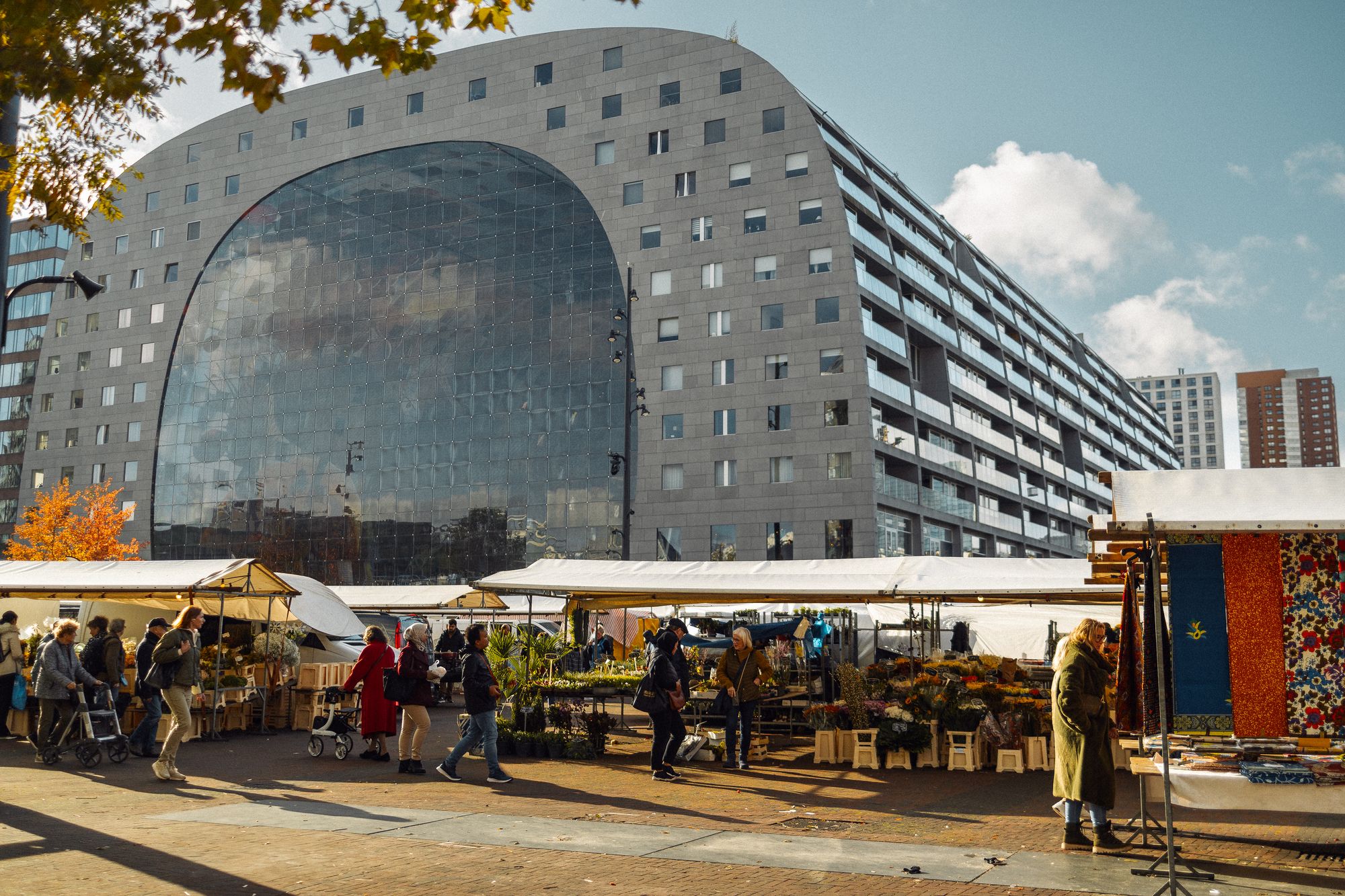
- Markthal, Ds. Jan Scharpstraat 298: more than 100 food spots under the arched housing block that opened on 1 October 2014. Monday to Thursday 10:00-20:00, Friday until 21:00, Saturday until 20:00, Sunday 12:00-18:00.
- Binnenrotte market, outside the Markthal: Tuesday 8:00-17:30 and Saturday 8:00-17:00. The city calls it the second-largest market in the Netherlands; a Sunday market runs from 12:00 to 17:00 until 27 September 2026.
- Afrikaandermarkt, Afrikaanderplein: Wednesday 8:00-17:30 and Saturday 8:00-17:00, with snacks from half the world between the vegetable stalls.
- When to go: Tuesday or Saturday for the Binnenrotte market, September for the National Restaurant Week menus, which run until 30 September, and early October for the new Michelin stars.
Questions before you book a table
Is Rotterdam expensive to eat in? Not at street level: a broodje pom costs €4.50, a meatball €5.20 and a kapsalon €9.50 to €14. The two-star tasting menus cost €185 to €249.
Do I need to book? For the starred restaurants and Tai Wu, yes. El Aviva, De Ballentent, the Markthal and the markets are walk-in.
What should I eat if I only have one day? Appeltaart at Dudok in the morning, the Binnenrotte market, a meatball at De Ballentent for lunch, a beer at De Pelgrim and roti or cachupa for dinner. That covers what to eat in Rotterdam in one loop.
Where to book first
- Parkheuvel, Heuvellaan 21: two stars, Erik van Loo with his son Juliën in the kitchen; menus of four to six courses cost €185-225, lunch from €95. Reopened on 1 June 2026 after a rebuild.
- FG, Katshoek 37B: François Geurds' two-star restaurant, with menus of five to seven courses at €195-249; dinner Wednesday to Saturday.
- Fred, Boompjes 41: Fred Mustert's two-star restaurant on the river since 2023, with lunch at €99-129 and the Inspiration menu at €225.
Everything else on this list is walk-in, which is how Rotterdam prefers it.