What to eat in Amsterdam: 10 dishes and where to find them
Raw herring, bitterballen, kroket, appeltaart and rijsttafel: ten plates that tell you where you are, mapped to the carts, cafés and dining rooms serving them in 2026.
What to eat in Amsterdam comes down to salt, frying fat and a long trading history: raw herring from a street cart, bitterballen in a brown café and a rijsttafel on a canal-side street. Skip anything sold near Dam Square with a photograph of a waffle on the door.
Dutch cooking was built for cold kitchens and long winters: potatoes mashed with the season's vegetable, meat stretched into ragout and fried, fish cured so it would keep. Amsterdam added the snack culture of a port that eats on its feet, then the kitchens of Indonesia and Suriname, which arrived with people from the former colonies and are now as much part of the city as the canals.
The high end is well documented, and the latest Michelin Guide Netherlands selection added eight new restaurants to it. The ten plates below are a better answer to what to eat in Amsterdam, because they tell you where you are. Prices were checked against the venues and 2026 guides; read them as ranges.
Amsterdam eats best standing up: at a herring cart, a croquette counter or a brown café bar.
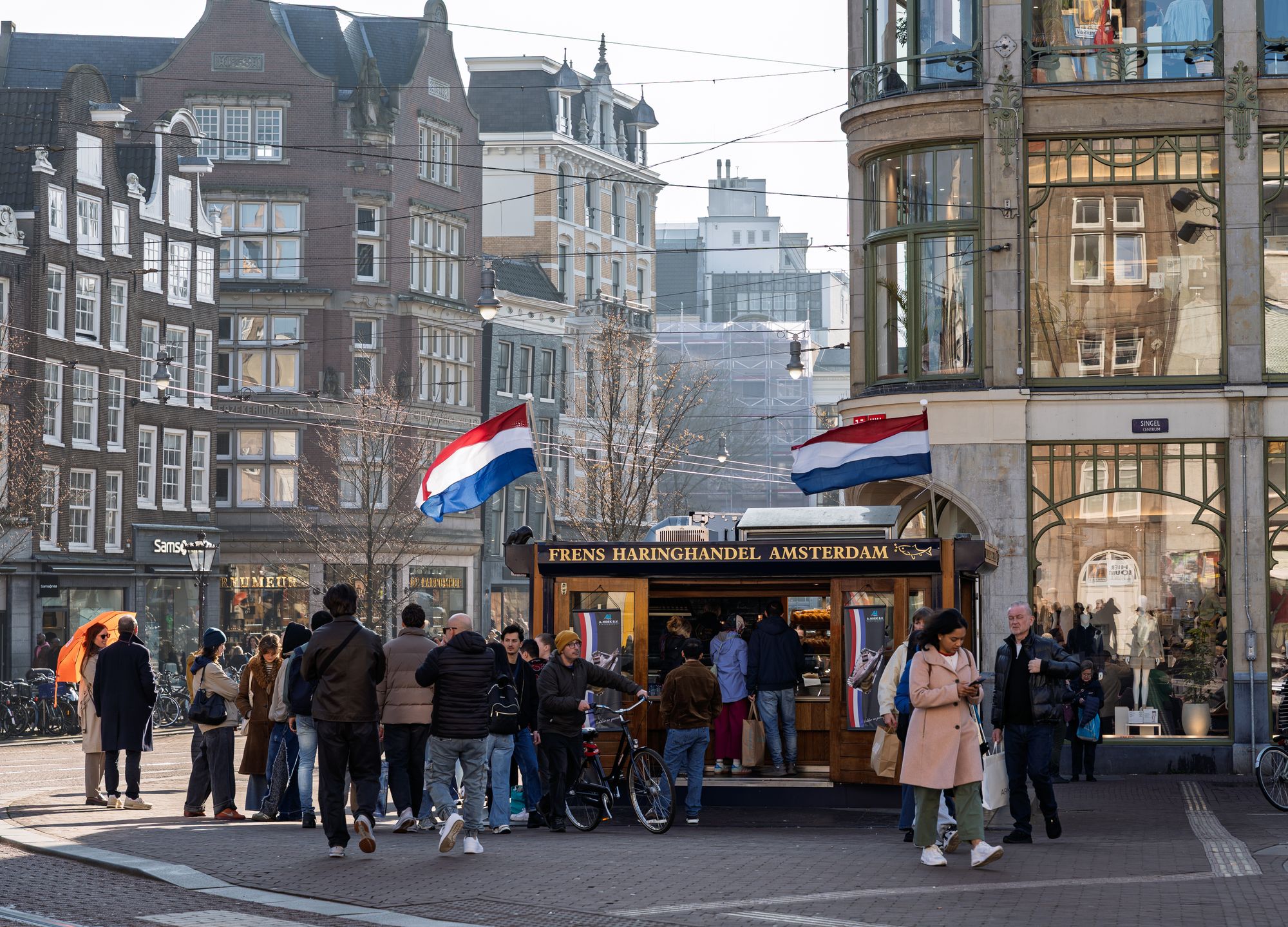
What to eat in Amsterdam starts with raw herring at Frens Haringhandel, Koningsplein
Haring is herring gutted at sea, lightly salt-cured and eaten raw, served in Amsterdam with chopped raw onion and pickles. The new season's catch arrives in June and the carts sell herring all year, usually cut into pieces and eaten standing up with a cocktail stick.
Frens Haringhandel has worked the square between the Singel and the Flower Market since 1986; the family has sold fish in the city since 1976. It also fries kibbeling, battered pieces of cod, to order. It opens from 11:00 to 18:00 Tuesday to Saturday and from noon on Sundays and Mondays. Expect €4-6 for a herring, a little more on a bun. Stubbe's Haring, on the Singel bridge near Central Station, is the other cart where locals queue. For what the fleet is landing now, read our North Sea September report.
Bitterballen at Café 't Smalle, Jordaan
Bitterballen are a thick beef or veal ragout bound with roux, chilled, rolled into balls, crumbed and fried. They arrive too hot to eat, with sharp mustard, and belong to the borrel, the Dutch after-work drink. The name comes from the herbal bitters they were once served with.
Café 't Smalle, on the Egelantiersgracht, dates from 1780 and began as a distillery tasting room; today it is a wood-panelled brown café with a terrace on the water. It opens at 14:00 from Monday to Wednesday and at noon at weekends. A portion of six to eight bitterballen costs around €7-10 in the city's brown cafés.
Kroket on a bun at Eetsalon Van Dobben, Rembrandtplein
The kroket is the same ragout shaped into a longer cylinder, put in a soft white roll with mustard and eaten at the counter. Eetsalon Van Dobben opened on the Korte Reguliersdwarsstraat, off Rembrandtplein, on 28 June 1945 and still sells beef and veal croquettes over the counter; vegan croquettes and bitterballen joined the range in 2026. A broodje kroket costs a few euros. For a pastry-shop version, Patisserie Holtkamp on the Vijzelgracht has made veal croquettes since 1969 and a Dutch shrimp one since the late 1980s.
Appeltaart at Winkel 43, Noordermarkt
Dutch apple pie is deep rather than wide: a crumbly, buttery crust around a tall filling of apple and cinnamon, served in a thick wedge with a mound of whipped cream, at any hour.
Winkel 43 occupies a corner building on the Noordermarkt in the Jordaan, bakes its pie fresh every day and sells hundreds of slices daily. It takes no reservations. Recent reviews put a slice with cream at around €5-6. Come on a Saturday, when the organic farmers' market fills the square.
Fresh stroopwafels at Albert Cuyp Market, De Pijp
A stroopwafel is two thin waffle discs pressed around caramel syrup. The packaged version travels well; the fresh one, split and filled while hot, is soft and chewy, with syrup that runs down your wrist.
The Albert Cuyp Market fills Albert Cuypstraat in De Pijp from Monday to Saturday, roughly 9:00 to 17:00. Rudi's Original Stroopwafels, near number 182, presses them to order but closes on Wednesdays and Thursdays. A fresh stroopwafel costs €3-4.
Rijsttafel at Tempo Doeloe, Utrechtsestraat
The rijsttafel, or rice table, took shape in the Dutch East Indies rather than in Indonesian home cooking: a dozen or more small dishes served at once around rice, from beef rendang and satay with peanut sauce to sambal goreng, pickles and krupuk.
Tempo Doeloe, at Utrechtsestraat 75, is the long-standing classic, small and lined with old photographs; a rijsttafel costs about €45-75 per person, and weekend tables go two to three weeks ahead. Restaurant Blauw, at Amstelveenseweg 158 near the Vondelpark, is the modern alternative at around €40-50, with vegetarian and vegan versions. Most places require at least two people.
Broodje pom at De Tokoman, Waterlooplein
Pom is a Surinamese oven dish of chicken layered with grated pomtajer, a starchy root related to taro, baked with citrus until the top caramelises. In a roll with zuur, a sharp pickled cabbage relish, and hot pepper sauce, it becomes the sandwich Amsterdammers argue about most.
De Tokoman, at Waterlooplein 327, built its name on broodje pom and salt cod sandwiches. It opens daily from 11:00 to 19:00 and a broodje pom costs about €7. For a sit-down Surinamese meal, Warung Spang Makandra on the Gerard Doustraat in De Pijp keeps most dishes under €15.
Frites with mayonnaise at Vleminckx de Sausmeester, Spui
Fries here are thick-cut, fried twice and buried in sauce: mayonnaise, satay sauce, or oorlog, which means war and combines mayonnaise, peanut sauce and raw onion.
Vleminckx de Sausmeester has fried Belgian-style fries at a hatch on the Voetboogstraat, just off the Spui, since 1957, and lists more than 20 sauces. It opens daily from 11:00 to 19:00, until 20:00 on Thursdays. A cone costs roughly €4-8 by size, and a sign reminds you that sauce is extra.
Stamppot at Moeders, Rozengracht
Stamppot is potato mashed with a vegetable, such as kale, endive, sauerkraut, or carrot and onion for hutspot, with a well for gravy and a smoked sausage on top. It is winter food the Dutch mostly cook at home, which makes it surprisingly hard to find on menus.
Moeders, which means mothers, has served it on the Rozengracht since 1990, under walls covered with photographs of guests' mothers; the stamppot comes with sausage, a meatball and bacon. Dinner only, from 17:00; a three-course menu composed from the card is listed at €26.50-30.50.
Jenever at Wynand Fockink, Pijlsteeg
Jenever, the malty ancestor of gin, is poured into a tulip glass filled to the brim, so the first sip is taken bending over the bar. Jonge jenever is the lighter, cleaner style; oude jenever is maltier and rounder.
Wynand Fockink's tasting room, in an alley behind Dam Square at Pijlsteeg 31, dates from 1679 and still pours its own jenevers and liqueurs, with guided tastings. No photographs inside; the room is the reason to come.
Markets, neighbourhoods and when to go
- Albert Cuyp Market, De Pijp: Monday to Saturday, about 9:00-17:00.
- Noordermarkt, Jordaan: organic farmers' market on Saturdays from 9:00 to 16:00, the first in the Netherlands to go organic, in 1987.
- Foodhallen, Oud-West: 19 stands and three bars in a converted tram depot, daily from 12:00 to 23:00, no reservations.
- De Kaaskamer, Runstraat 7, in the Nine Streets: a floor-to-ceiling cheese shop where locals buy aged Gouda. Read our piece on boerenkaas and the raw-milk rule first.
- When to go: June for the new herring, October to February for stamppot and brown cafés, any Saturday for the markets.
Questions before you book a table
Is Amsterdam expensive to eat in? Street food is not: herring, a kroket or a stroopwafel costs under €7, a broodje pom about €7. A rijsttafel costs €40-75 per person, and three courses at Moeders under €31 before drinks.
Do I need to book? For rijsttafel and for Moeders, yes. Winkel 43, Foodhallen and the herring carts take no reservations.
What should I eat if I only have one day? Herring at lunchtime, appeltaart in the afternoon, bitterballen with a beer at five and a rijsttafel for dinner. That covers what to eat in Amsterdam in a single loop.
Can vegetarians eat well? Yes. Blauw and Sampurna, on the Singel, serve vegetarian rijsttafels, and Van Dobben now sells vegan croquettes.
Where to book first
- Tempo Doeloe, Utrechtsestraat 75: the rijsttafel, two to three weeks ahead for a weekend.
- Restaurant Blauw, Amstelveenseweg 158: modern Indonesian, with vegetarian and vegan rijsttafels.
- Moeders, Rozengracht 251: stamppot and Dutch classics, dinner from 17:00.
Everything else on this list is walk-in, which is rather the point.