What to eat in Amsterdam: 11 dishes and where to find them
From raw herring by a bridge to apple pie in the Jordaan, this is where Amsterdam actually eats, dish by dish and neighbourhood by neighbourhood.
What to eat in Amsterdam starts with raw herring eaten by the tail and ends with apple pie eaten with a fork, and in between comes a city whose everyday food is simpler and saltier than its fine-dining reputation suggests.
Amsterdam carries more Michelin stars than any other Dutch city, part of a wider wave covered in Amuse's rundown of every new star in the Netherlands, but the food that actually defines daily life here is standing-up food: a herring cart by a bridge, a wall of hot snacks behind coin-slot doors, a bowl of fried bitterballen passed around a brown café table. Much of it traces back to a trading port that imported spices from Indonesia and built a culture around fast, portable, calorie-dense food for people working the docks and the markets.
What to eat in Amsterdam is also a question of geography: most of the best versions of these dishes sit a short walk from each other in the canal ring, the Jordaan and De Pijp, rather than scattered across the city.
The rough, jagged break in a chascada potato is not a flaw, it's the whole technique.
Haring at Stubbe's Haring, near Centraal
Raw herring, lightly cured in salt, is the dish most associated with the Netherlands, and Amsterdam's herring carts serve it the traditional way: filleted, topped with chopped onion and pickles, and eaten by the tail, head tilted back.
Stubbe's Haring has worked from a stall on the Haarlemmersluis bridge over the Singel canal, a few minutes from Centraal Station, for decades. A single herring with onion costs around €3 to €4; a roll with herring and pickles runs a little more.
Bitterballen at a Jordaan brown café
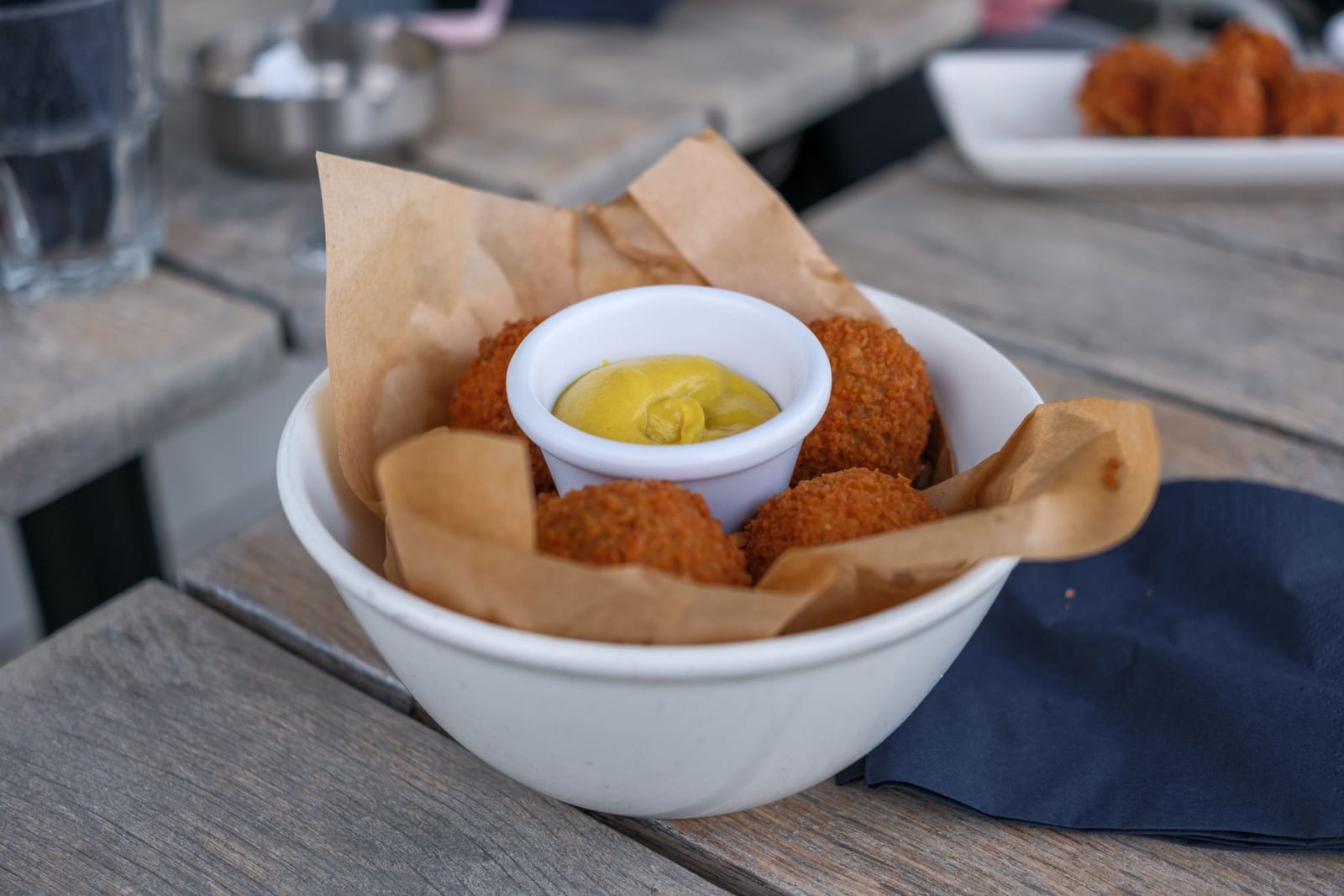
Bitterballen are deep-fried, breadcrumbed balls of a thick beef ragout, served with mustard for dipping, and they are the default order with a beer in any Amsterdam brown café, the small, wood-panelled pubs that give the genre its name.
Café Chris on Bloemstraat 42, in the Jordaan, has operated since the 17th century and is often named the city's oldest brown café; a portion of six bitterballen typically costs €8 to €9. The scalding-hot centre is the main hazard, so order a round and let them cool for a minute.
Patatje oorlog at Vlaams Friteshuis Vleminckx
Dutch fries are double-fried and served in a paper cone, and the local variation, patatje oorlog, or "fries at war," adds peanut satay sauce, mayonnaise and chopped raw onion on top.
Vlaams Friteshuis Vleminckx, at Voetboogstraat 33 near the Spui, has sold fries from the same small shopfront for generations, with queues most afternoons. A medium cone runs roughly €4 to €6 depending on toppings, cash preferred.
Kroket from a FEBO wall
The kroket is a breadcrumbed, deep-fried roll of ragout, and Amsterdam's most famous way to eat one is still from a FEBO automat, the coin- or card-operated wall of small glass doors that has stood in for late-night takeaway here since the 1960s.
FEBO has branches across the centre, including a well-known one on Leidseplein; a kroket costs around €2.50 to €3 and arrives hot enough to burn the roof of your mouth if you bite too soon.
Appeltaart at Winkel 43
Dutch apple pie is dense, heavily spiced with cinnamon, and served warm with whipped cream, closer to a cake than the thin, flaky pastry the name might suggest elsewhere.
Winkel 43, on the Noordermarkt square in the Jordaan, is widely cited as the city's best version; a slice costs around €5 to €7. There are no reservations, so arrive on a weekday morning to avoid the queue that forms by early afternoon.
Rijsttafel at Kantjil & de Tijger
Rijsttafel, or "rice table," is a spread of small Indonesian dishes built for sharing, a legacy of Dutch colonial trade with Indonesia that has become one of Amsterdam's most distinctive restaurant formats, built around rice, satay, rendang and sambal.
Kantjil & de Tijger, on Spuistraat in the city centre, lets tables assemble their own rijsttafel rather than serving one fixed set menu; a shared spread typically runs €35 to €45 per person.
Stroopwafel at Albert Cuyp Market
A stroopwafel is two thin waffles pressed around a caramel syrup filling, and the market version, made to order and handed over warm, is a different food from the packaged ones sold at the airport.
Rudi's Original Stroopwafels, inside Albert Cuyp Market in De Pijp, presses them fresh in front of customers for around €3 to €4 each; the market runs Monday to Saturday and is closed on Sundays.
Dutch cheese at De Kaaskamer
Aged Gouda and Old Amsterdam-style cheeses are a daily staple rather than a tourist prop, sold by weight and tasted before buying at the city's specialist cheese shops.
De Kaaskamer, on Runstraat in the Nine Streets shopping area, stocks more than 350 Dutch and European cheeses and will cut tasting pieces on request; a wedge to take away runs from around €6 depending on weight and age. See Amuse's guide to how to read a Gouda label before you buy.
Jenever at Wynand Fockink
Jenever, the juniper-flavoured spirit that predates gin, is drunk standing up, in small glasses filled to the brim, at tasting houses rather than cocktail bars.
Wynand Fockink, tucked down the Pijlsteeg alley off Damrak, has poured jenever since the 17th century; a glass costs around €3 to €4, and staff will talk newcomers through the house range of oude and jonge styles.
Kibbeling at a market fish stall
Kibbeling is bite-sized battered and fried white fish, usually cod, served with a garlic or tartar-style sauce, and it is Amsterdam's answer to fish and chips, sold from fish stalls rather than restaurants.
A portion at the fish stalls inside Albert Cuyp Market runs around €7 to €9 and is best eaten standing, straight from the paper tray, while it is still hot.
A full food hall at De Foodhallen
For a single stop covering several of these dishes at once, De Foodhallen, inside the former tram depot De Hallen in Oud-West, groups around 20 stalls under one roof, from fries and bitterballen to Indonesian and Surinamese cooking.
It gets busy on weekend evenings; a weekday lunch is the easier time to get a table in the shared seating area. For a sit-down option nearby, Élan Amsterdam, the Roux team's restaurant in the old Maris Piper space, opened this year a short tram ride from Oud-West.
Markets, neighbourhoods and when to go
Most of what to eat in Amsterdam clusters in a few walkable areas rather than spreading thinly across the city.
- Albert Cuyp Market, De Pijp: Monday to Saturday, 09:30–17:00, closed Sunday; stroopwafels, kibbeling and produce stalls side by side.
- Jordaan: narrow canal streets with the highest concentration of brown cafés and Winkel 43's apple pie queue.
- Noordermarkt, Jordaan: Monday morning flea market and Saturday organic farmers' market.
- Nine Streets (De 9 Straatjes): the shopping grid between Keizersgracht and Prinsengracht, home to De Kaaskamer.
- De Hallen, Oud-West: De Foodhallen food court inside a converted tram depot.
Amsterdam food questions, answered
Is Amsterdam expensive to eat in? Street food and market snacks mostly run €2 to €9, which keeps a day of grazing affordable even though the city's starred restaurants sit at the other end of the price scale.
Is raw herring actually raw? It is lightly salt-cured rather than cooked, which is why it is served chilled with onion and pickles rather than as sashimi-style raw fish.
Do I need a reservation for rijsttafel? Booking ahead is sensible at Kantjil & de Tijger on weekend evenings, though walk-ins are often possible earlier in the week.
Is Amsterdam cuisine only Dutch? No: Indonesian and Surinamese cooking, legacies of Dutch colonial history, are as embedded in the city's everyday eating as bitterballen and herring.
Where to book first
Kantjil & de Tijger, Spuistraat 291-293, for rijsttafel on a weekend evening. Winkel 43, Noordermarkt 43, for apple pie before the queue builds. Café Chris, Bloemstraat 42, for bitterballen in the oldest brown café in the Jordaan.