What to eat in Chennai: 8 dishes and where to find them
From dawn idlis to midnight Mysore pak, Tamil Nadu's capital serves its best food in tiffin rooms, Chettinad kitchens and one restaurant where you pay what you feel.
What to eat in Chennai starts before sunrise, at a tiffin room serving idli and filter coffee, and ends after dark with a slab of Mysore pak from a sweet shop that has been making it the same way since 1982.
Chennai eats on a different clock from the rest of India. Breakfast is a full meal, lunch is a banana-leaf thali, and dinner can mean kothu parotta scraped off a hot griddle at midnight. Tamil Nadu's capital rarely gets credited as a food city the way Mumbai or Delhi do, but its cooking runs deep: a vegetarian tradition built on rice and lentils, a Chettinad repertoire of fiery non-vegetarian curries from the merchant families of the Karaikudi region, and a Tamil Muslim biryani culture centred on Triplicane and Anna Salai. It is a tradition that sits at the southern end of a vast Indian spice map, one that runs north all the way to Kashmir's saffron terraces.
The city's food culture made headlines of its own this month: Chef Damu, the Padma Shri-winning Tamil cooking educator and television judge, died in Chennai on 25 October at 72. It is a reminder of how much weight home-style Tamil cooking carries here, even as biryani and Chettinad kitchens get the louder reputation. What to eat in Chennai, in practice, means moving between these worlds in a single day.
Chennai eats breakfast like a meal, lunch like a ritual, and dinner like an afterthought scraped hot off a griddle.
What to eat in Chennai: idli, ghee roast and filter coffee
The Chennai breakfast is built around tiffin: idli (steamed rice-and-lentil cakes), vada, and dosa, eaten with sambar, coconut chutney and a stainless-steel tumbler of filter coffee. Murugan Idli Shop, a chain with branches across the city including one on G.N. Chetty Road in T. Nagar, is the version most visitors reach first, and it still runs on the same ghee-heavy formula that made it a local institution. A meal runs roughly ₹200 to ₹400 a person.
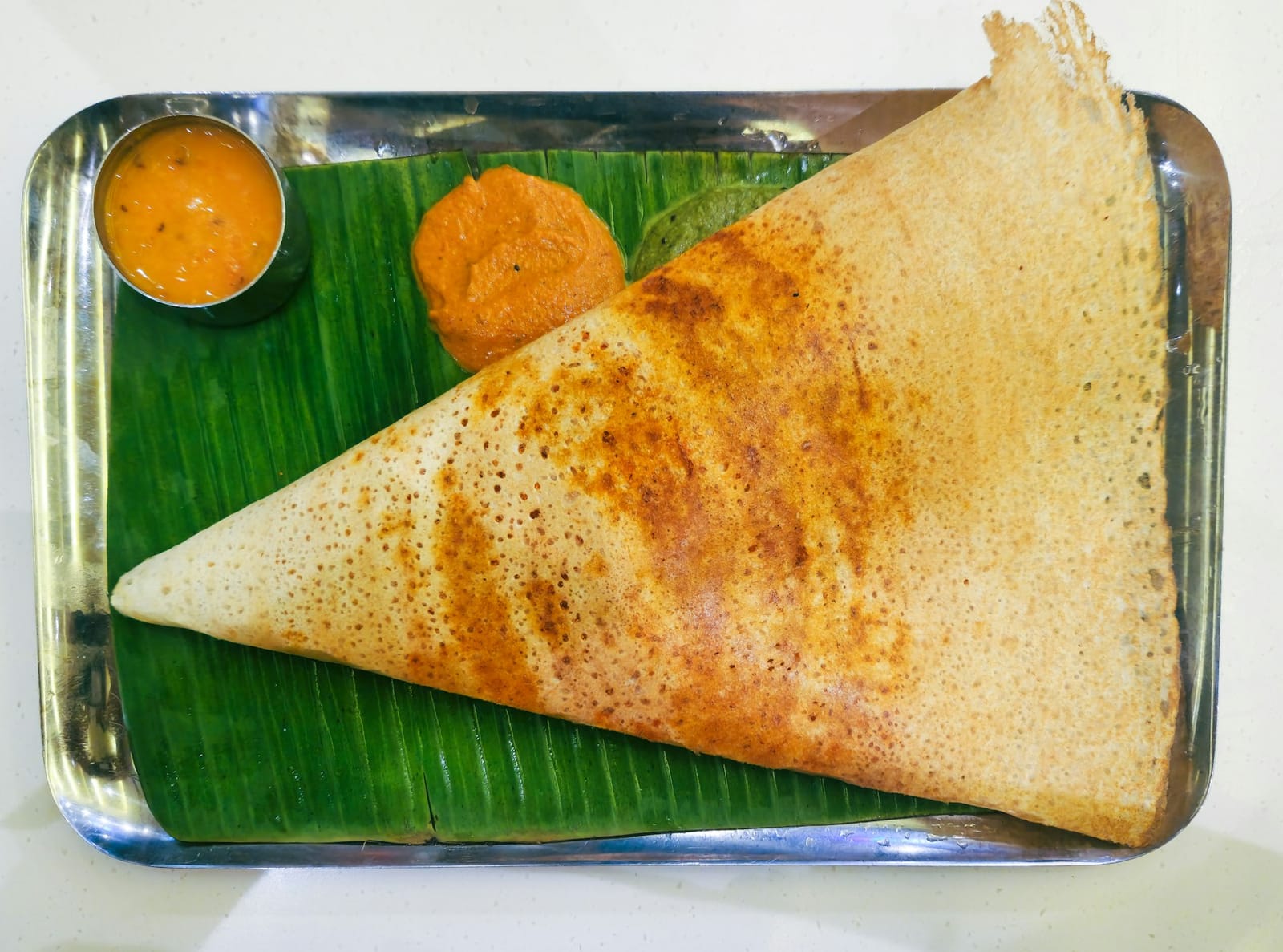
Order the ghee roast — a dosa cooked until the edges crisp and blister — alongside podi idli, idli tossed in dry chutney powder and more ghee. The filter coffee, brewed through a two-chamber metal filter and served half milk, half decoction, is not optional.
Chettinad chicken and fish curry in Mylapore
Chettinad cooking comes from the Nattukottai Chettiar merchant families around Karaikudi, a few hours south-west of Chennai, and it is built on roasted, ground spice blends rather than wet masalas. Kaaraikudi Chettinad Restaurant, with a branch on Dr Radha Krishnan Salai in Mylapore, serves the city version: chicken curry dark with pepper and fennel, and fish curry sharpened with tamarind.
The cuisine's wider repertoire runs to small game and offal, but chicken and fish curries are the entry point for most eaters, usually ordered with rice or parotta rather than the tiffin breads of the morning.
Kothu parotta after dark
Parotta — a layered, flaky flatbread related to Malaysia's roti canai — becomes kothu parotta once it is chopped on a hot griddle with egg, vegetables, meat and a ladle of spiced gravy called salna. It is street and roadside food, eaten late, and the Alwarpet branch of Dindigul Thalappakatti does a reliable version in chicken, mutton, egg and vegetable styles.
The dish is loud by design: the chopping is done with two flat blades, audibly, on a steel plate, and the result should come out slightly charred in places. Order it with extra salna on the side.
Biryani and Chicken 65 on Anna Salai
Chennai's biryani is lighter and less layered than Hyderabad's, built on short-grain seeraga samba rice and cooked closer to a pilaf. Buhari, which opened on what is now Anna Salai in 1951 as one of the first restaurants in the newly independent city, is widely credited, though not definitively documented, as the birthplace of Chicken 65, the bright-red, deep-fried chicken starter now served across India. Its biryani still arrives with a boiled egg on top, a house signature for more than half a century.
Triplicane, the neighbourhood behind Anna Salai, is the city's biryani engine: hundreds of small kitchens cook for weddings and functions as well as walk-in trade. For a different regional take on rice, lentils and slow spicing, see our lamb dhansak recipe, the Parsi dish from India's other coast.
Kuzhi paniyaram on the street
Kuzhi paniyaram — the same fermented rice-and-lentil batter used for idli and dosa, cooked into small dumplings in a cast-iron mould with cavities — is an evening snack rather than a meal. Tiffin rooms serve it alongside the usual breakfast items, and street carts around Mylapore sell it crisp-edged and soft inside, plain or studded with onion and chilli.
A fine-dining South Indian tasting at Southern Spice
For a formal version of the same repertoire, Southern Spice at the Taj Coromandel in Nungambakkam plates South Indian cooking from across four states as a sit-down tasting menu, in a dining room rather than a canteen. A meal runs around ₹3,000 for two, smart-casual dress included.
It is the place to taste a Chettinad or Andhra-style dish without hunting down the specific kitchen that makes it, and a useful contrast to the tiffin-room version eaten an hour earlier.
A pay-as-you-wish thali at Annalakshmi
Annalakshmi, a vegetarian restaurant run by volunteers under the Shivanjali Trust, has operated in Chennai since 1986 on a pay-what-you-feel model: diners eat a full vegetarian thali and leave whatever they consider fair, with proceeds going toward the trust's charitable work. The concept began in Kuala Lumpur in 1984 and has since spread to several cities, but Chennai's branch — winner of a 2013 Times Food and Nightlife Award for the city's best stand-alone South Indian restaurant — is one of its longest-running.
The food is traditional Tamil vegetarian cooking: rice, sambar, rasam, kootu and a rotating set of vegetable dishes, served on a banana leaf or thali plate.
Mysore pak and sweets in Adyar
Grand Sweets & Snacks opened in Adyar in 1982 with three items — mysore pak, laddoo and mixture — and the name itself is local legend: a customer once told the owner his sweets were "grand," and it stuck. The mysore pak, a dense, ghee-soaked gram-flour fudge, remains one of the shop's draws, alongside badam halwa and a long counter of savoury mixtures to take away.
Mysore pak is not actually from Mysore by most Chennai accounts — the name is contested — but the city's version, thick with ghee and sugar syrup, is distinct enough to be its own thing.
Markets, neighbourhoods and when to go
Mylapore is the city's temple-town food district, dense with tiffin rooms and sweet shops around the Kapaleeshwarar Temple. T. Nagar is Chennai's shopping and eating engine, loud and commercial. Triplicane and Anna Salai hold the biryani and Tamil Muslim food culture. Adyar and Nungambakkam carry the sweet shops and the hotel dining rooms.
- Kasimedu, in Royapuram, is Chennai's largest fishing harbour and the source of most of the city's fresh fish and prawns.
- Mylapore's tiffin rooms and street stalls run from early-morning breakfast service through to late-evening snacks.
- T. Nagar's Panagal Park area is dense with budget tiffin rooms open from around 7am.
Chennai is hot and humid for most of the year; December to February is the most comfortable stretch for eating outdoors and walking between neighbourhoods, with daytime temperatures easing to around 20–25°C, though December can bring rain from the retreating monsoon.
Chennai food FAQ
Is Chennai expensive to eat in? No. A tiffin-room breakfast costs roughly ₹200 to ₹400 a person, and even a sit-down lunch rarely passes ₹1,000. Hotel fine dining, such as Southern Spice, runs closer to ₹3,000 for two.
Is Chennai food very spicy? Chettinad cooking is genuinely hot, built on roasted chilli and pepper; tiffin food is milder, and most restaurants will tone a dish down on request.
Is Chennai mostly vegetarian? Everyday tiffin and thali culture is vegetarian by default, but the city has strong non-vegetarian traditions in Chettinad cooking and Tamil Muslim biryani.
What should I drink with the food? Filter coffee, always, and rasam or buttermilk with lunch rather than anything carbonated.
Where to book first
Start with Murugan Idli Shop, G.N. Chetty Road, T. Nagar, for breakfast. For dinner, book Southern Spice at the Taj Coromandel, 37 Mahatma Gandhi Road, Nungambakkam. And set aside one evening for Buhari, 83 Anna Salai, Triplicane, for biryani and Chicken 65 under neon rather than chandeliers.