Crema catalana recipe: Can Marc's cinnamon and lemon custard
Milk instead of cream, cinnamon and lemon instead of vanilla, sugar burnt at the last minute: the Catalan custard step by step, with the one warning its cook gives.
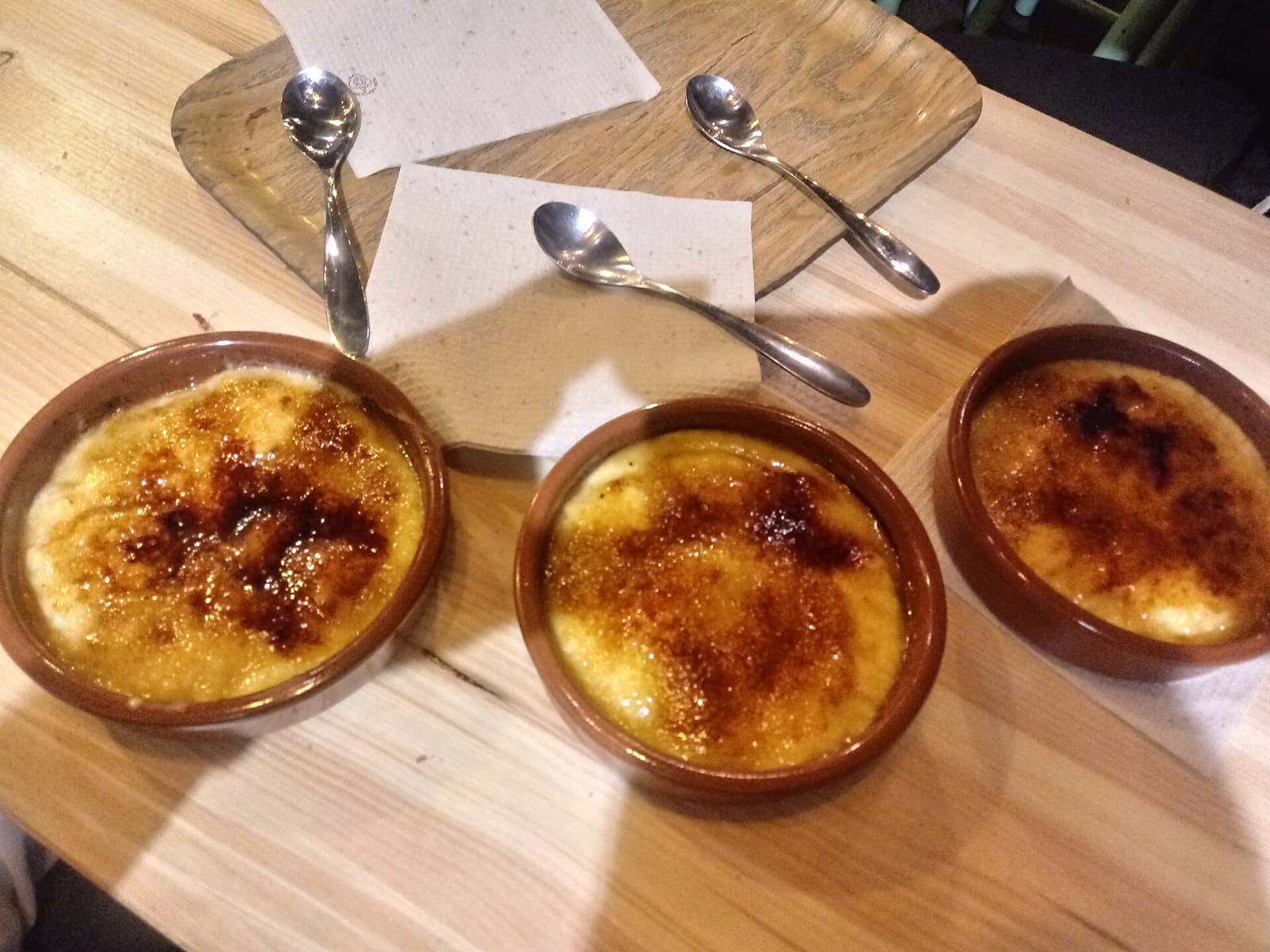
This crema catalana recipe keeps the rule that separates it from crème brûlée: milk rather than cream, perfumed with cinnamon and lemon peel, thickened on the stove with a little starch and burnt only at the last minute. It is Amuse Kitchen's rewrite of the traditional version that Oriol Sabé, cook at Can Marc in Sant Esteve de Palautordera, laid out for the Catalan daily Ara.
Unburnt precursors already appear in the 14th-century Llibre de Sent Soví, and the name crema catalana reached print in 1745 in a cookbook by the Aragonese friar Juan de Altamiras. Long the dessert of Saint Joseph's Day, 19 March, it now ends meals at most of the tables in our guide to what to eat in Barcelona.
Sabé's one warning concerns the cinnamon: a cheap stick can split in the hot milk, so buy a good one.
Milk, cinnamon, lemon and a crust burnt at the last minute: that is the whole rule.
Ingredients
- 750 ml whole milk
- 1 good-quality cinnamon stick
- Peel of 1 unwaxed lemon, without the white pith
- 6 egg yolks
- 110 g caster sugar
- 35 g cornflour
- 6 tbsp caster sugar for the crust
Method
- Heat the milk with the cinnamon and lemon peel until the first bubbles appear at the edge, then take it off the heat, cover and leave for 20 minutes; steeping off the heat draws out the flavour without reducing the milk.
- Lift out the cinnamon and peel. Whisk 100 ml of the milk with the cornflour until smooth, so the starch disperses without lumps.
- Beat the yolks with the sugar until pale, then whisk in the cornflour mixture.
- Pour the rest of the warm milk over the yolks in a thin stream, whisking all the time; tempering raises their temperature gradually so they do not curdle.
- Return everything to the pan over low heat and stir with a spatula for 6 to 8 minutes, scraping the bottom, until the cream coats the spatula and no longer runs off in a stream. Do not let it boil.
- Pour into six shallow terracotta dishes, let it cool, cover and chill for at least 3 hours.
- Just before serving, scatter a tablespoon of sugar over each dish and caramelise it with a blowtorch or a red-hot iron until amber. Serve within a few minutes, while the crust still cracks.
The iron, the orange and what to pour
The traditional tool is a round iron heated over the flame and pressed onto the sugar; a blowtorch does the same job faster. Orange peel can replace the lemon, as some Catalan households prefer, but vanilla belongs to natillas, not to this dessert. A glass of sweet moscatell from the Empordà stands up to the caramel.
Questions about this crema catalana recipe
What is the difference between crema catalana and crème brûlée? Crème brûlée is usually made with cream and vanilla and baked in a water bath; crema catalana uses milk, cinnamon and lemon and is thickened on the hob with starch.
Can I make it ahead? Yes. The cream keeps for two days in the fridge, covered; caramelise it only when you serve it, because the crust softens on cold cream within half an hour.
Can I make it without a blowtorch? Put the sugared dishes under a very hot grill, close to the element, for one or two minutes; the cream warms slightly, but the crust forms.