Pastel de nata recipe: Lisbon's custard tarts at home
Twelve blistered Portuguese custard tarts from a rolled puff pastry shell, a custard sweetened with 106-108 °C syrup and the hottest oven you have.
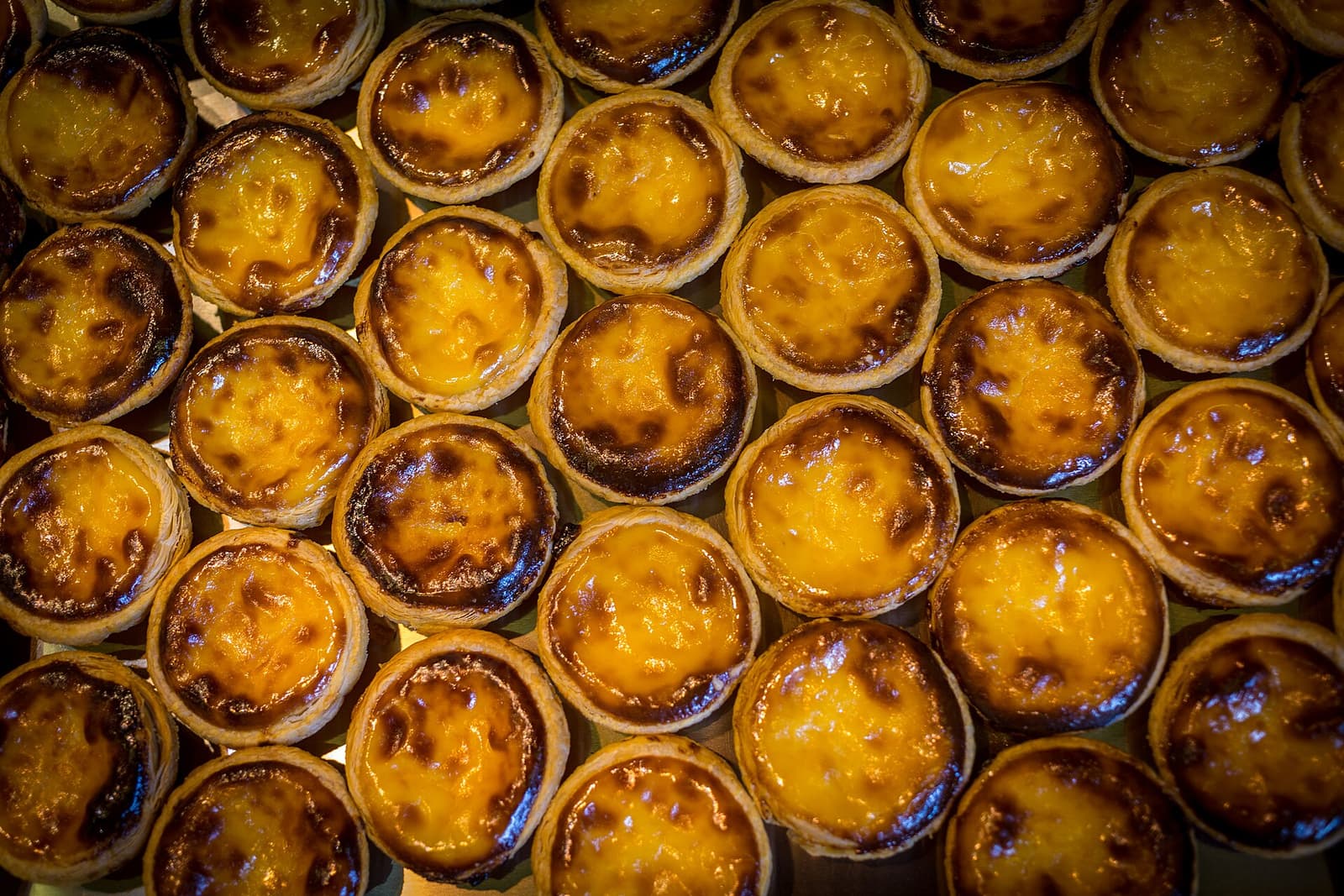
This pastel de nata recipe rebuilds Lisbon's blistered custard tart at home: a flaky shell made from a rolled and sliced puff pastry log, a custard sweetened with syrup, and an oven set as hot as it will go.
The tart took its modern form in Belém, where the Pastéis de Belém bakery has sold it since 1837, after monks from the nearby Mosteiro dos Jerónimos, closed in 1834, passed on their recipe. The bakery still guards its version as a secret. This one follows the method Lisbon-born chef Nuno Mendes published in Country and Town House (puff pastry rolled into a log, sugar syrup, custard poured into very hot tins), with our own quantities and steps, scaled to a standard 12-hole muffin tin.
Three things decide the result: a thin shell with visible layers, a custard thick enough to set without turning eggy, and enough heat to scorch the top before the middle overcooks. Everything below serves one of those three.
The blistered top is not decoration: it is what a very hot oven does to sugar and egg.
Ingredients
- 640 g cold all-butter puff pastry (two 320 g sheets)
- 20 g melted butter, for the tin
- 500 ml whole milk
- 40 g plain flour
- 1 cinnamon stick
- 2 long strips of lemon zest
- 220 g caster sugar
- 120 ml water
- 6 egg yolks
- Ground cinnamon and icing sugar, to finish
Method
- Brush a 12-hole muffin tin with the melted butter and chill it. Roll each pastry sheet tightly from its long edge into a log and chill for 20 minutes, so the spiral of dough and butter firms up and cuts cleanly.
- Slice each log into six discs about 1.5 cm thick. Place them cut side up in the tin, wet your thumb and press from the centre outwards until the shell is thin and stands slightly above the rim. Chill again for 15 minutes, which stops it shrinking in the oven.
- Heat 400 ml of the milk with the cinnamon stick and lemon zest until it steams, then take it off the heat and steep for 10 minutes. This flavours the custard without dairy skin or scorching.
- Whisk the flour with the remaining 100 ml cold milk until smooth. Strain the warm milk onto it, whisking, return to the pan and cook over low heat for 3 to 4 minutes until it thickens to the texture of double cream. The cooked flour gives the custard body, so it sets soft instead of scrambling.
- Dissolve the sugar in the water over medium heat, then boil without stirring until a thermometer reads 106-108 °C, about 5 minutes. Pour it in a thin stream into the thick milk, whisking. Let the mixture cool to lukewarm, whisk in the yolks and strain; hot custard would cook the yolks on contact.
- Put a baking tray on the top shelf and heat the oven to its maximum, 250-290 °C, for at least 20 minutes. Fill each shell to about 3 mm below the rim and bake on the hot tray for 10 to 13 minutes, until the custard is blistered with dark spots and the pastry is deep gold. Cool in the tin for 5 minutes, then dust with cinnamon and icing sugar.
Tips for a better pastel de nata recipe
The dark blisters are the point, not a mistake: they are sugar and egg caramelising in a few minutes of fierce heat. If your oven stops at 220 °C, bake on the lowest-but-one shelf on a preheated tray and add two or three minutes, and expect paler spots. Serve warm, within an hour of baking, with a bica (the short Lisbon espresso) or a small glass of tawny port.
Once this pastel de nata recipe works, you may want to try the real thing: our guide to what to eat in Lisbon covers where the tarts fit among the city's other dishes.
Pastel de nata FAQ
Can I make it ahead? Partly. The shaped, unbaked shells keep in the freezer for a month and the custard keeps two days in the fridge, but fill and bake only at the last moment. Baked tarts are best the same day and can be refreshed for 5 minutes at 180 °C.
Can I use shop-bought puff pastry? Yes, as long as it is all-butter. Oil-based pastry does not give the fine, crisp layers, and it browns unevenly at these temperatures.
Is it the same as a pastel de Belém? Not quite. Pastel de nata is the general name; Pastéis de Belém is the bakery's protected brand and recipe. Homemade versions, including this pastel de nata recipe, are close relatives rather than copies.