What to eat in Marrakech: 10 dishes and where to find them
The tanjia goes to the hammam furnace, the lamb comes out of a pit at noon and the square starts cooking at dusk. Ten dishes, ten addresses and what they cost in dirhams.
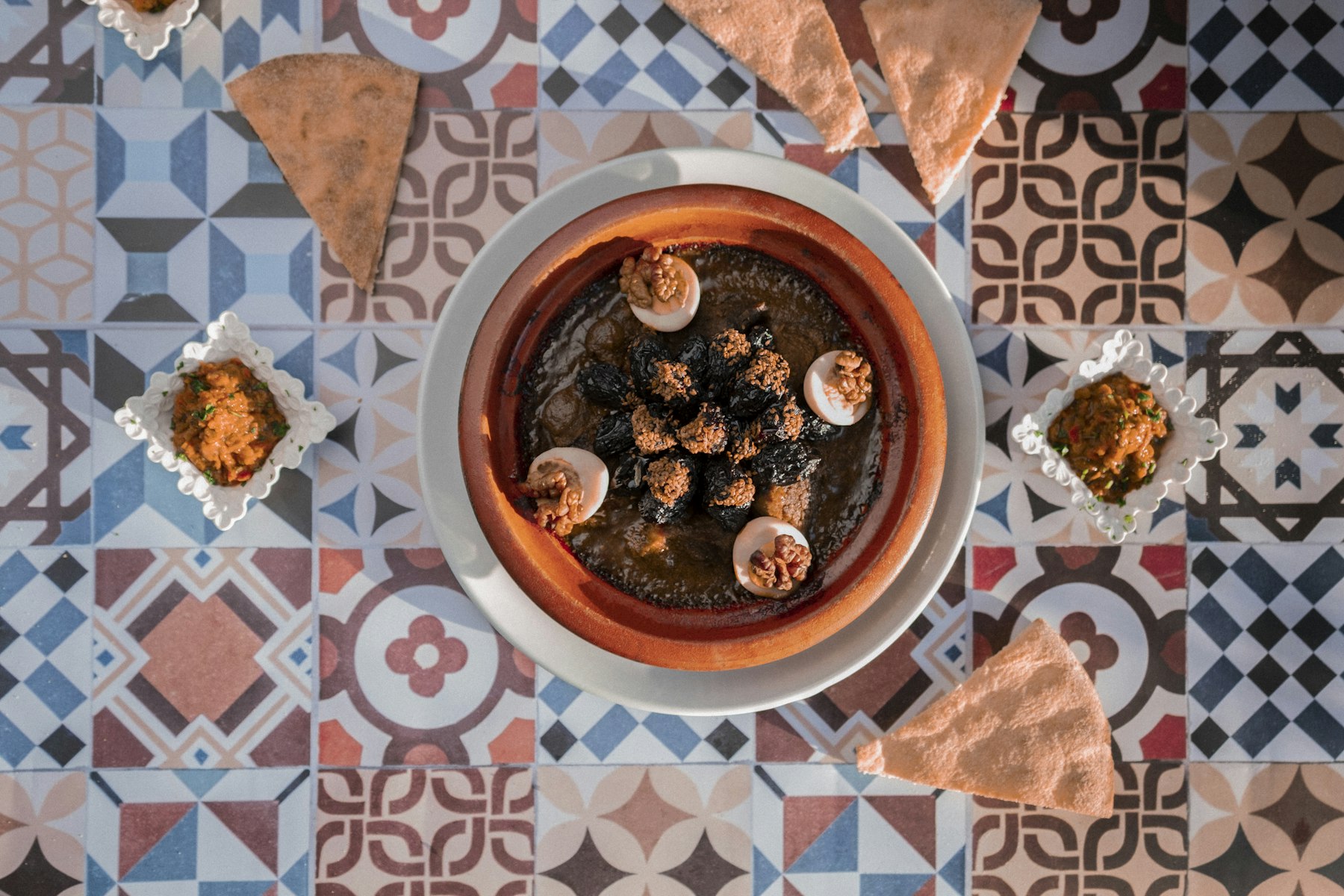
What to eat in Marrakech begins with one pot: the tanjia, a clay urn of beef or lamb that the cook seals with paper and string and sends to the furnace under the neighbourhood hammam, where it sits in the ashes for six to eight hours. Around that pot is a city that grills, steams and fries in the open, from Mechoui Alley at noon to the Jemaa el-Fna stalls after dark.
Marrakech cooks between the Atlas and the Haouz plain, and the pantry shows it: saffron from Taliouine, argan and almonds from the Souss, dates from the Drâa valley, preserved lemons, and olives and oil pressed from groves that ring the city.
There is no Michelin selection in Morocco, so the ranking that counts is MENA's 50 Best Restaurants, announced in Abu Dhabi on 5 February 2026. Five Marrakech kitchens made the list: La Grande Table Marocaine at the Royal Mansour at No. 19, which also took the Art of Hospitality Award, then Le Petit Cornichon at No. 21, Sesamo at No. 24, +61 at No. 31 and Farmers at No. 49. Everything below is priced in dirhams, the only currency worth carrying in the medina.
Marrakech cooks in public: the hammam furnace, the charcoal pit, the square at dusk.
Tanjia marrakchia at Le Tanjia, Mellah
Tanjia belongs to Marrakech and to nowhere else. Shin or shoulder goes into a two-handled amphora with preserved lemon, cumin, saffron, garlic and smen, the aged butter that gives the sauce its farmyard depth. The pot then goes to the farnatchi, the man who feeds the hammam boiler, rather than to any kitchen.
Le Tanjia, in the Mellah, builds its menu around the dish and serves the meat sliding off the bone in its own reduced fat. À la carte mains start around 150 MAD, with a mechoui menu for two at 480 MAD and a tasting menu for two at 590 MAD.
Mechoui lamb in Mechoui Alley, off Derb Semmarine
Mechoui is whole lamb, salted and buttered, lowered into a clay pit and cooked in residual heat until the fat renders into the meat. Mechoui Alley is a short lane of pit ovens near the north end of Jemaa el-Fna, off Derb Semmarine, and it is the cheapest serious meal in the city.
Buy by weight from one of the stalls in the middle of the lane rather than the famous names at either end: the rate runs around 260 MAD a kilo, so half a kilo with bread, cumin and salt feeds two for roughly 130 MAD. Go between 11am and 2pm: when the pit is empty it is empty, and most stalls do not open on Fridays.
Harira and brochettes at the Jemaa el-Fna stalls
At dusk the square fills with numbered stalls and a haze of charcoal smoke. Harira — tomato, lentil and chickpea soup thickened with flour and finished with coriander and a squeeze of lemon — costs 10 to 15 MAD a bowl and is what Marrakchis actually eat there, usually with dates or a sticky chebakia. Alongside it: kefta and merguez brochettes off the grill, and babbouche snails in peppery broth by the small bowl.
The rule is the same as in any great street-food city: eat where the queue is local, look at the grill before you sit, and agree the price before the plate lands.
Pastilla at Al Fassia, Guéliz
Al Fassia, at 55 Boulevard Mohammed Zerktouni in Guéliz, has been open since 1987 and is run and staffed entirely by women. It cooks Fassi food, the refined register of Fez, rather than Marrakchi home cooking.
The pastilla is the reason to come: shredded pigeon, almonds, cinnamon and softly set egg folded into warqa pastry and dusted with icing sugar, sweet and savoury in the same mouthful. Mains run about 170 to 190 MAD. The lamb shoulder mechoui needs 24 hours' notice.
Friday couscous at Le Trou au Mur, Derb el Farnatchi
Couscous in Morocco is a Friday dish, steamed three times over the broth until the grain is loose and buttery, and it is served at home more often than in restaurants. Ordering it on a Tuesday usually gets you something that was steamed once.
Le Trou au Mur, at 39 Derb el Farnatchi near the Ben Youssef madrasa, runs a rotating weekly menu of house recipes that rarely reach dining rooms: tihane, the stuffed spleen, m'rouzia with raisins and honey, tride, clay-oven mechoui, and a couscous and tagine of the day. The lanes are too narrow for a taxi, so the last stretch is on foot.
Modern tagine at Nomad, Rahba Lakdima
Nomad took over a carpet shop at 1 Derb Aarjane on the spice square in 2014 and stacked four floors of dining rooms and terraces above it, looking over Rahba Lakdima towards the Atlas.
The kitchen cooks modern Moroccan without turning it into a theme: cauliflower salad, chermoula-marinated fish, tagines lightened with less sugar and more acid, and homemade ice creams. It fills early, so book or arrive at opening.
M'semen and a garden lunch at La Famille, Riad Zitoun Jdid
M'semen is the square laminated flatbread, folded with semolina and fried on a flat pan, eaten at breakfast with honey and amlou, the argan-and-almond paste from the Souss.
La Famille, at 42 Riad Zitoun Jdid near the Bahia Palace, serves it and little else you can predict: the menu is meat-free, changes daily and runs to salads, homemade pasta and fruit tarts under the trees. Lunch only, midday to 4pm, closed Sundays, and small enough that a reservation is not optional.
Camel burger at Café Clock, Kasbah
The camel burger sounds like a tourist joke and is not one: the meat is lean, dense and closer to beef shin than to anything exotic. Café Clock, at 224 Derb Chtouka in the Kasbah, sells it for 95 MAD and has been doing so long enough for the kitchen to have worked out the fat ratio.
The cafe is open from 9am to 11pm and doubles as a cultural venue: storytelling nights in English and Darija, calligraphy classes and cooking workshops.
Nos-nos and coffee at Bacha Coffee, Dar el Bacha
Nos-nos means “half-half”: espresso and foamed milk in a small glass, the everyday coffee of every Moroccan cafe from Guéliz to the Kasbah, and it costs 12 to 20 MAD in an ordinary one.
Bacha Coffee, inside the restored Dar el Bacha palace on Rue Fatima Zahra, is the opposite end of that scale: a coffee room with a global arabica list, opening at 10am, where breakfast lands around 300 MAD. Go for the room and the pour, not for the bill.
Seasonal cooking at Le Petit Cornichon, Guéliz
Le Petit Cornichon, No. 21 on MENA's 50 Best Restaurants 2026, is the best argument that Marrakech has a restaurant scene and not only a food culture. Chef-owner Erwann Lance cooks Moroccan produce through a French bistronomy lens: celeriac and pear carpaccio with gorgonzola, sea bass with potato consommé and miso clams, and a cellar of more than 300 wines that includes Morocco's own.
For the Australian-Moroccan version of the same idea, +61 at 96 Rue Mohammed el Beqal sits at No. 31 on the same list. Both are in Guéliz, both take reservations, and both serve alcohol, which most medina addresses do not.
Markets, neighbourhoods and when to go
- Rahba Lakdima (Spice Square): spices, dried herbs and apothecary stalls, open all day.
- Marché Central, Guéliz: the new town's produce, fish and cheese market, mornings, where restaurant kitchens shop.
- Mechoui Alley and Derb Dabachi: pit lamb at noon; sandwiches and briouats from 10 to 15 MAD in the afternoon.
- Jemaa el-Fna: orange juice all day, stalls from sunset until late; the rooftops have the view, not the food.
- Kasbah and Mellah: the quieter southern medina, tanjia, bakeries and the old Jewish quarter's spice shops.
- When: October to April. July and August run above 40°C and the pit ovens close early; Ramadan shifts every kitchen to after sunset.
What to eat in Marrakech: questions before you book
Is Marrakech expensive to eat in? It is two cities. A stall dinner on the square runs 60 to 100 MAD, a medina restaurant with a set menu 300 to 500 MAD, the MENA's 50 Best addresses more. Half a kilo of mechoui at 130 MAD stays the best value.
Can you drink wine with dinner? Often not in the medina. Guéliz restaurants and riads with a licence serve Moroccan wine from Meknès and Benslimane; medina addresses frequently do not, so ask when you book rather than when you sit down.
Is the street food safe? The stalls are inspected and turn over fast, which is the real safeguard. Eat what comes off the grill in front of you, skip anything lukewarm, and treat the square like any open-air food market.
One meal only — what is it? Tanjia. Nowhere else sends dinner to the public baths to cook.
Where to book first
Le Tanjia, Mellah — the city's own dish, done plainly, with a rooftop for afterwards.
Al Fassia, 55 Boulevard Mohammed Zerktouni, Guéliz — pastilla and the mechoui that needs a day's notice.
Le Petit Cornichon, Guéliz — No. 21 in the region, and the only one of the three where the wine list matters.