What to eat in Paris: 10 dishes and where to find them
A prize-winning baguette in the 14th, onion soup at 3am in Les Halles, steak au poivre in the 11th and a dozen oysters in Saint-Germain: ten dishes, ten addresses and what they cost.
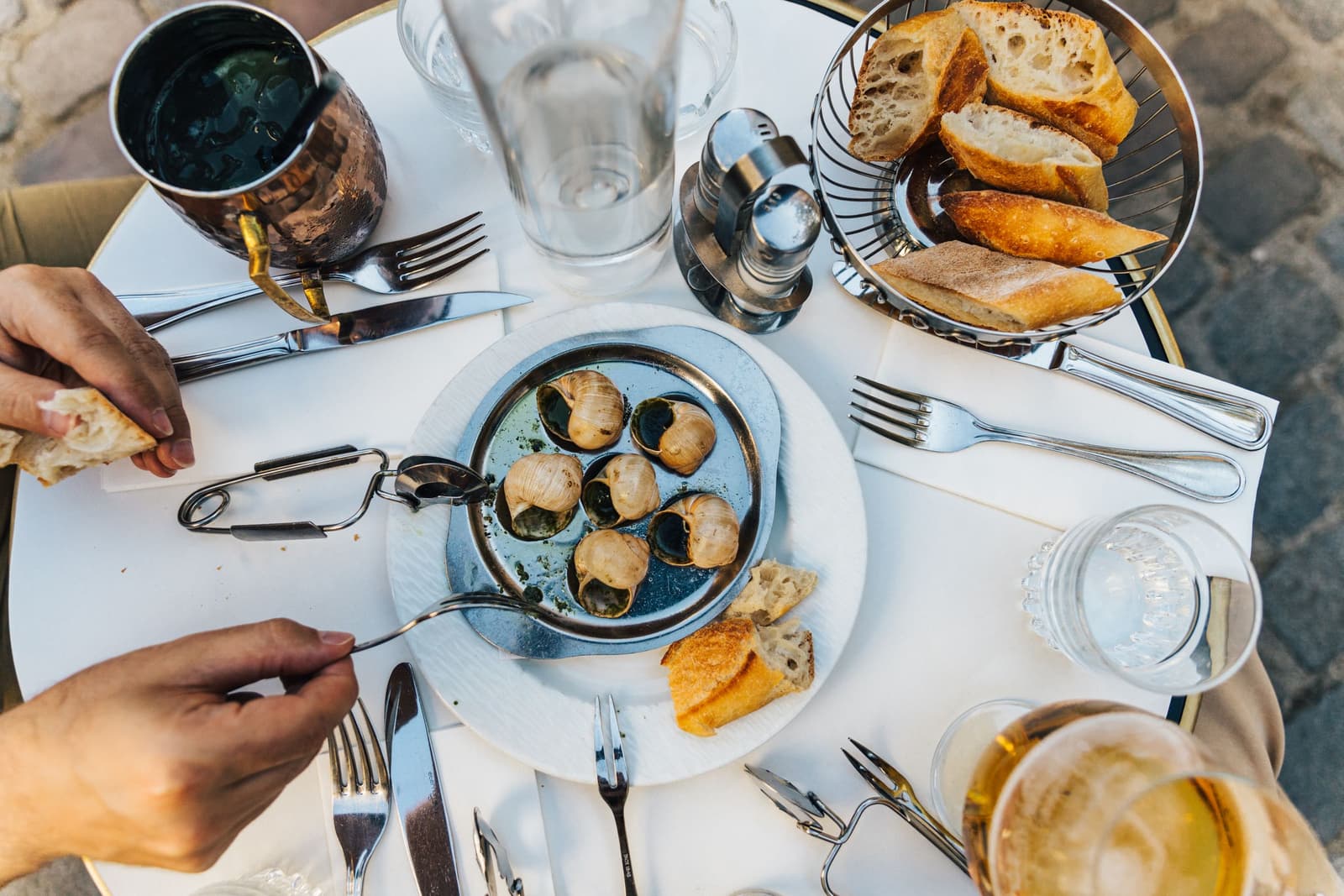
What to eat in Paris starts with bread and ends at a bistro counter: a baguette de tradition from the baker who won the city's 2026 prize, then onion soup, steak au poivre, confit de canard and oysters in rooms that have served them for decades. The dishes below cost between €2 and €70 a head, and none requires a tasting menu.
The city's reputation rests on its three-star dining rooms, but they are changing fast: Bruno Verjus announced this month that Table will close on 22 December. What Parisians eat every day has changed far less. It is built on bakeries, on bistros with chalkboard menus, on the bouillons that fed workers in the 19th century and on produce from the covered markets.
This guide follows that everyday city, arrondissement by arrondissement. Prices come from the restaurants' own menus or recent published figures; many bistros close on Sunday, Monday or for part of August, so check before you cross town.
Paris is not a tasting menu. It is a baguette, a bistro and a market, every day.
Baguette de tradition at Fournil Didot, 14th
On 26 February 2026 the City of Paris gave its Grand Prix de la baguette to Sithamparappillai Jegatheepan of Fournil Didot, at 103 rue Didot, chosen from 143 entries. The prize is €4,000 and a year supplying bread to the Élysée Palace.
Jegatheepan arrived in France from Sri Lanka in 2003, worked in restaurants, trained in pastry and moved to bread in 2018. A tradition baguette, made only with flour, water, salt and yeast or leaven, costs under €2 here as in most Paris bakeries. Pair it with a croissant and you will understand why the lamination technique behind a croissant is a matter of civic pride.
Soupe à l'oignon gratinée at Au Pied de Cochon, Les Halles
Onion soup belongs to Les Halles, the wholesale market that fed Paris until 1969, where porters and night owls ate it before dawn. Au Pied de Cochon, at 6 rue Coquillière, opened in 1946 and still keeps market hours: from 8am to 5am, every day.
The soupe à l'oignon gratinée des Halles costs €11.50, the grilled pig's trotter with béarnaise €25.50, and a two-course menu €19.90. To make the dish at home, follow our French onion soup recipe and give the onions the full hour they need.
Œuf mayonnaise at Bouillon Chartier, Grands Boulevards
Bouillons were cheap canteens for workers, and Chartier, at 7 rue du Faubourg-Montmartre, has served under the same brass and mirrors since 1896. The queue on the pavement is part of the ritual.
The house egg with warm potatoes, salad and homemade mayonnaise costs €5, and a full meal of starter, main and dessert runs €15 to €25. Order leeks vinaigrette, a pot-au-feu or a sausage with lentils, and expect the waiter to write the bill on the paper tablecloth.
Steak au poivre at Bistrot Paul Bert, 11th
At 18 rue Paul Bert, this bistro has been a reference for more than 30 years, and the Michelin Guide lists it among its iconic addresses, in its moderate price band. The dish to order is the fillet with a pepper sauce built on cognac and cream.
It opens Tuesday to Saturday, for lunch and dinner, and takes bookings by phone only. The lunch menu is the cheapest way in; finish with the Paris-Brest if it is on the board.
Confit de canard at Joséphine Chez Dumonet, 6th
Duck legs cooked slowly in their own fat, then crisped in the pan, are south-western food that Paris adopted long ago. At Joséphine Chez Dumonet, 117 rue du Cherche-Midi, the house confit costs €29 and comes with potatoes fried in duck fat.
The room is a timber-and-mirror bistro that has changed little, and the portions of the classics, from boeuf bourguignon to the Grand Marnier soufflé, are sized for two.
Oysters at Huîtrerie Régis, Saint-Germain
From September to spring, Parisians eat oysters by the dozen with a glass of Muscadet or Chablis. Huîtrerie Régis, at 3 rue de Montfaucon, is a tiny white room that serves little else.
A dozen fines de claire costs €34, spéciales de claire €39 to €48 and flat Belon-aged oysters €69; the set of twelve oysters and a glass of white wine is €39.
Falafel at L'As du Fallafel, Le Marais
Rue des Rosiers is the heart of the Pletzl, the Marais's historic Jewish quarter, and L'As du Fallafel at No. 34 is its busiest counter. The pitta comes stuffed with falafel, fried aubergine, cabbage, hummus and tahini.
Expect to spend €10 to €20 a head. It is kosher, closes on Friday afternoon and all Saturday, and the takeaway window moves faster than the dining room.
Galette complète at Breizh Café, Le Marais
A galette is a Breton buckwheat pancake, and the complète, with ham, cheese and a runny egg, is its standard. Breizh Café has made them at 109 rue Vieille-du-Temple since 2010, with IGP buckwheat and Bordier butter.
Galettes run from about €6.50 to €16.50; drink cider from a bowl. It opens daily from 9am to 11pm and, unusually for the Marais, takes reservations.
Aged Comté at Fromagerie Laurent Dubois, Maubert
A cheese course is part of any serious Paris meal, and the best way to learn it is at a fromager affineur. Laurent Dubois won the Meilleur Ouvrier de France title as a cheesemonger in 2000 and ages cheese in the cellars under his shop on Place Maubert.
Ask for Comté aged beyond 24 months, a Pyrenean ewe's milk cheese and a small goat's cheese, and have them cut for a picnic on the quays of the Seine.
Mont-Blanc and hot chocolate at Angelina, Rivoli
Angelina, at 226 rue de Rivoli, opposite the Tuileries, is a belle époque tea room famous for two things: a thick hot chocolate and the Mont-Blanc, a meringue base under chestnut cream and vermicelli of chestnut purée.
Each costs around €10 in the tea room, and the queue is shortest mid-morning. If you prefer to bake it, our Mont Blanc recipe takes the chestnut dessert step by step.
Markets, neighbourhoods and when to go
- Marché des Enfants Rouges, 39 rue de Bretagne: the oldest covered market in Paris, founded in 1628, open Tuesday to Sunday, with lunch counters inside.
- Marché d'Aligre, 12th: open-air stalls and a covered hall, cheapest in the city, mornings from Tuesday to Sunday.
- Rue Montorgueil, 2nd: a pedestrian street of bakers, cheese shops and fishmongers near Les Halles.
- Marché Bastille: one of the largest street markets, on Thursday and Sunday mornings.
- When to go: September to June. Oysters and game are in season in autumn, and many independent bistros close for part of August.
Frequently asked questions
Is Paris expensive to eat in? It does not have to be. A tradition baguette costs under €2, a falafel €10 to €20 and a three-course bouillon meal €15 to €25; bistro mains start around €25, and lunch menus are the best value.
What is the most famous food in Paris? The baguette, the croissant and onion soup, followed by bistro classics such as steak frites, confit de canard and oysters. The answer to what to eat in Paris changes less by season than by neighbourhood.
Do I need to book restaurants in Paris? For bistros such as Paul Bert or Chez Dumonet, yes, often a week ahead and sometimes only by phone. Bouillons, falafel counters and most crêperies work on walk-ins.
When are Paris restaurants closed? Many independents close on Sunday and Monday and for two to three weeks in August; brasseries and bouillons open every day.
Where to book first
If you only book three tables, make them Bistrot Paul Bert, 18 rue Paul Bert (by phone, Tuesday to Saturday), Joséphine Chez Dumonet, 117 rue du Cherche-Midi, and Breizh Café, 109 rue Vieille-du-Temple. Everything else on this list of what to eat in Paris can be done with a queue and a little patience.