What to eat in Lima: 10 dishes and where to find them
The World's 50 Best Restaurants is handed out in Lima on 4 November. Before the tasting menus fill up, here is the city the cooks themselves eat in, market counters included.
What to eat in Lima runs from an S/8 anticucho off a night cart to a S/1,295 nikkei counter, and the city treats both as serious cooking. The World's 50 Best Restaurants hands out its awards here on 4 November 2026, the first time the list has been staged in South America.
Lima eats what the cold Humboldt current, the Andes and four waves of migration put in front of it. Japanese, Cantonese, Italian and West African kitchens landed on this coast and stayed, which is why one lunch can move from raw fish cured in lime to a wok-fired beef stir-fry to a steamed dumpling without anybody reaching for the word fusion.
The geography is simple. Miraflores has the cevicherías and the sea. Barranco has the tasting menus and the bars. Surquillo has the market and the cooks who shop in it. The old centre has the sandwiches and Calle Capón. Almost everything below costs less than the taxi that takes you between them.
Lima treats a ten-sol skewer and a thousand-sol counter as the same craft.
What to eat in Lima first: cebiche at La Mar, Miraflores
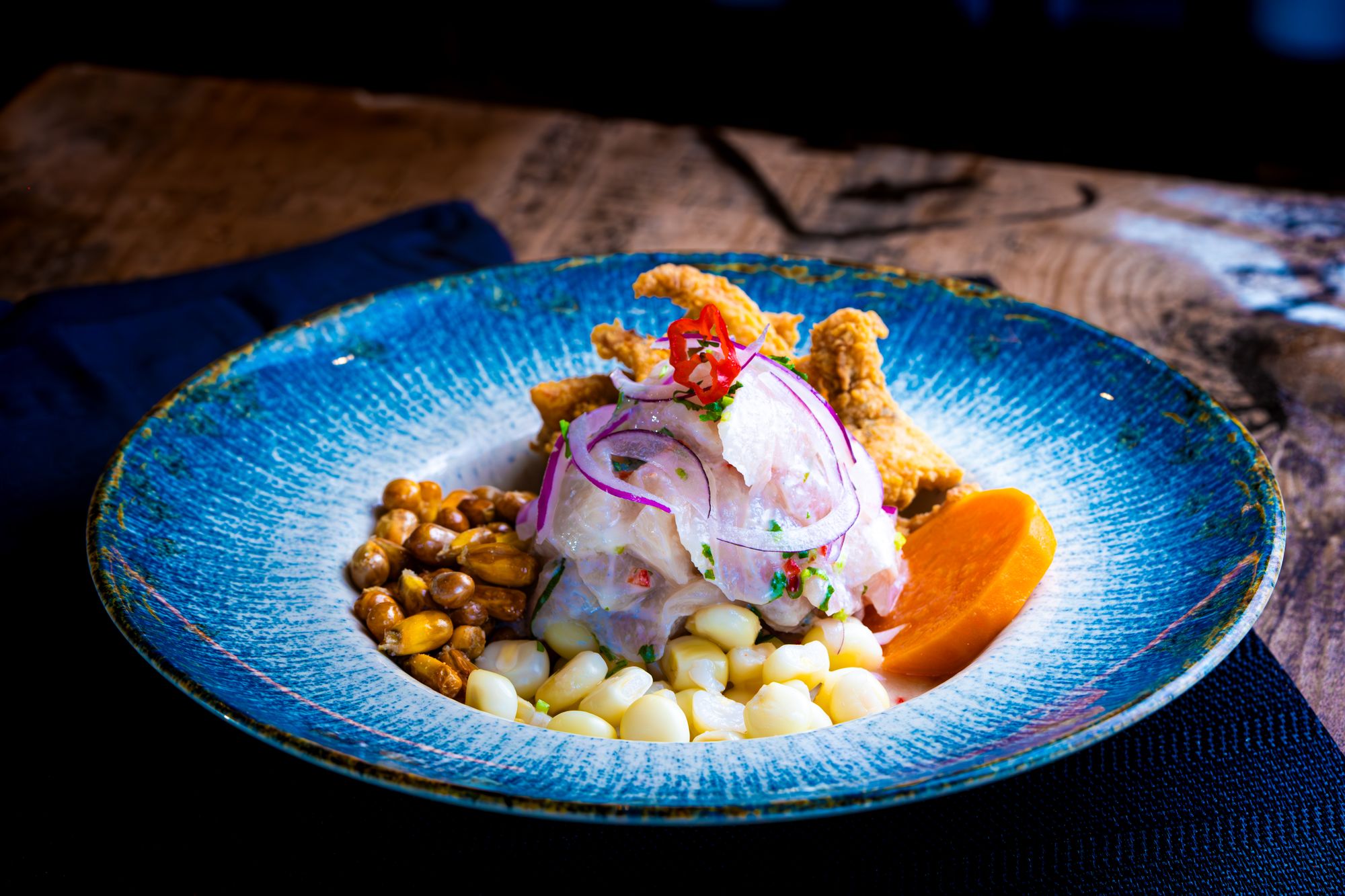
Cebiche here is not a marinade, it is a two-minute dressing. Fish is cut to order, tossed with lime, salt, red onion and ají limo, and sent out while the flesh is still firm. The cloudy liquid left in the bowl is leche de tigre and it is drunk, not left.
La Mar, at Av. La Mar 770, is the cevichería Gastón Acurio built to prove the dish deserved a dining room of its own. It opens for lunch, takes no bookings and stops when the catch runs out. Budget S/80–150 a head with a pisco sour.
Go before one o'clock. The queue at two is real, and the best fish has gone by three.
Anticuchos at Grimanesa Vargas, Miraflores
Anticuchos are beef hearts, cubed, marinated in ají panca, vinegar, cumin and garlic, then grilled hard over charcoal. The offal note is faint. What arrives is closer to a very concentrated steak with a smoky crust.
Grimanesa Vargas has been cooking them for more than forty years and now works from a room at Calle Ignacio Merino 466, evenings only, Monday to Saturday. Carts around Breña, Surquillo and the Miraflores malecón sell the same skewers for S/8–12.
Order them with a boiled potato and a round of choclo. The rocoto sauce beside them is not decoration.
Pan con chicharrón at El Chinito, central Lima
The Lima breakfast sandwich is fried pork belly, sweet potato fried in the same fat and salsa criolla — raw red onion, lime, chilli — inside a crisp francés roll. The sweet potato is the point: it stops the fat flattening everything else.
El Chinito has made it at Jirón Chancay 894 since 1960 and now runs a dozen branches, Barranco and Miraflores among them. A sandwich comes to around S/24; chicharrón sold by weight starts near S/30 for a quarter.
It is a morning dish. By two in the afternoon Limeños have moved on to lunch.
Lomo saltado and cocina criolla at Isolina, Barranco
Lomo saltado is the clearest evidence of Lima's Chinese century: beef, onion and tomato thrown into a smoking wok with soy and vinegar, then served with chips and rice, because Peru saw no reason to choose.
Isolina, at Av. San Martín 101, cooks the old criollo repertoire at a scale built for sharing. Lomo saltado runs around S/74, cau cau with blood sausage S/54, costillar a la chorrillana S/96, starters S/23–83. Two people ordering three dishes will not finish them.
José del Castillo opened it in 2015 and has not modernised it since. That is the compliment.
Chifa at Chifa Unión, Barranco
Chifa is Cantonese cooking rebuilt with Peruvian produce over 150 years, and it is not a novelty here: it is what families eat on Sundays. Wonton soup, arroz chaufa, tallarín saltado, ribs in tamarind.
Chifa Unión sits at Jr. Unión 126 and cooks it without the banquet-hall theatre. For the older, denser version, Calle Capón in Barrios Altos is Lima's original Chinatown and still the address for it.
Order the chaufa last. It arrives fastest and fills the table quickest.
Nikkei omakase at Maido, Miraflores
Nikkei is Japanese technique applied to Peruvian ingredients by Japanese-Peruvian families, and Mitsuharu Tsumura has spent fifteen years turning it into a grammar rather than a trick.
Maido, at Calle San Martín 399, was named the world's best restaurant in June 2025 and its tasting menu now starts at S/1,295 a head without pairings, lunch and dinner, Monday to Saturday. Bookings open weeks ahead.
If the number stops you, the same cooking exists across the city at a tenth of the price. The idea travelled faster than the bills did.
Whole fish at La Picantería, Surquillo
A picantería is a northern Peruvian institution: long shared tables, no waiting for a free two-top, and fish sold by the kilo. You pick the fish off the blackboard and choose how the kitchen divides it.
La Picantería, Francisco Moreno 388, rewrites that blackboard every morning with the catch, so the bill follows the weight rather than a printed menu — the honest way to sell fish. Chicharrón de chancho and the sudado are the other reasons to come.
It is a lunch house. Arrive at noon, not at three.
The tasting menus at Central and Kjolle, Barranco
Central built its menu as a vertical section through Peru, from the seabed to 4,000 metres, using ingredients most Lima kitchens had never bought. It held the world's number one spot in 2023.
It shares a door at Av. Pedro de Osma 301 with Kjolle, where Pía León cooks a shorter, brighter menu of her own. Central runs from roughly S/750 to over S/1,000 a head; Kjolle costs less and fills just as fast.
Both take reservations months ahead. In the week of the 50 Best awards on 4 November they will take none at all.
The S/25 menú at Mercado N.º 1 de Surquillo
Every Lima market keeps counters at the back where the traders eat, and Surquillo is the one the chefs shop in. A three-course menú del día — soup, a main, a drink — runs S/25–40.
You get the same fish the cevicherías bought that morning, plus lomo saltado, ají de gallina and papa a la huancaína, eaten elbow to elbow with somebody who has been buying limes since six.
Cash only, and go before two.
Picarones, chancaca and the pisco sour after dark
Picarones are squash-and-sweet-potato rings, fried to order and drowned in chancaca syrup. They cost S/5–10 a portion from a cart and are best eaten within ninety seconds of leaving the fryer.
The pisco sour is a Lima invention rather than a Cusco one: pisco, lime, sugar syrup, egg white, a drop of Angostura, shaken hard. The bars on and around Av. Grau in Barranco will make it properly. The beach-front tourist rooms will not.
Markets, neighbourhoods and when to go
- Mercado N.º 1 de Surquillo — produce, fish and lunch counters. Before 2pm, cash only.
- Calle Capón, Barrios Altos — Lima's Chinatown and its oldest chifas. Daytime.
- Miraflores — cevicherías, anticucho carts on the malecón, the sea. Lunch and late evening.
- Barranco — tasting menus, chifa and the bars. Dinner.
- Season: December to April is the coastal summer and the best of the fish. May to November brings the garúa, a grey sea fog that never quite rains.
- Hours: cevicherías are lunch-only, anticucheras evening-only. Almost nothing good happens between four and seven.
Frequently asked questions about what to eat in Lima
Is Lima expensive to eat in? Not unless you choose it to be. A market menú is S/25–40 and a street anticucho S/8–12. The tasting menus are the outlier, not the rule.
Is the raw fish safe? The cevicherías that open only for lunch do so because they buy that morning and sell out. Choose those and the risk is what it is anywhere with a cold current offshore.
How far ahead should I book? Central, Kjolle and Maido: weeks, and months around 4 November. Everything else on this list takes no booking at all.
And if there is only one meal? Cebiche, at lunch, in Miraflores. Everything else in Lima is a footnote to it.
Where to book first
Maido, Calle San Martín 399, Miraflores — the nikkei counter, and the reason the awards are in town at all.
Central and Kjolle, Av. Pedro de Osma 301, Barranco — two menus, one door, both months ahead.
Isolina, Av. San Martín 101, Barranco — the criollo cooking the other two are arguing with.
The ceremony on 4 November is the first South American edition in the list's history, staged by an organisation that has just changed its name to The 50. The hotel rooms in Barranco went first. The tables went next.
Sources
- The World's 50 Best Restaurants · 2026-07-10
- The Only Peru Guide — Lima food guide · 2026-08-20
- El Comercio — Isolina, cuánto cuesta comer · 2026-04-18
- El Comercio — Los anticuchos de Grimanesa Vargas · 2023-11-14