What to eat in Oaxaca: 10 dishes and where to find them
Levadura de Olla and Los Danzantes both hold Michelin stars, but the real education starts at a market comal. This is where Oaxaca eats, from tejate at 15 pesos to a mole that took three days to cook.
What to eat in Oaxaca starts with corn worked into a dozen shapes and mole built from twice that many ingredients, then keeps going through mezcal, quesillo and a market culture that still runs on cash and comals. Skip the hotel breakfast, walk to Mercado Benito Juárez for chapulines and tejate, and save one dinner for a mole tasting that took three days to cook.
Oaxaca cooks with what the Central Valleys, the Sierra Sur and the Isthmus grow, and keeps the distinctions between them rather than blending everything into one style. Zapotec and Mixtec kitchens built the base: nixtamalized corn, native chiles, herbs like hoja santa and pitiona, and the seven moles that give the state its shorthand — negro, rojo, amarillo, verde, coloradito, chichilo and manchamanteles. Spanish contact added pork, wheat and almonds on top; none of it displaced the corn, the same pattern behind Sinaloa's shredded, chile-cooked chilorio.
Two ingredients travel furthest: quesillo, the stretched Oaxacan string cheese, goes into everything from tlayudas to empanadas, and mezcal, distilled from more than a dozen local agave species, moved from market jug to tasting flight without losing its roadside stalls. The same corn-and-market logic drives our guide to what to eat in Lima, its Peruvian counterpart.
Oaxaca treats a sixty-peso tlayuda and a three-day mole as the same discipline.
What to eat in Oaxaca first: mole negro at Levadura de Olla, Centro
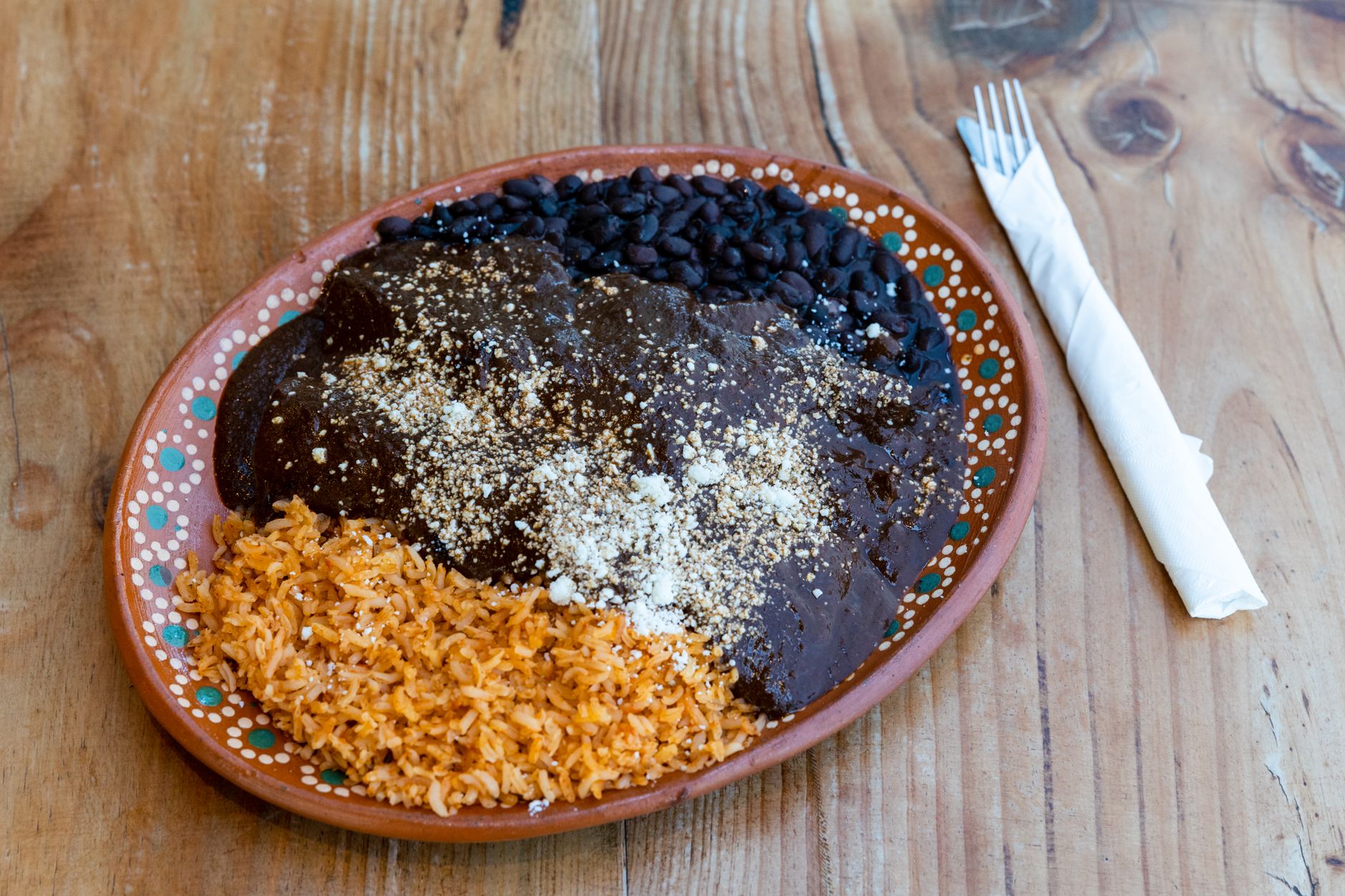
Mole negro is what most people mean by Oaxacan food: dried chilhuacle and mulato chiles, charred tortilla, chocolate, plantain and spices, simmered for two days from a list of thirty-plus ingredients.
Levadura de Olla, at Manuel García Vigil 304, earned a Michelin star in 2024 for chef Thalía Barrios García's cooking from the Sierra Sur, where she grew up. Mole negro with chicken runs 240 MXN à la carte; the tasting menu through her home region's dishes costs around 1,200–1,600 MXN per person.
Tlayuda at Mercado 20 de Noviembre, Centro
A tlayuda is a large, thin corn tortilla toasted crisp on a comal, spread with asiento (unrefined pork lard), black beans, cabbage, avocado and quesillo, often folded over grilled tasajo or cecina.
Mercado 20 de Noviembre, at 20 de Noviembre 512, keeps its tlayuda counters near the Pasillo de Humo, the grilled-meat alley where you buy meat by the kilo and have it cooked to order. Comedor Chabelita is one of the sit-down stalls here for tlayudas with squash blossom and cheese; 60–120 MXN depending on the meat added.
Chapulines at Mercado Benito Juárez, Centro
Chapulines are small grasshoppers, toasted on a comal with garlic, lime and salt until dry and faintly smoky, eaten by the handful, folded into a taco, or scattered over guacamole and tlayudas.
Mercado Benito Juárez, off the zócalo, has stalls along Calle Miguel Cabrera selling chapulines by weight in several spice levels, plus chapulín tacos assembled to order. A small bag runs 40–80 MXN, a taco 30–50 MXN.
Buy from a stall with steady turnover — the crunch only holds for a day or two.
Tejate at La Flor de Huayapam, Mercado Benito Juárez
Tejate is a cold, foam-topped corn-and-cacao drink native to the Central Valleys, thickened with mamey seed and flor de cacao, whipped by hand until a dense foam rises. It carries no alcohol and predates Spanish contact by centuries.
La Flor de Huayapam runs the best-known stall inside Mercado Benito Juárez, at the corner of the Cañada and Chatinos aisles, open 10am to 7:30pm. Ask for it en jícara, in the painted gourd bowl; 15–30 MXN a serving.
Memelas at Mercado Sánchez Pascuas
Memelas are smaller and thicker than tlayudas — a corn base pinched at the edges and cooked on the comal until it holds asiento, beans, salsa and crumbled cheese without folding. They belong to breakfast more than any other meal.
Mercado Sánchez Pascuas, off Calle Porfirio Díaz or Tinoco y Palacios, has run comedores serving memelas off wood-fired comals since the 1970s. Three memelas with salsa and cheese runs about 60–90 MXN, best before 11am, when the market's breakfast trade is still going.
Barbacoa de chivo at the Tlacolula Sunday market
Barbacoa here means goat, cooked slowly in a pit until it falls apart, served in tacos with its own consommé on the side — a Sunday-only dish tied to the weekly market.
The Tlacolula de Matamoros market, about 30km east of the city, runs its barbacoa stalls from early morning to mid-afternoon every Sunday, alongside stands selling mezcal straight from the barrel — worth tasting before you buy, since quality swings more here than in the city's mezcalerías. Tacos and a consommé for two run around 250–300 MXN total.
Mezcal flight at In Situ Mezcalería, Centro
Mezcal is agave spirit, and Oaxaca produces the largest share of it in Mexico, from more than a dozen agave species with wildly different profiles — smoky espadín, funkier tobalá, vegetal tepeztate. Tasting three side by side says more than any single bottle.
In Situ, at Vicente Guerrero 413, stocks more than 180 mezcals from small producers, organised by agave type and distillation method rather than brand. A flight of three pours runs roughly 250–500 MXN; open Monday to Saturday, 2pm to 11pm. Prefer wine? Mexico's ambitions lie elsewhere — Guanajuato's wine region just took the country's top prize — but Oaxaca's bars pour mezcal, not Cabernet. Ask the bartender to build your flight — the gap between an espadín and a tobalá is the whole point.
Chocolate de agua at Chocolate Mayordomo, Calle Mina
Oaxacan hot chocolate is ground from roasted cacao, cinnamon, almonds and sugar, then whisked into water (de agua) or milk (de leche) until it froths, usually drunk alongside pan dulce rather than instead of breakfast.
Chocolate Mayordomo has ground chocolate at Francisco Javier Mina 219, just south of Mercado 20 de Noviembre, since 1956, milling beans in the front window. Chocolate de agua with bread runs around 40–60 MXN; bars to take home start under 100 MXN.
Seven-mole tasting at Los Danzantes, Alcalá
Oaxaca's mole family runs to seven recognised versions, and few kitchens outside a home serve more than two or three at once — a tasting flight is the shortcut to how far the family spreads, from fruit-forward manchamanteles to smoky chichilo.
Los Danzantes, at Calle Macedonio Alcalá 403, holds a Michelin star and a Michelin Green Star for its organic garden, and serves a five-mole tasting — negro, rojo, amarillo, chichilo and manchamanteles, with plantain dumplings. A full dinner with starter, main, dessert and a drink averages around 800 MXN per person; reserve ahead, since walk-ins can wait an hour or two.
Tasting menu at Origen, Centro
Origen is the other half of Oaxaca's food scene: chefs trained in the city's markets who now reinterpret those ingredients with restaurant technique rather than reproducing family recipes exactly.
Chef Rodolfo Castellanos, who won the first season of Top Chef México, opened Origen at Miguel Hidalgo 820 in 2011. The six-course tasting menu runs around 1,100 MXN per person, with a wine pairing for an additional 450 MXN; lunch and dinner, Monday to Saturday — the easiest fine-dining reservation on this list, bookable two or three days out rather than months.
Markets, neighbourhoods and when to go
- Mercado Benito Juárez, Centro — chapulines, tejate, produce. Daily, roughly 8am–8pm.
- Mercado 20 de Noviembre, Centro — tlayudas and the Pasillo de Humo grill alley. Daily, busiest after dark.
- Mercado Sánchez Pascuas — memelas and breakfast comedores. Mornings only.
- Tlacolula de Matamoros — the region's biggest tianguis, goat barbacoa and mezcal by the barrel. Sundays only, early morning to mid-afternoon.
- Jalatlaco and Xochimilco — quieter, residential, newer restaurants and mezcalerías, a short walk from Centro.
- Season: October to April is dry season, easiest for walking between markets; July brings the Guelaguetza festival and higher prices.
Frequently asked questions about what to eat in Oaxaca
Is Oaxaca expensive to eat in? Not if you follow the markets. A market meal runs 60–120 MXN and a mezcal flight 250–500 MXN; the two Michelin-starred kitchens here charge 800–1,600 MXN, still under equivalent menus in Mexico City.
Is street food in Oaxaca safe to eat? Choose stalls with visible turnover cooking to order on the comal in front of you. Chapulines, tlayudas and memelas are all served hot off it.
What is the difference between a tlayuda and a memela? Size and fold. A tlayuda is large and crisp, folded over its toppings; a memela is smaller, thicker and eaten flat, usually at breakfast.
Should I book the mole tasting menus in advance? Yes, for Levadura de Olla and Los Danzantes — a day or two ahead usually suffices outside July's Guelaguetza festival.
Where to book first
Levadura de Olla, Manuel García Vigil 304, Centro — the mole negro tasting menu that explains everything else on this list.
Los Danzantes, Calle Macedonio Alcalá 403, Centro — the five-mole flight, in a Michelin Green Star dining room with its own garden.
Origen, Miguel Hidalgo 820, Centro — the easiest of the three to book same-week, and the clearest view of where Oaxacan cooking is heading.
Sources
- MICHELIN Guide — Levadura de Olla Restaurante · 2026-09-14
- MICHELIN Guide — Los Danzantes Oaxaca · 2026-09-14
- In Situ Mezcalería — official site · 2026-09-14
- Chocolate Mayordomo — Sucursales · 2026-09-14
- Origen Oaxaca — official site · 2026-09-14