What to eat in Mexico City: 10 dishes and where to find them
From tacos al pastor off the spit to Pujol's mole madre, ten dishes that define the Mexican capital, with addresses, opening days and prices in pesos.
What to eat in Mexico City comes down to corn, dried chillies and the street: tacos al pastor carved from the spit, tostadas piled high in a market, lamb barbacoa on a weekend morning and moles that take days to build. Do not leave without eating standing up at a taquería counter after dark, and without one long lunch at a seafood table in Roma.
The capital cooks with the whole country's pantry. Nixtamalised corn is the base of almost everything, dozens of dried chillies do the work that stock and butter do elsewhere, and each wave of migration left a dish behind: the Lebanese spit that became al pastor, the Spanish churro, the pit barbacoa of neighbouring Hidalgo. Since the Michelin Guide arrived in Mexico in 2024, the fine-dining end gets more attention, but the city still eats mostly on the street, where a taco costs a few tens of pesos. If you are travelling south as well, our guide to what to eat in Oaxaca covers moles, tlayudas and mezcal.
Prices below are in Mexican pesos (MXN) and come from menus and recent listings; street prices move quickly, so treat them as ranges.
Mexico City still eats mostly on the street, where a taco costs a few tens of pesos.
Tacos al pastor at El Vilsito, Narvarte
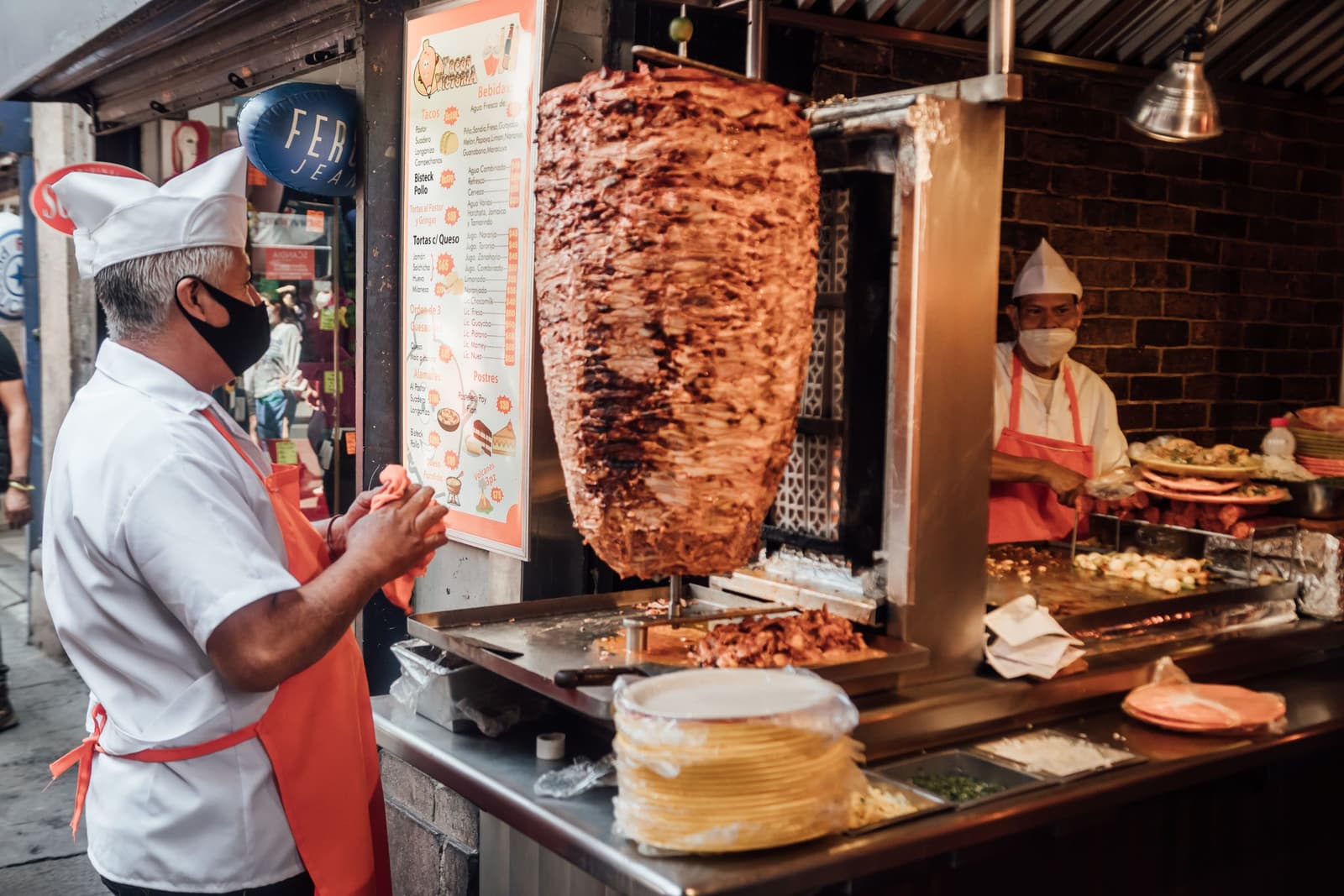
Pork marinated in chilli and achiote is stacked on a vertical spit, the trompo, crowned with a pineapple and shaved straight onto small corn tortillas. It is the taco most visitors come for, and it descends from the shawarma that Lebanese immigrants brought to Puebla.
El Vilsito, at Avenida Universidad 248 in Narvarte, is a car repair workshop by day and a taquería at night, and it appears in the Michelin Guide's selection. Expect about MXN 25 a taco and MXN 100 to 200 per person. To cook it at home, follow our tacos al pastor recipe.
Suadero tacos at Los Cocuyos, Centro Histórico
Suadero is a thin cut of beef cooked slowly in its own fat on a domed griddle until it is soft inside and crisp at the edges. The campechano mixes it with longaniza sausage; tongue is the other order regulars swear by.
Los Cocuyos, a narrow counter at Bolívar 56 that has been working since 1980 and stays open around the clock, is also listed by the Michelin Guide. Prices are those of a street stand: expect roughly MXN 25 to 40 a taco.
Tuna tostadas at Contramar, Roma Norte
Gabriela Cámara opened Contramar in 1998, and its tostadas de atún, raw tuna on a crisp tortilla with chipotle mayonnaise, fried leek and avocado, have been copied across the city ever since. The other signature is pescado a la talla, a butterflied fish grilled half with red chilli, half with green herbs.
The restaurant, at Durango 200, is a lunch institution: the long Mexican comida, from mid-afternoon into the evening. An order of four tostadas costs MXN 420 on the current menu; plan on several hundred pesos per person with drinks, and book.
Lamb barbacoa at El Hidalguense, Roma Sur
Barbacoa here means lamb cooked overnight in an earth oven, wrapped in maguey leaves, the Hidalgo way. It comes with consomé made from the drippings and tortillas pressed by hand.
El Hidalguense, Campeche 155, opens only Friday to Sunday, from 7am to 6pm, and the best cuts go early. Budget MXN 300 to 500 per person; the meat is sold by weight, at over MXN 1,000 a kilo according to recent reviews.
Chiles en nogada at Hostería de Santo Domingo, Centro Histórico
A poblano chilli stuffed with a picadillo of meat, fruit and nuts, covered in a cold walnut cream and scattered with pomegranate: green, white and red, the colours of the flag. The dish belongs to late summer, from August into September around Independence Day on 16 September.
Hostería de Santo Domingo, at Belisario Domínguez 72, says it has served guests since 1860 and makes chiles en nogada all year. Half portions are available; count on a few hundred pesos for a whole chile.
Mole madre at Pujol, Polanco
Enrique Olvera's restaurant, which holds two Michelin stars, serves its best-known dish as two circles on one plate: a fresh mole and a mole madre that has been reheated and topped up daily for years, more than 2,800 times by 2022.
Pujol is at Tennyson 133. Recent listings put the dining-room tasting menu at about MXN 3,600 and the taco omakase at the bar at around MXN 4,000, before drinks. Book weeks ahead.
Tostadas at Tostadas Coyoacán, Mercado de Coyoacán
Inside the covered market on Ignacio Allende, this stall has been piling toppings on crisp tortillas for more than 60 years: chicken tinga, pig's trotters, shrimp, octopus, ceviche and around two dozen more.
A tinga tostada costs about MXN 30, seafood versions more; most people spend under MXN 250. It is open daily from 11am to 6pm, which makes it an easy lunch before a walk around Coyoacán's squares.
Guava roll at Panadería Rosetta, Roma Norte
Elena Reygadas, named the World's Best Female Chef by The World's 50 Best Restaurants in 2023, opened her bakery at Colima 179 in 2012. Its rol de guayaba is laminated dough rolled around guava paste and cream cheese, a pastry-shop version of ate con queso, the Mexican pairing of fruit paste and cheese.
There is little seating and a queue on weekend mornings; take the roll to go and eat it on a bench in the neighbourhood's tree-lined streets.
Churros and hot chocolate at El Moro, Centro Histórico
El Moro has fried churros on Eje Central Lázaro Cárdenas 42 since 1935 and is open 24 hours. Order them hot, dusted with sugar, with a cup of chocolate to dip them in: Mexican, Spanish, French or bitter.
A single churro costs MXN 15, four cost MXN 56 and a regular chocolate MXN 80; the package of chocolate with four churros is MXN 125.
Pulque at Las Duelistas, Centro Histórico
Pulque, the fermented sap of the maguey agave, was drunk in the valley long before the Spanish arrived. It is thick, slightly sour and low in alcohol; curados are blended with fruit, oats or celery.
Las Duelistas, at Aranda 28 near the Mercado de San Juan, is one of the city's best-known pulquerías, with painted walls and shared tables. Glasses start around MXN 40. It opens from 10am to 9pm and closes on Sundays.
Markets, neighbourhoods and when to go
- Mercado de San Juan, Centro: specialist produce, cheeses, game and imported goods.
- Mercado de la Merced, Centro: the city's largest traditional market, for chillies, spices and moles by the kilo.
- Mercado de Medellín, Roma Sur: produce from across Latin America and a good lunch counter.
- Roma Norte and Condesa: restaurants, bakeries, coffee bars and cocktail bars within walking distance.
- Centro Histórico: cantinas, churrerías, pulquerías and the oldest taquerías.
- Timing: lunch between 2pm and 5pm is the main meal; al pastor is a night food; barbacoa is a weekend-morning food; chiles en nogada peak in August and September.
- Street corn: esquites and elotes are sold from carts in every neighbourhood in the evening; our elote recipe shows how it is dressed.
What to eat in Mexico City: frequently asked questions
Is Mexico City expensive to eat in? Not at street level: tacos cost roughly MXN 20 to 40 each and a market lunch rarely passes MXN 250. A seafood lunch at Contramar runs to several hundred pesos, and Pujol's tasting menu costs about MXN 3,600 before drinks.
What is the most typical dish of Mexico City? Tacos al pastor are the city's signature, but locals would add quesadillas, which in the capital do not necessarily contain cheese, and the Sunday barbacoa.
Is street food safe to eat? Choose busy stands where food is cooked to order and turnover is high, and follow the queue of locals. Most visitors eat at stands every day.
Do I need to book? For Pujol, Contramar and other sit-down restaurants, yes. Taquerías, markets and bakeries work on a queue.
Where to book first
Pujol, Tennyson 133, Polanco: the reservation to secure before the flight, weeks in advance.
Contramar, Durango 200, Roma Norte: book a late lunch and order the tuna tostadas and the fish a la talla.
Hostería de Santo Domingo, Belisario Domínguez 72, Centro Histórico: for chiles en nogada, best while the season lasts. Finish with coffee: Mexico's own beans are having a moment, and a Veracruz café recently won Latin America's top coffee title.