Pan de muerto recipe: Mexico's orange-blossom bread of the dead
The sweet, sugar-coated loaf Mexican families bake before Día de Muertos: an egg-rich dough scented with orange blossom and anise, crossed with dough bones and crowned with a small skull.
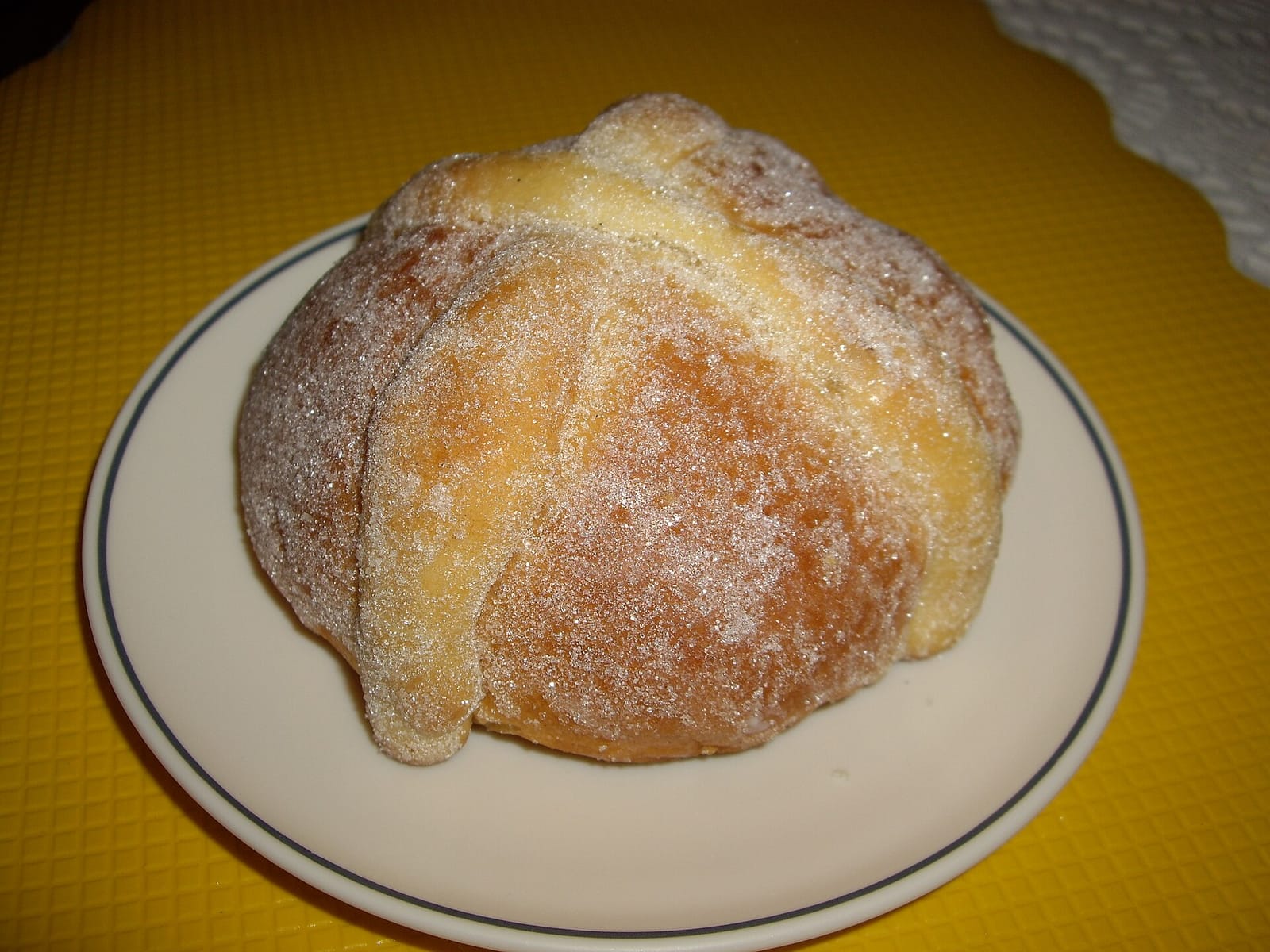
This pan de muerto recipe makes the sweet, orange-blossom bread Mexican families bake in the weeks before Día de Muertos on 1 and 2 November. The technical key is a rich, sticky dough given a long, warm rise, then a coat of butter and sugar while the loaf is still hot.
The round loaf is crossed with dough bones and topped with a small ball, most often read as a skull, though Mexican writers note that the meaning varies by community. Families set it on home altars, the ofrendas, and eat it with hot chocolate. One line of history traces it to the Spanish pan de ánimas, the soul bread of All Souls' Day; Mexican institutions point to pre-Hispanic offerings instead.
This pan de muerto recipe follows the version Pati Jinich published through WGBH on 19 October, with our own quantities in grams. For the rest of the festive table, see what to eat in Oaxaca.
Butter holds the sugar, and it only sticks while the bread is still warm.
Ingredients
- 500 g plain flour
- 120 ml whole milk, lukewarm
- 10 g active dry yeast
- 90 g caster sugar
- 5 g fine salt
- 4 large eggs plus 1 yolk
- 2 tbsp orange blossom water
- 1 tsp anise seeds, crushed
- Grated zest of 1 orange
- 100 g unsalted butter, softened
- 40 g butter, melted
- 100 g caster sugar, for coating
Method
- Whisk the milk, yeast and 50 g of the flour and leave for 20 minutes, until bubbly. The starter wakes the yeast before sugar and fat slow it down.
- Beat the eggs and yolk and keep 2 tablespoons aside. Add the rest with the remaining flour, sugar, salt, orange blossom water, anise and zest, and knead for 8 minutes. Gluten built before the butter goes in lets the dough hold its shape.
- Knead in the soft butter a spoonful at a time for 5 more minutes, until glossy. Added late, butter coats the gluten without stopping it forming.
- Cover and leave somewhere warm for 2 hours, until doubled. Chilling it overnight adds flavour and makes it easier to shape.
- Set a quarter of the dough aside and shape the rest into a tight ball on a lined tray. Surface tension makes it rise upwards, not outwards.
- Roll the reserved dough into four knobbly bones and a small ball. Brush the loaf with the reserved egg and fix the decorations on top: the egg glues them in place.
- Prove for 1 hour and heat the oven to 175°C. An underproved loaf tears at the base.
- Bake for 30 to 35 minutes, covering with foil after 20 so the rich crust does not burn. It is done when the base sounds hollow.
- Brush the warm loaf with the melted butter and coat it with sugar, which only sticks while the bread is warm.
Orange blossom, anise and variations
Taste the orange blossom water first, as its strength varies; without it, use water and the zest of a second orange.
Pan de muerto recipe questions
Can I make the dough ahead? Yes. The overnight chill can stretch to 24 hours; warm the dough for an hour before shaping.
How long does pan de muerto keep? Two days, well wrapped.
Can I make small buns instead? Yes. Divide the dough into eight, add two small bones to each and bake for 18 to 20 minutes.