Hairy crab season opens on Yangcheng Lake with 10,100 tonnes
The Suzhou lake that gave the Chinese autumn crab its name now supplies only a small share of it. Each crab carries a numbered tag, and the first ones reached Beijing the same afternoon.
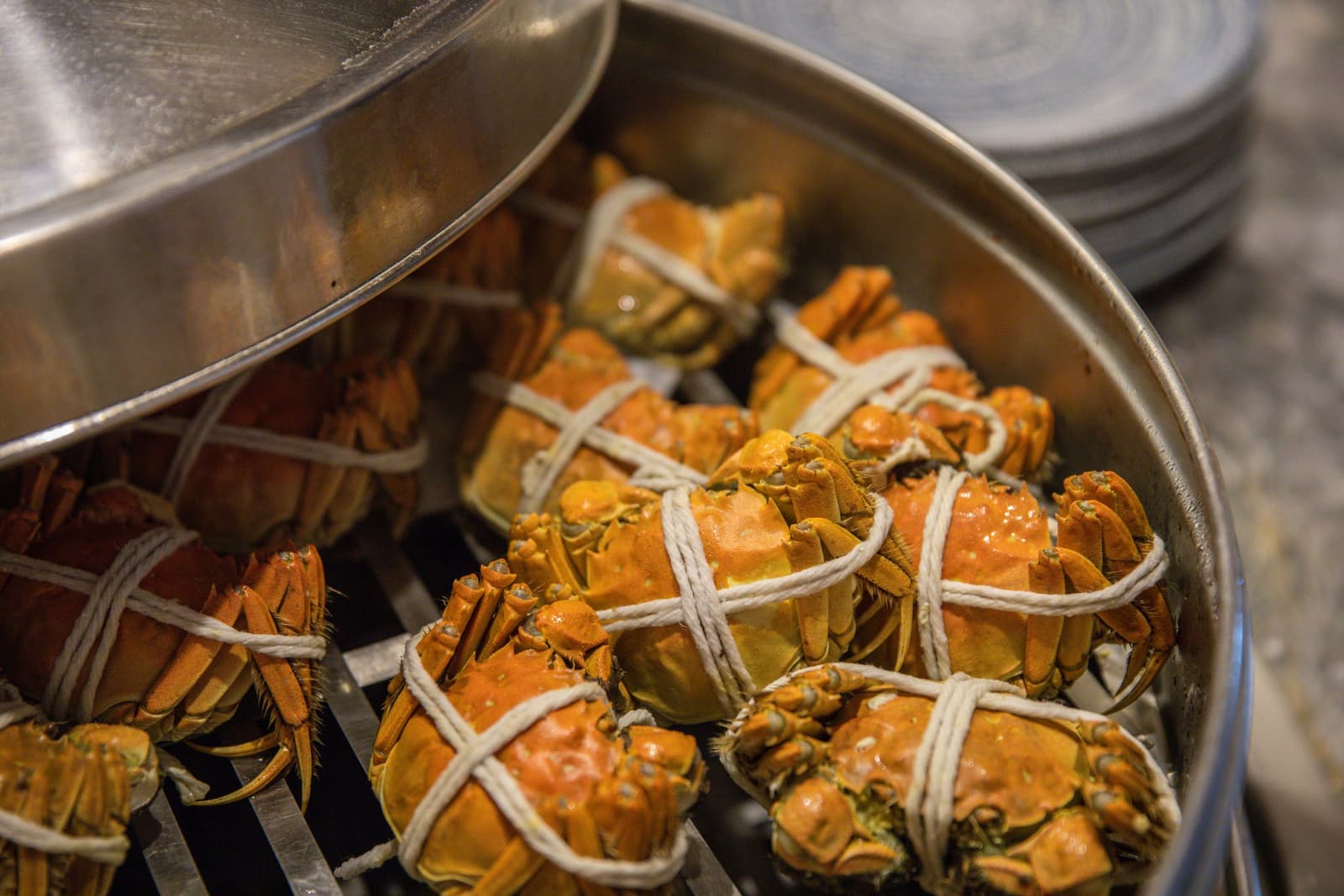
The hairy crab season officially opened on Yangcheng Lake, near Suzhou in eastern China, on Monday 28 September, and the local industry association expects about 10,100 tonnes this year, according to Xinhua and the Shanghai daily Wen Hui Bao.
The opening event took place in Bacheng, a lakeside town in the municipality of Kunshan. It was organised by the Suzhou Yangcheng Lake Hairy Crab Industry Association together with the associations of Kunshan, Changshu, Xiangcheng and the Suzhou Industrial Park. Boats hung with red silk went out on the water, and two drones flew the season's first basket of crabs to the venue, where it was packed and sent to the first customers.
The breakdown of the harvest is more telling than the total. About 1,600 tonnes come from net enclosures on the lake itself, covering 15,300 mu, or roughly 1,020 hectares. About 8,500 tonnes come from 65,400 mu of ponds built to a set standard around the lake, some 4,360 hectares. Roughly five in six crabs sold this year as Yangcheng Lake hairy crab will never have lived in open lake water.
Five in six Yangcheng Lake crabs now come from ponds, which is why each one carries a serial number.
How a hairy crab proves its origin
The 2026 system keeps one numbered clip per crab and one label per box, both carrying the geographical-indication emblem and a unique serial number, and adds an AI-readable dot code. According to Beijing Youth Daily, red clips mark crabs from the lake enclosures and green clips those from the ponds, and a QR code gives the traceability data. Crabs raised elsewhere and sold under the lake's name have long been the trade's main problem.
The first-day crabs were large for late September: the biggest males weighed more than six liang, or 300 grams, and the biggest females more than five liang, or 250 grams, the Guangzhou outlet Southern Plus reported.
From the lake to Beijing by the afternoon
Deliveries started the same day. The first live crabs reached an authorised shop in Beijing's Dongcheng district at around 14:00 by cold-chain air freight, and the 200 jin, or 100 kilograms, in that first shipment had already been sold in advance, Beijing Youth Daily reported. SF Express and JD Logistics promise next-day delivery to the capital. Guangdong has 129 authorised shops and sales points, the third-largest network outside Jiangsu.
The species, Eriocheir sinensis, is known in northern Europe mainly as an invasive pest in rivers such as the Elbe. In the Yangtze delta it is the autumn luxury, steamed whole with its legs tied and eaten with vinegar and ginger. The associations place the best eating window between mid-October and mid-December. Further up the Yangtze basin, the cooking changes completely, as our guide to what to eat in Chengdu shows.