What to eat in Chengdu: 10 dishes and where to find them
Sichuan's capital serves numbing chilli heat at every turn, from century-old mapo tofu to bubbling hotpot and teahouse ear-cleaning rituals in People's Park.
What to eat in Chengdu comes down to one sensation: ma la, the numbing, citrusy burn of Sichuan peppercorn stacked on chilli heat, running through everything from mapo tofu to backstreet hotpot. Don't leave without a bowl of dan dan noodles and an afternoon at a teahouse.
Chengdu's food culture runs on contrast: the same kitchens that invented mapo tofu's fire also perfected the slow stillness of a teahouse afternoon in People's Park. Sichuan cuisine gets flattened abroad into simply "spicy," but here heat is one ingredient among many — fermented broad bean paste, black vinegar, preserved vegetables and the tingling numbness of hua jiao, or Sichuan peppercorn, each doing distinct work in the same bowl.
Most of the best eating happens in small, decades-old rooms rather than grand dining rooms: a noodle shop dry-tossing the same recipe since the 1940s, a tofu restaurant tracing its name to 1862. Prices are correspondingly low — a full meal for two rarely tops ¥150.
Chengdu's real specialty isn't spice. It's the numbing hua jiao buzz underneath it, in almost everything.
Mapo tofu at Chen Mapo Tofu, Qingyang District
Silken tofu cubes sit in a broth of fermented chilli bean paste and minced beef, with enough Sichuan peppercorn to leave lips buzzing. This is the dish that gave Sichuan cooking its name abroad, and Chen Mapo Tofu, on Qinghua Road, is where the story starts: the restaurant traces its recipe to 1862 and now holds a Michelin Bib Gourmand.
A bowl costs around ¥74 (about €9.50) and easily feeds two as a shared plate with rice. Order it alongside the restaurant's kung pao chicken, another dish that claims Chengdu roots despite becoming shorthand for Chinese takeaway elsewhere.
Dan dan noodles and wontons at Long Chaoshou, Chunxi Road
Dan dan noodles are Chengdu's street-corner staple: thin wheat noodles tossed, not soaked in broth, with minced pork, preserved mustard greens, chilli oil and a scrape of Sichuan peppercorn. Long Chaoshou, on Chunxi Road, has served them for decades alongside its namesake red-oil wontons and Zhong dumplings, making it the closest thing Chengdu has to a one-stop introduction to its own snacks.
A plate runs ¥30 to ¥50 (€4 to €7), and locals treat the noodles as a starter rather than a meal — order two or three small dishes rather than one large one.
Hotpot at Piaoxiang Hotpot, Yulin
Chengdu hotpot runs on beef tallow rather than the clearer broths found further south: a pot of dark red oil, whole dried chillies and Sichuan peppercorn simmers at the table while diners cook thin-sliced beef, tripe, lotus root and tofu skin in it. Piaoxiang Hotpot, on Yulin West Road in Wuhou District, is a neighbourhood favourite rather than a tourist stop, which means queues at peak times but a broth that hasn't been softened for outside palates.
Expect to pay ¥80 to ¥100 (€10 to €13) a head. Ask for a yuanyang, or split pot, if a full mala broth feels like too much on a first visit.
Twice-cooked pork at Yongle Restaurant, Xiaojiahe
Twice-cooked pork, hui guo rou, is Sichuan technique distilled into one dish: pork belly is simmered whole, sliced thin, then stir-fried hard with leeks, fermented broad bean paste and a little sugar until the edges curl and char. Yongle Restaurant, on Xiaohe Middle Street, has cooked it since 1985 and is known equally for a liver-and-kidney stir-fry that rarely makes menus built for visitors.
Arrive up to 30 minutes before opening — queues form fast — and expect a full meal here to run about ¥60 (€8) a head, among the cheapest sit-down eating in this guide.
Fuqi feipian at Fuqi Feipian Snack Center, Zongfu Road
"Husband-and-wife lung slices" is a dish with a marketing problem in translation and none at all on the plate: thinly sliced beef shank, tongue, tripe and heart, served cold in chilli oil with roasted peanuts and coriander. The name comes from the street-vendor couple who invented it in the 1930s, not the ingredients, despite the enduring myth. The Fuqi Feipian Snack Center, on Zongfu Road near Chunxi Road, is the closest thing the dish has to an original address.
It's sold by weight, generally ¥30 to ¥40 (€4 to €5) for a portion large enough to share, and works best as a cold starter before hotpot rather than a meal on its own.
Guokui flatbread at Yan Taipo Guokui, Qingyang District
Guokui is Chengdu's answer to a stuffed flatbread: dough pressed thin, filled with shredded vegetables, minced meat and a smear of chilli oil, then griddled and finished in a clay oven until the layers separate and crisp. Yan Taipo Guokui, on Renmin Middle Road, draws a queue most afternoons and can sell out some fillings by mid-afternoon.
A single guokui costs ¥8 to ¥15 (€1 to €2) and is built to eat standing up, ideally on the way to or from Kuanzhai Alley rather than as a sit-down course.
Tangyuan and sugar fritters at Lai Tangyuan, near Chunxi Road
For something sweet, Lai Tangyuan is one of the city's oldest snack institutions, serving glutinous rice balls, tangyuan, with sesame or peanut fillings alongside tangyou guozi, deep-fried dough fritters glazed in brown sugar syrup and eaten hot off a bamboo skewer. Both are breakfast food as much as dessert, and the shop, close to Chunxi Road, opens early and can sell out its morning batch before noon.
A portion of either costs ¥10 to ¥20 (€1.50 to €2.50), cheap enough to try both.
Malatang skewers at Hua Chi Zui'er Malatang, Jinjiang District
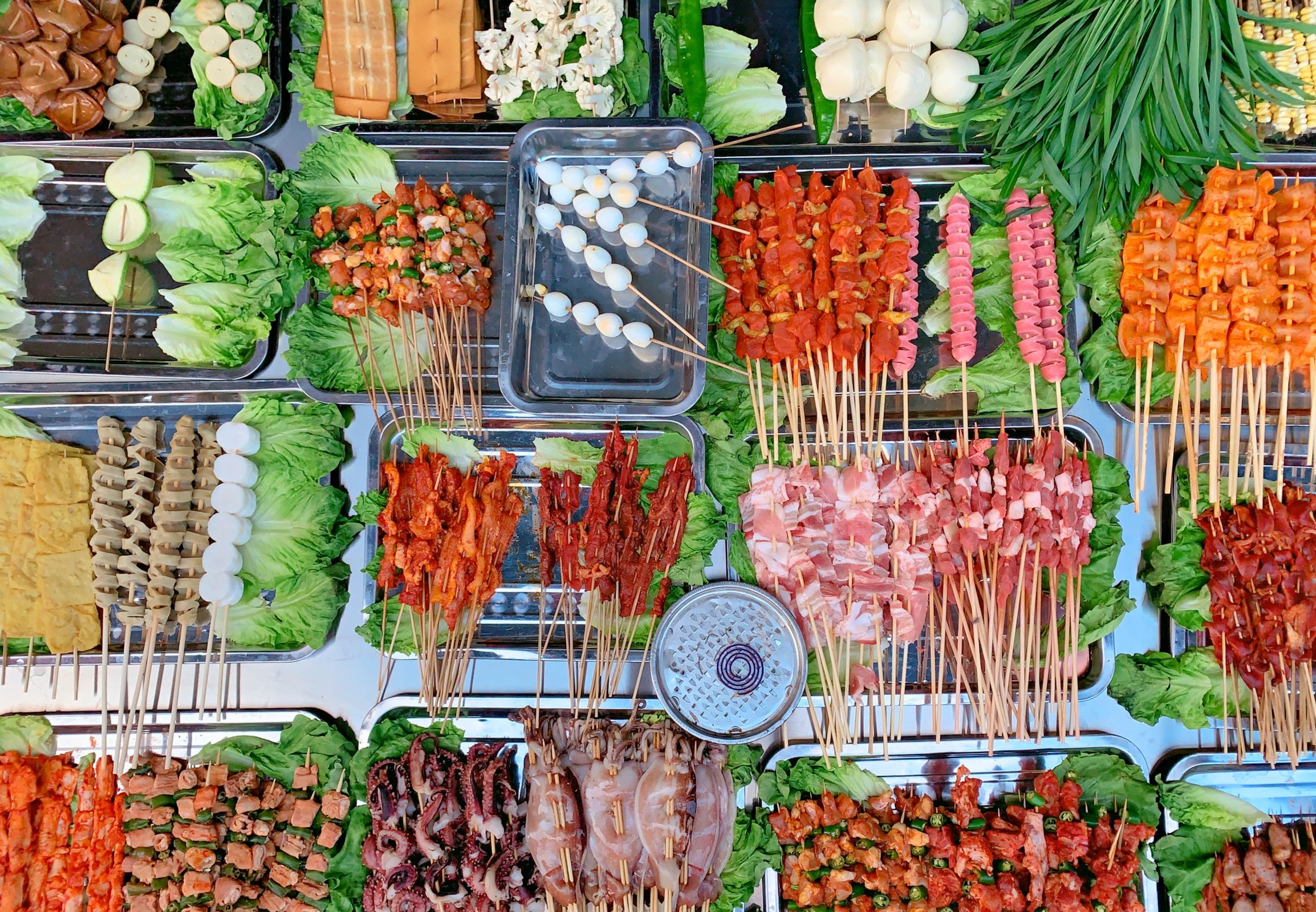
Malatang, literally "numbing spicy soup," is Chengdu's self-serve answer to hotpot: pick skewers of meat, tofu, mushrooms and greens from a chilled display, and they're blanched to order in a shared pot of the same mala broth used for hotpot. Hua Chi Zui'er, on Wangping Street, is known for its beef skewers and for refreshing its broth through the night rather than letting it sit, a detail regulars watch for.
Pricing is per skewer, generally ¥2 to ¥5 (€0.30 to €0.70) each, so a filling meal for one runs ¥25 to ¥40 (€3.50 to €5.50).
Tea and ear-cleaning at Heming Teahouse, People's Park
Chengdu's other defining meal isn't a meal at all: an afternoon in a bamboo chair at Heming Teahouse, inside People's Park, with a bottomless cup of jasmine or zhuyeqing tea and, for those who want it, an ear-cleaning session from a practitioner working the crowd with a goose-feather brush and a set of fine metal tools. The teahouse dates to 1923 and functions as much as a viewing gallery for local life — card games, opera singing, matchmaking corners — as a place to drink tea.
Tea runs ¥20 to ¥40 (€3 to €5.50) with refills; an ear-cleaning session is a separate ¥30 (€4) and takes ten to fifteen minutes.
Vegetarian temple food at Wenshu Monastery Xiangyuan
Wenshu Monastery, a working Buddhist temple in the city centre, runs a vegetarian canteen, Xiangyuan, serving a self-service buffet alongside a more refined set menu built entirely around soy, mushroom and vegetable preparations styled to mimic meat dishes — a mock mapo tofu among them. It's a genuinely different register from the rest of this list: quiet, unhurried and priced for a temple rather than a restaurant.
The buffet runs ¥50 to ¥100 (€7 to €13); the set menu, ¥200 to ¥500 (€26 to €65), is worth booking ahead for.
Markets, neighbourhoods and when to go
- Kuanzhai Alley — three restored Qing-dynasty lanes of snacks, teahouses and boutiques; atmospheric but priced for visitors.
- Jinli Ancient Street — near Wuhou Temple, good for nostalgic snacks and evening lantern light rather than a serious meal.
- Kuixinglou Street — Chengdu's late-night food strip, best after 9pm for skewers and noodles.
- Yulin and Jianshe Road — younger, more local and less crowded than the old-town alleys.
- Wenshu Monastery area — temple food and a calmer pace during the day.
- Best time to go — March to May or September to November; summers are hot and humid, winters see little daylight.
Common questions about eating in Chengdu
Is Chengdu food always this spicy? Most of it, yes, though dishes like guokui and tangyuan are mild, and restaurants will usually adjust the heat on request for hotpot and malatang.
Can I pay with cash? Rarely at street stalls. Alipay or WeChat Pay, linked to a foreign card, covers almost everywhere; carry some cash as backup for the oldest, smallest shops.
What's the best single meal for a first visit? Mapo tofu and dan dan noodles together cover the city's two defining textures — silky and dry-tossed — in one sitting.
Is Chengdu expensive to eat in? No. A full day of eating well, across four or five stops, rarely tops ¥300 (about €40) a person, and China's wider food scene is having a moment: Guangzhou's Hope & Sesame was recently named Asia's Best Bar, working Sichuan pepper into cocktails the same way Chengdu's kitchens use it in broth.
Where to book first
Chen Mapo Tofu, 3 Tongsheng Road, Qingyang District — the dish's origin address, and the one worth prioritising if time is short.
Piaoxiang Hotpot, 34 Yulin West Road, Wuhou District — for the beef-tallow broth that defines Chengdu hotpot, best reserved ahead on weekend evenings.
Heming Teahouse, 12 Shaocheng Road, inside People's Park — no booking needed, but arrive by mid-afternoon for a bamboo chair with a view of the square. Chengdu rewards the same slow approach that makes Seoul's market culture or Bangkok's street-food circuits worth a full day rather than a rushed tasting menu, and its tea culture runs on the same seasonal rhythms as the Japanese tea harvest further east.
Sources
- meetlocal Chengdu food guide · 2026-01-01
- Chengdu Travels restaurant guide · 2026-01-01
- Urban China Travelogue, fuqi feipian · 2026-01-01
- Go China Travel, Heming Teahouse · 2026-01-01