Tajarin al tartufo: Piedmont's yolk-rich pasta technique
Alba's 96th white truffle fair opens this month, the moment to explain why tajarin dough runs on egg yolks alone, rested until silky and thin.
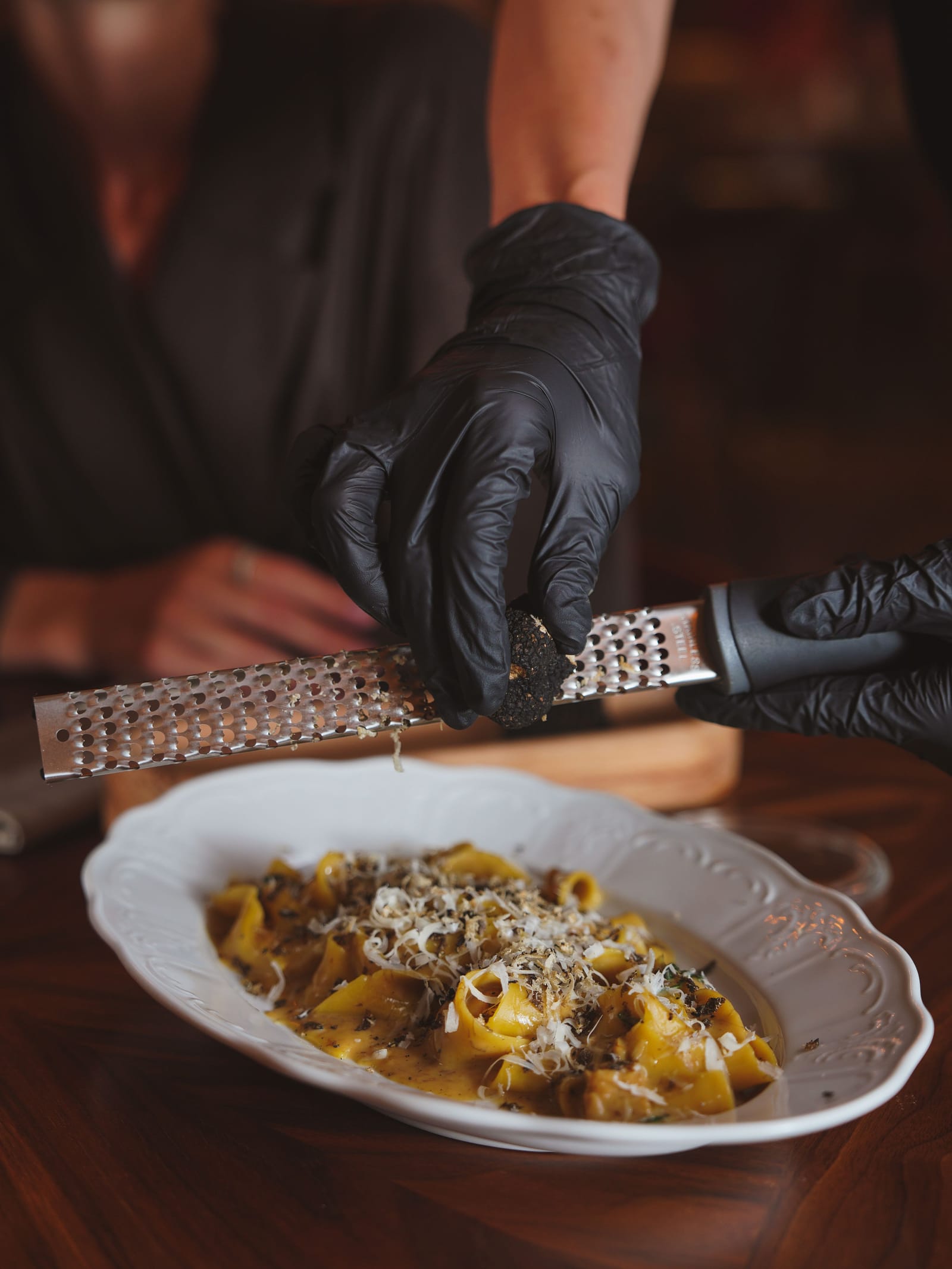
Tajarin is Piedmont's thinnest fresh pasta, a narrower cousin of tagliatelle from the Langhe hills around Alba, and its defining technical point is yolks: a dough built almost entirely on egg yolk rather than whole egg, which is what gives it a deep yellow colour and a silkier bite than ordinary egg pasta. Dressed simply with butter and fresh white truffle, it is Piedmont's clearest demonstration that a good technique needs almost nothing added to it.
AMUSE is covering the 96th Fiera Internazionale del Tartufo Bianco d'Alba, the city's white truffle fair, which runs from 10 October to 6 December 2026 across its weekend market. Alba's truffle hunters, or trifolau, sell Tuber magnatum through that window at the season's highest prices, which is reason enough to run tajarin now, while fresh white truffle is actually in the shops rather than a few months away.
Ingredients
Eight yolks and almost no water: that is what gives tajarin its density and colour.
- 150 g "00" flour
- 100 g fine durum wheat semola
- 8 egg yolks
- 1 tsp fine salt
- 60 g unsalted butter
- 60 ml pasta cooking water
- 25 g fresh white truffle (Tuber magnatum), to shave
- 30 g Parmigiano Reggiano, finely grated
Method
- Mix the "00" flour and semola with the salt, then work in the egg yolks until a dense, dry dough forms. At roughly three yolks per 100 g of flour, with no added water, the dough stays this stiff on purpose: it is the near-total absence of water and whites that gives tajarin its density and its deep colour.
- Knead by hand for 8-10 minutes until smooth and elastic, then wrap in cling film and rest for 30 minutes at room temperature. Resting lets the flour fully hydrate from the yolks alone, relaxing the gluten so the dough rolls thin without springing back or tearing.
- Roll the dough out to under 2 mm thick, by hand or machine, dusting lightly with semola as you go. Semola, coarser than "00" flour, keeps the thin sheets from sticking to each other once rolled and cut.
- Roll the sheet loosely and cut into strands no more than 2 mm wide, then unroll and dust with more semola. The narrow cut is what distinguishes tajarin from tagliatelle, and it works here because the high yolk content makes the dough sturdy enough to hold such a fine strand.
- Cook in a large pot of well-salted boiling water for 2-3 minutes, until just tender, then lift the pasta straight into a pan with the butter and a splash of the cooking water. Moving it wet, rather than draining it fully first, carries over the starch that is needed to bind butter and water into a sauce.
- Toss off the heat until the butter and water form a smooth, pale emulsion coating the strands. Off the heat matters: direct heat can split the fat from the water, leaving a greasy puddle instead of a sauce that clings.
- Plate immediately, scatter the Parmigiano, and shave the white truffle over at the table, never into the pan. Truffle is never cooked: heat burns off the volatile compounds that give Tuber magnatum its aroma within seconds, so it is added raw, at the last possible moment.
Why so many yolks, and what to avoid
The yolk-heavy dough is an old Piedmontese way of using what the region had: in a dairy and cattle economy, egg yolks were often more available than fine flour, and whites were saved for other dishes like the region's meringue-based desserts. For background on the fair driving this season's prices, see AMUSE's report on the Alba white truffle fair.
Skip garlic, cream or strong cheese: all three mute the truffle's aroma rather than support it, which is why the classic plate carries only butter, a little Parmigiano and the truffle itself.
What makes this tajarin recipe different from ordinary egg pasta? It uses yolks almost exclusively, with no added water, which is what gives tajarin its density, deep colour and silky bite.