Vitello tonnato recipe: Piedmont's cold veal in tuna sauce
Poached veal, sliced thin and dressed in a creamy anchovy-caper-tuna sauce. No mayonnaise, no shortcuts, just a classic that outgrew Piedmont.
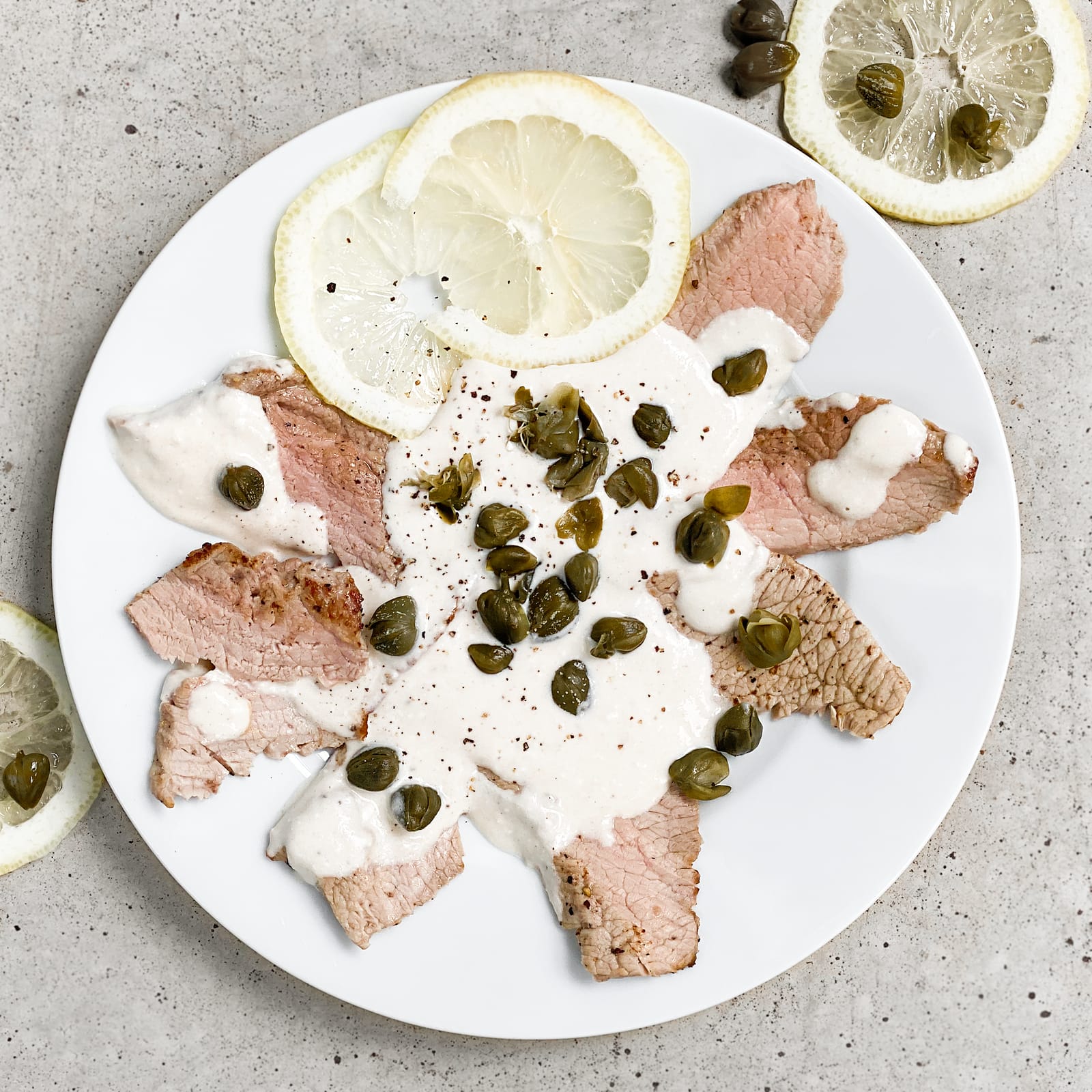
This vitello tonnato recipe is Piedmont's cold-sliced veal under a tuna, anchovy and caper sauce, and the whole dish turns on one piece of technique: poach the meat low and slow so it stays barely pink, never grey.
The dish is older than its name suggests. In its earliest form, the veal wasn't dressed with tuna at all, it was conciato, cured with a pounded mix of anchovies and capers. Tuna joined the recipe later, in the second half of the 19th century, and the version with tuna is the one that stuck, spreading from Piedmontese trattorie onto menus across Italy and beyond.
Mayonnaise crept into the sauce somewhere along the way too, as a shortcut. The traditional version skips it: the sauce is built instead from egg yolk, tuna, anchovy and capers loosened with the veal's own poaching broth, which keeps it lighter and lets the fish taste like fish.
Poach it slow, chill it properly, slice it thin: the sauce was never the hard part.
Ingredients
- 800 g veal eye of round (girello), trimmed
- 500 ml dry white wine
- 1 celery stalk, 1 carrot, 1 onion, roughly chopped
- 2 garlic cloves, 1 bay leaf, 3 cloves, 1/2 tsp black peppercorns
- 2 eggs
- 120 g tuna in olive oil, drained
- 4 anchovy fillets in oil
- 2 tbsp capers in vinegar, drained, plus extra to finish
- 1 tbsp white wine vinegar or lemon juice
- 60 ml extra-virgin olive oil
- Lemon slices, to serve
Method
- Put the veal in a non-reactive dish, pour over the wine, scatter in the celery, carrot, onion, garlic, bay leaf, cloves and peppercorns, and marinate in the fridge for at least 6 hours, ideally overnight. The wine both seasons the meat through and firms it slightly before cooking.
- Lift the veal out and strain the marinade, keeping the liquid and vegetables separate from the meat. Put both back in a pot, cover with water by about 5 cm and bring to a very gentle simmer, skimming off any foam.
- Poach the veal at a bare simmer, never a boil, for 40-45 minutes, until a thermometer inserted in the centre reads around 65°C. A hard boil would tighten and grey the meat; a slow poach keeps it moist and just pink.
- Lift the veal out, reserve the broth, and let the meat cool to room temperature, then chill it in the fridge for at least 2 hours, ideally longer. Cold meat firms up enough to slice thinly without tearing.
- Hard-boil the eggs for 9 minutes, cool, peel and roughly chop them while still warm, which helps them blend smoothly into the sauce.
- Blend the eggs with the tuna, anchovies and capers, adding the reserved broth a ladle at a time until the sauce is the texture of a loose mayonnaise. Whisk in the olive oil and vinegar at the end to bind it and sharpen the flavour.
- Cover the sauce and let it rest in the fridge for at least 30 minutes before serving; the capers and anchovy mellow into the egg base rather than sitting on top of it.
- Slice the chilled veal as thin as the knife allows, against the grain, and fan the slices over a plate. Spoon over the sauce, scatter with a few whole capers and finish with lemon slices.
What to drink with it
Piedmont's own white, Roero Arneis, has enough acidity to cut through the sauce without fighting the anchovy. A light, chilled Barbera works too if the table wants red.
Vitello tonnato keeps well covered in the fridge for up to two days, and the flavour only improves as the sauce settles into the meat; it is built to be made ahead, not rushed to the table. For the same Piedmontese produce this week, AMUSE has covered the region's white truffle risotto.
Can I make vitello tonnato a day ahead? Yes, and it is better for it: slice and sauce it, then cover and chill, so the flavours have time to settle before serving.